
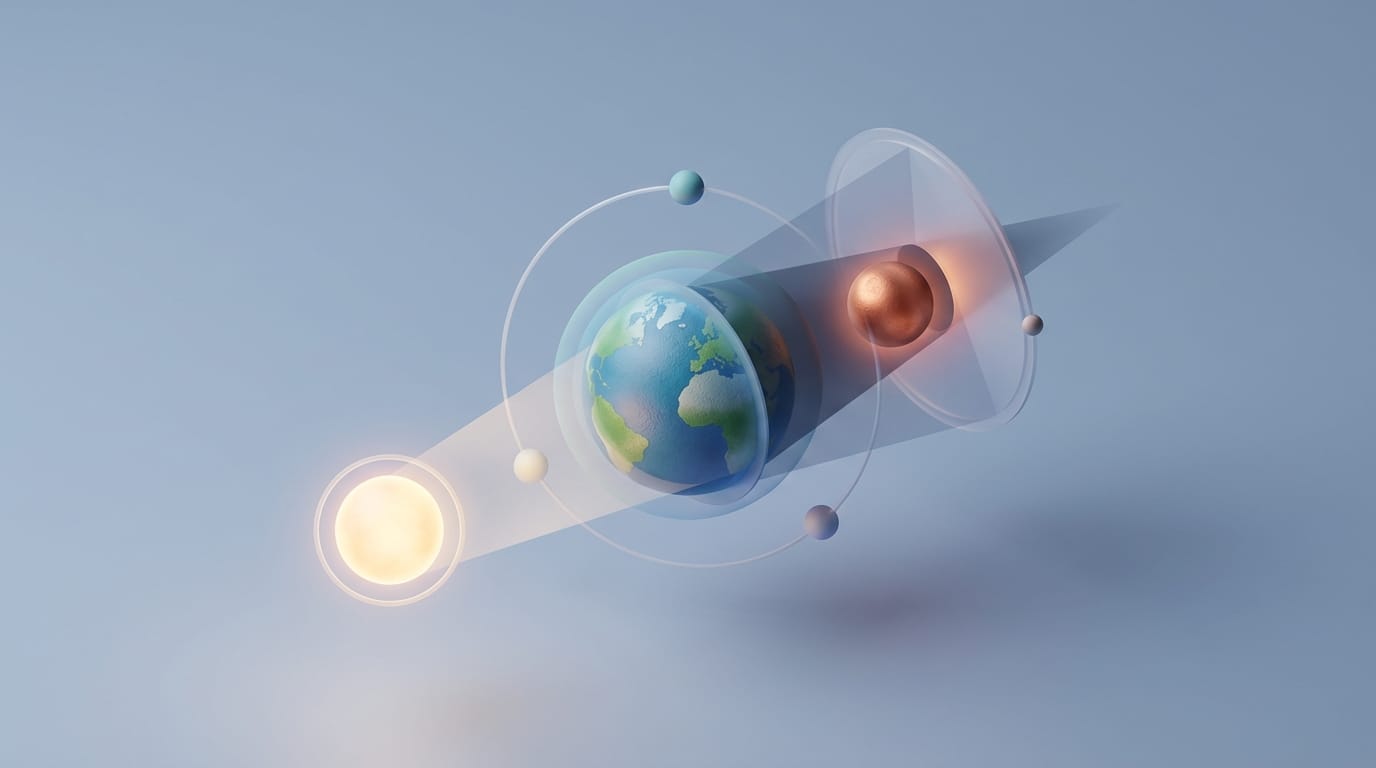
While most see the Blood Moon as an optical curiosity, the event acts as a massive atmospheric lens and environmental sensor. Understanding lunar eclipse science reveals the health of our planet’s stratosphere, letting us see past the dramatic red color. When the Earth aligns between the Sun and the Moon, it does not simply block light; it filters and bends it through a layer of protective gases.
This alignment, known as syzygy, creates a laboratory in the sky. By studying the wavelengths of light reaching the lunar surface, researchers measure the concentration of aerosols, volcanic ash, and ozone in the atmosphere. What appears to be a superstitious omen is a high-fidelity data stream projected onto the Moon for everyone to observe.
Why the Earth Shadow Is Not a Simple Black Void
To understand why the Moon turns red rather than disappearing, we must examine the nature of the Earth’s shadow. Unlike a solar eclipse where the Moon’s small profile creates a sharp shadow on Earth, a lunar eclipse involves our planet casting a massive shadow cone into deep space. If the Earth were a vacuum-sealed rock with no atmosphere, the Moon would vanish into total darkness during a total eclipse.
The Role of Earth’s Atmosphere as a Lens
The Earth is wrapped in gases that act like a spherical lens. As sunlight grazes the edge of the planet, it passes through the thickest parts of the atmosphere. This medium bends the light rays inward and focuses them toward the center of the shadow cone. This refraction ensures that even in the deepest part of the shadow, some light still reaches the Moon. This process is similar to how the atmosphere works as a wavelength filter, where gases selectively interact with different parts of the solar spectrum.
Defining the Umbra and Penumbra
The Earth’s shadow consists of two distinct regions: the umbra and the penumbra. The penumbra is the outer, lighter shadow where the Earth blocks only a portion of the Sun. The umbra is the central, darkest part where the Sun is completely hidden. During a total lunar eclipse, the Moon must pass entirely into the umbra. Even here, the darkness is relative; refracted light fills the umbra with the deep, coppery glow we associate with the Blood Moon.
How Orbital Mechanics Dictate Eclipse Frequency
If the Moon orbits the Earth every month, one might expect a lunar eclipse during every full moon. However, the geometry of our solar system is more complex. The primary reason we do not see monthly eclipses is the five-degree tilt of the Moon’s orbital plane relative to the Earth’s orbit around the Sun. Most months, the Full Moon passes either above or below the Earth’s shadow cone and misses the alignment.
Crossing the Nodes during Syzygy
For an eclipse to occur, the Full Moon must happen when the Moon is crossing the ecliptic plane, which is the imaginary line of Earth’s orbit. These intersection points are called lunar nodes. A total lunar eclipse only happens when the Moon is near one of these nodes during its full phase. This specific lunar eclipse science explains why eclipses occur in seasons twice a year, as the nodes slowly drift through space in a cycle that takes about 18 years to complete.
Total Partial and Penumbral Eclipses Compared
Not all eclipses look the same, and the visual experience depends on the Moon’s path through the Earth’s shadow. Amateur astronomers often sort these events by how deep the Moon enters the shadow.
- Penumbral Eclipses: These are the most subtle events. The Moon passes only through the Earth’s outer shadow. To the naked eye, this looks like a slight graying or dimming on one side of the Moon.
- Partial Eclipses: This happens when only a fraction of the Moon enters the umbra. It looks as if a giant bite has been taken out of the Moon. The part inside the umbra may show a faint red tint, but the brightness of the rest of the Moon often hides it.
- Total Lunar Eclipses: This is the main event where the entire lunar disk enters the umbra. The Blood Moon effect is visible because direct sunlight is removed, allowing the faint, refracted atmospheric glow to dominate.
The Physics of Rayleigh Scattering and the Red Hue
The reason the Moon turns red rather than blue or green lies in the physics of light scattering. As sunlight enters the atmosphere, it hits nitrogen and oxygen molecules. This interaction scatters shorter wavelengths, such as blue and violet light, in all directions. This is the same principle that explains why the sky appears blue during the day.
Short-Wave vs Long-Wave Light Filtration
While blue light scatters away, longer wavelengths like red and orange pass through the atmosphere with less interference. During a lunar eclipse, the only sunlight reaching the Moon is the light that has traveled the longest path through the atmosphere. By the time this light exits the atmosphere to reach the Moon, the blue has been filtered out, leaving only the deep reds of a thousand simultaneous sunsets.
Lunar Eclipse Science: The Danjon Scale as an Atmospheric Monitor
The most fascinating aspect of a Blood Moon is how the brightness and hue act as indicators of the Earth’s atmospheric health. Scientists use the Danjon Scale, which is a five-point scale, to sort the appearance of the Moon during totality. This application of lunar eclipse science helps researchers track how clear the upper atmosphere is at any given time.
- L=0: A very dark eclipse where the Moon is almost invisible and appears as a dark gray disk.
- L=2: A rust-colored eclipse with a dark central shadow.
- L=4: A bright copper-red or orange eclipse, often with a bluish rim.
This scale acts as a diagnostic for the stratosphere. If there have been massive volcanic eruptions, the Moon will appear darker. For example, the eruption of Mount Pinatubo injected sulfur dioxide into the stratosphere, which led to dark lunar eclipses for years. NASA’s GISS analysis shows that while some eruptions are massive, their sulfate aerosol load determines the impact on eclipse brightness. By observing these shifts, astronomers track the cloudiness of the upper atmosphere. A bright eclipse suggests a clean stratosphere, while an ink-black eclipse warns of high levels of volcanic ash or industrial pollution.
Historical Interpretation and Modern Data
Ancient cultures viewed the reddening of the Moon as a sign of divine anger. However, even in the past, the seeds of science were being sown. The Greeks used the curved shape of the Earth’s shadow on the Moon to prove that the Earth was a sphere, a concept that eventually replaced ancient myths about the sun with a structured understanding of orbital motion.
Today, researchers use historical eclipse records to track the Earth’s rotation. Because the timing of an eclipse depends on the Earth’s spin, differences between ancient predictions and recorded observations reveal that the Earth’s rotation is gradually slowing. Eclipses act as the timestamps of history and allow us to calibrate clocks across millennia.
Practical Viewing Techniques
One benefit of a lunar eclipse is its accessibility. Unlike solar eclipses, which require filters to prevent eye damage, lunar eclipses are safe to view with the naked eye. The Moon is simply reflecting filtered sunlight and its brightness is lower than a standard full moon.
While the naked eye is enough to enjoy the effect, using binoculars or a small telescope reveals the movement of the shadow across specific craters. This allows you to see the terminator line, which is the boundary between light and shadow. This line appears fuzzier than the sharp shadows found on a normal crescent moon because of atmospheric scattering.
If you photograph the event, the primary challenge is the drop in light. During totality, the Moon can be 100,000 times dimmer than a full moon, so you will need a tripod and a camera capable of long exposures. Recent research on aerosols suggests that the exposure value needed changes depending on stratospheric conditions; if the atmosphere is dusty, you may need longer exposure times to capture red details.
The Blood Moon is a byproduct of our planet’s protective atmosphere. Every time we witness that copper glow, we see a global projection of every sunset occurring on Earth at that moment. By understanding lunar eclipse science, we gain a deeper appreciation for the atmospheric filters that make life possible. The next time the Moon turns red, remember that you are looking at a real-time status report of the air you breathe. The shade of the Moon reveals whether the sky is clear or carrying the signature of a distant volcano.