
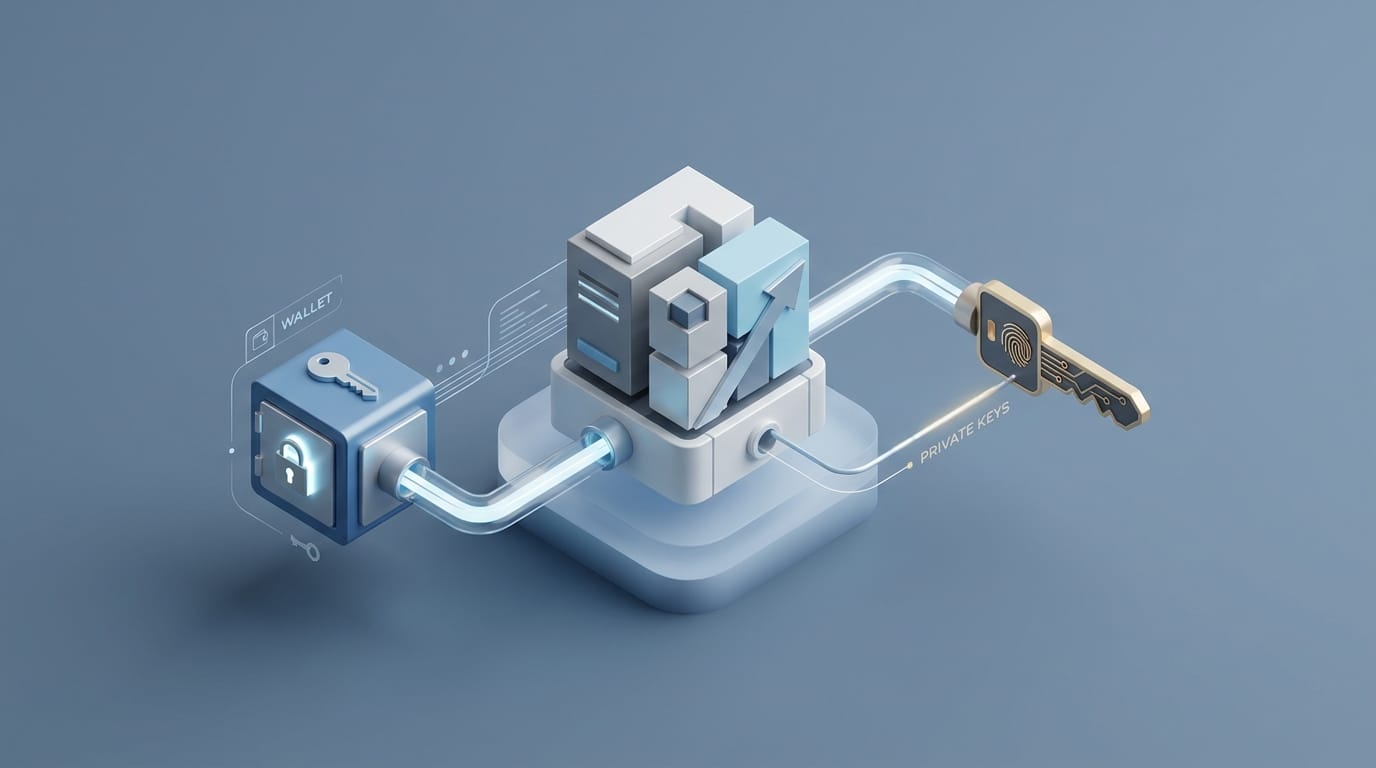
Losing access to cryptocurrency rarely involves a vault heist; instead, investors often lose the ability to prove their identity to the blockchain ledger. In the digital asset world, ownership depends on controlling specific cryptographic information rather than possessing a physical object or a legal claim in a database. Understanding crypto custody helps investors move beyond surface-level retail trading and into the technical reality of how these assets stay secure.
Digital assets do not exist as files for download or transfer; they live as entries on a distributed ledger that remains permanently on a network. To own an asset means holding the mathematical proof needed to authorize a change in that ledger entry. This shift from physical possession to informational control creates security challenges that traditional finance is still learning to navigate. Custody systems bridge the gap between the unchanging blockchain and the person or institution who owns the assets. Effective strategies ensure that authorization keys remain available when needed, protected from hackers, and safe from permanent loss. Without a plan, the finality and lack of a central authority that make blockchain secure can become the greatest risks to the owner.
The Reality of Crypto Custody and Storage
Wallets do not contain cryptocurrency; they act as a viewer and a signing device. Assets never leave the blockchain, staying attached to a specific public address. The wallet stores the keys that let a user broadcast a message to the network, proving they have the authority to move those assets to a new address. This distinction changes how we view security because the blockchain serves as the single source of truth. In a traditional bank, the institution can edit or reverse its internal database. The blockchain ledger is append-only, meaning once a transaction is signed and broadcast, it becomes part of the permanent history of the network. If someone compromises a wallet, they do not take assets out of it; they use the keys to tell the ledger to update the ownership record to their own address.
Because the ledger stays distributed across thousands of nodes, it is nearly impossible to hack the network itself to change a balance. Security failures almost always occur at the edges of the system where humans interact with their keys. Analysts estimate that millions of Bitcoins are permanently lost due to forgotten keys and hardware failures, according to research from Chainalysis. This represents a significant portion of the total supply that will never be recovered because the proof of ownership no longer exists.
The Cryptographic Foundation of Private Keys
Proof of ownership relies on a pair of cryptographic keys: the public key and the private key. Think of the public key as an email address that others use to send funds. The private key acts like a password that grants access to the account. Because the public key comes from the private key through a one-way mathematical function, it is easy to generate an address but impossible to reverse the process. When a user initiates a transaction, the wallet uses the private key to create a digital signature. This signature proves the user possesses the private key without revealing the key itself. Network nodes check this signature against the public key to verify the transaction. This process explains how identity defines the security perimeter in digital spaces. The person who holds the key is the owner in the eyes of the blockchain, regardless of their legal identity.
The consequences of losing a private key are absolute. Unlike a bank account, no “forgot password” button exists on a decentralized network. If the key is lost, the assets associated with it become unspendable entries on the ledger. They still exist, but they remain frozen in time. Private key management is the most important part of any security plan because the key functions as the asset itself.
Self-Custody vs Third-Party Crypto Custody Services
Investors must choose between managing their own keys or delegating that responsibility to a third-party service. Self-custody gives users total sovereignty, removing the risk that an exchange might go bankrupt or freeze an account. However, this puts the entire burden of security on the individual. If a mistake happens, no customer support can reverse the transaction. Institutional and retail-focused third-party crypto custody services manage keys on the user’s behalf, providing legal protections, insurance against theft, and recovery protocols. For many investors, the risk of human error is greater than the risk of a regulated custodian failing. Modern custodians differ from exchanges because they focus on secure storage rather than active trading. It helps to distinguish between a data breach and a data leak here; a custodian might lose personal data (a leak) while keeping the keys and assets safe (preventing a breach).
Choosing between these models involves a trade-off between control and convenience. Self-custody requires a deep understanding of hardware security and backup procedures. Third-party custody requires trusting an entity to act in the owner’s best interest. Both paths require a clear plan for how to handle emergencies and long-term storage.
Hot Wallets vs Cold Wallets for Asset Security
The most basic architectural decision involves choosing between a hot or cold wallet. A hot wallet stays connected to the internet through a mobile app, a browser extension, or an exchange account. These are convenient for frequent trading and small transactions, but their connectivity makes them vulnerable to remote hacking, malware, and phishing. They act like the cash in a physical wallet. In contrast, cold storage keeps private keys entirely offline, often on specialized hardware devices or computers that never connect to a network. Because these devices stay offline, they are immune to most remote digital attacks. To spend funds from cold storage, a user must physically interact with the device to sign the transaction. This gap provides a heavy layer of protection, making it the standard for long-term holding.
Most investors use a tiered approach. They keep a small amount of money in a hot wallet for immediate use and store the bulk of their portfolio in a hardware wallet. This mirrors traditional habits where people keep a small amount in a checking account and the majority in a less accessible savings account. When using hardware wallets, many users find that using physical security for backups helps protect recovery phrases from digital spying and keyloggers.
Advanced Security via Multi-Sig and MPC
Organizations and high-net-worth individuals often find that a single private key represents a dangerous point of failure. If that key is stolen or lost, the assets disappear. To lower this risk, advanced crypto custody solutions use distributed authority models like Multi-Signature (Multi-Sig) and Multi-Party Computation (MPC). These systems ensure that no single person or device can move funds alone. Multi-Sig requires a specific number of independent signatures to authorize a transaction (for example, two out of three authorized keys must sign off). While this creates transparency, it can be expensive because each signature is a separate event on the blockchain.
MPC has emerged as a standard because it solves many of the limitations of Multi-Sig. This technology breaks a private key into multiple shares distributed across different servers or devices. When a transaction is needed, these shares collaboratively generate a signature without ever reassembling the full key in a single location. This keyless approach works across all blockchains and allows for flexible approval policies. Major financial institutions prefer this architecture because it supports dynamic updates to authorized signers without needing to move assets to a new wallet address.
Best Practices for Maintaining Digital Sovereignty
The security of any system eventually comes down to the seed phrase, a series of 12 to 24 random words that acts as the master key to the wallet. If a hardware device breaks or goes missing, the seed phrase recreates the keys on a new device. Protecting this phrase is the single most important task for any user. Standard practice dictates that users should never store their seed phrase digitally (no photos, no cloud storage, and no unencrypted text files). Physical storage on paper or engraved stainless steel keeps the phrase offline and safe from hackers. You should never share these phrases with anyone, as they function like a master password for an identity on the ledger. Many investors also fail to plan for the future, leaving assets inaccessible to heirs because they did not create an inheritance plan for their keys.
Security is a continuous process rather than a one-time setup. It requires auditing storage methods, updating hardware firmware, and staying informed about new phishing tactics. As the value of a portfolio grows, the complexity of the storage solution should grow with it, moving from simple mobile apps to hardware wallets and eventually to distributed models or professional services. Digital ownership replaces institutional trust with mathematical certainty. While this grants individuals control over their wealth, it removes the traditional safety nets. Understanding the nuances of crypto custody is a fundamental shift in how we define and protect our digital lives. As blockchain integrates into the global economy, managing a cryptographic identity will become a core skill for every participant in the modern financial system.