
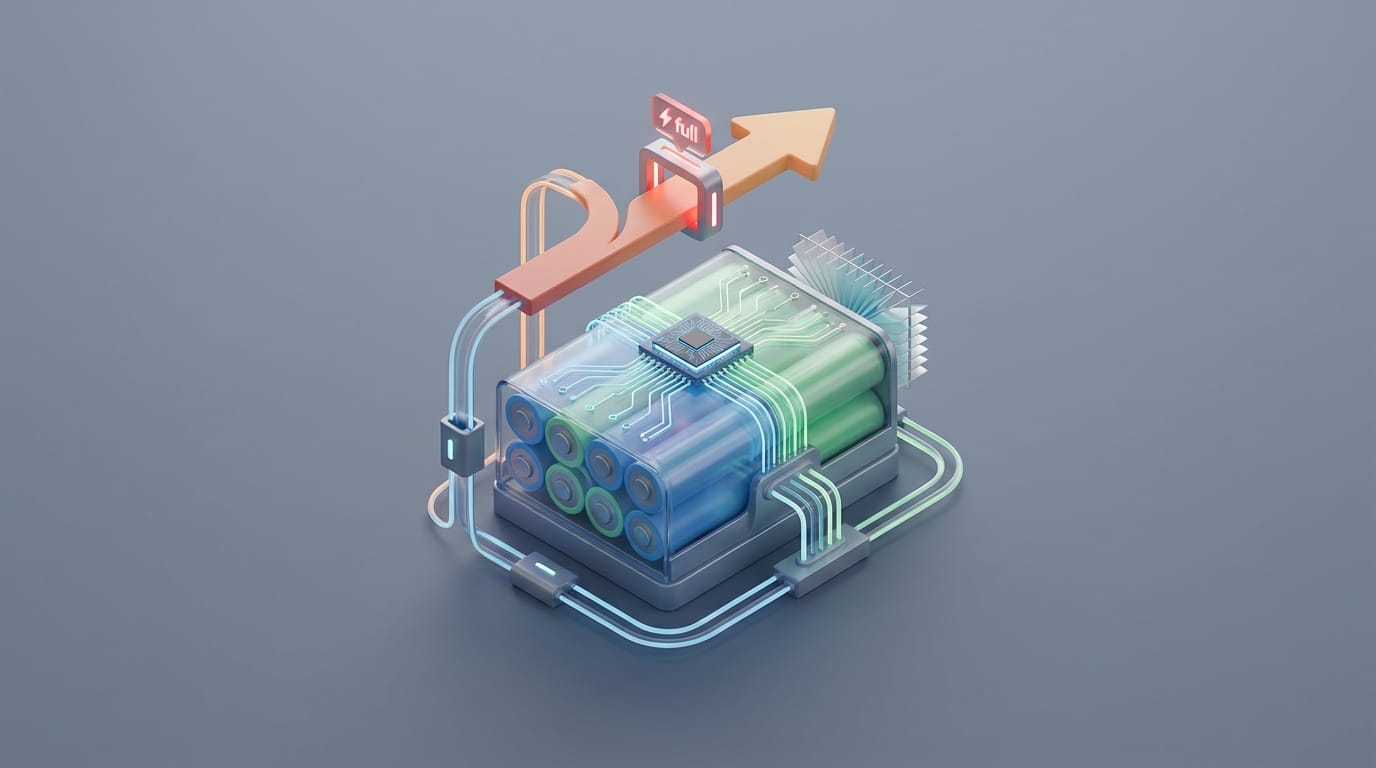
The battery management system overcharge protection circuit manages how modern devices handle power, removing the need for manual unplugging rituals. This system uses a layer of hardware and software to keep lithium-ion cells from reaching chemical instability or physical failure. Instead of acting as a simple fuse that pops when the battery is full, it functions as a dynamic controller. It coordinates a complex handshake between your wall charger and the individual cells to ensure safety. By the time your phone or laptop displays 100 percent, the system has already completed several stages of power throttling to prevent the degradation typically associated with high-voltage states.
The interplay between electrical sensors and the chemical limits of lithium-ion cells ensures your device stays safe even when left on the charger. This management system is the primary reason modern electronics can remain plugged in indefinitely without risking memory effects or venting hazards common in older technologies. Understanding the internal mechanics of your battery helps clear up common misconceptions about how to preserve its lifespan.
The Hardware and Software Handshake Inside Your Device
Defining the Battery Management System Role
The Battery Management System (BMS) serves as the brain of the battery pack. It is an active monitor that calculates the state of charge and overall health by measuring voltage, current, and temperature. Technical guides on battery safety from RELiON explain how the BMS keeps batteries within a safe operating area to prevent failure. The system prevents a battery from crossing its electrical boundaries by regulating every charge cycle.
If a single cell in a multi-cell pack, like those in laptops or electric vehicles, shows a higher voltage than others, the BMS performs cell balancing. It bleeds off excess energy to keep the entire pack uniform and stable. This active management supports the way batteries store and release energy through electrochemistry without damaging the internal structure of the electrodes. By monitoring these variables, the system ensures the battery operates only under ideal conditions.
The Communication Loop Between Cells and Charger
When you plug in a device, a handshake occurs between the BMS and the charging circuit. The wall adapter does not push electricity into the phone; instead, the BMS pulls the exact current it needs. Sensors located throughout the battery pack report data to microcontrollers hundreds of times every second. If the internal temperature climbs too high, the BMS tells the charger to slow down or stop the process to prevent heat damage. This bi-directional communication turns a simple power cord into a smart network that prioritizes the health of the hardware.
The Mechanics of battery management system overcharge protection
The Constant Current to Constant Voltage Transition
Lithium-ion charging follows two distinct stages to protect the battery. In the first stage, known as Constant Current, the BMS allows a steady flow of electricity to reach 80% capacity quickly. As the battery nears its target voltage, the system transitions into the Constant Voltage stage. During this phase, the system holds the voltage steady while letting the current slowly taper off. This prevents the cells from becoming overwhelmed by too much energy as they reach their saturation point.
Why Charging Speed Drops Near the Top of the Cycle
You may notice the last 20 percent of a charge takes longer than the first 20 percent. This is a deliberate safety feature the BMS uses to reduce internal resistance and heat. As lithium ions move from the cathode to the anode, the available space in the anode structure becomes limited. Forcing ions in at high speed when the battery is nearly full causes electrical congestion and heat. By slowing the current, the BMS lets ions distribute themselves evenly, preserving the long-term health of the battery chemistry.
The Truth About the One Hundred Percent Capacity Limit
Chemical Capacity vs. Safe Operational Capacity
The 100 percent figure shown on your screen is rarely the true chemical maximum of the battery. Manufacturers program a safe limit into the BMS that sits below total chemical saturation. For instance, if a lithium-ion cell has a theoretical limit of 4.30V, the system might define full as 4.15V. This buffer provides protection against the stress of full charging by preventing the internal electrolyte from breaking down. This safety margin allows the battery to survive thousands of cycles without reaching a state of maximum stress.
How the BMS Prevents Lithium Plating
If a battery accepts current beyond its saturation point, a dangerous phenomenon called lithium plating occurs. Instead of fitting into the anode, lithium ions begin to deposit as metal on the surface. These deposits can grow into needle-like structures called dendrites that can pierce the internal separator and cause a short circuit. The battery management system overcharge protection stops this by monitoring the plating potential and cutting off the charge current long before the anode becomes saturated. This keeps the internal pressure at a safe level and prevents catastrophic failure.
Why Overnight Charging Does Not Lead to Overcharging
The Myth of the Continuous Trickle Charge
Many users believe leaving a phone plugged in overnight results in a constant trickle charge that damages the battery. While this affected older nickel-cadmium batteries, it does not happen in modern lithium-ion systems. Technical data from EDOM Technology shows that constant trickle charging is harmful to lithium chemistry, so modern devices avoid it entirely. Instead, they use an end-of-charge protocol that cuts the current to zero once the safe threshold is reached.
How Modern Devices Switch to Bypass Mode
When a laptop or smartphone reaches its defined 100 percent and remains plugged in, the BMS engages a bypass mode. In this state, the internal circuitry runs directly off the power from the wall outlet, letting the battery sit in a rest state. The charger handles the work of powering the screen and processor while the battery remains disconnected from the charging circuit. This makes manual unplugging unnecessary. Our guide on common smartphone battery myths explains how these old rituals often cause more stress than they prevent.
Factors That Impact Long Term Battery Health
Thermal Management Over Electrical Management
Heat is the primary factor that shortens battery life, not the act of being plugged in. High temperatures speed up the chemical reactions that break down the electrolyte and degrade the electrodes. Fast charging creates significant heat, and using a device for heavy tasks like gaming while charging increases that thermal load. While the BMS will attempt to slow charging if it detects heat, persistent high temperatures remain the greatest threat to longevity. Keeping your device cool is more effective than worrying about when to unplug the cable.
The Impact of Extreme Discharge Cycles
While overcharging is prevented by the BMS, deep discharging is just as harmful. Letting a battery drop to 0 percent can cause the voltage to fall below a critical threshold where the cell may never recharge. The BMS protects against this by shutting the device down while a small amount of emergency reserve remains. We have explained why draining a battery to zero ruins its lifespan by forcing the chemistry into an unstable low-voltage state.
For those seeking maximum longevity, staying within the 20 to 80 percent range is the best approach. This avoids both high-voltage stress and low-voltage strain. However, the battery management system overcharge protection ensures that even those who charge to 100 percent every night benefit from a system that is far more protective than the battery meters of the past.
“The goal of a modern BMS is not just to prevent the battery from exploding, but to manage the invisible chemical trade-offs that dictate how many years your device will last.”
Modern electronics rely on invisible automation to manage their own health. The transition from a simple power cable to a bi-directional communication network has turned the battery from a consumable part into a managed asset. By understanding that your device actively protects itself, you can move away from ritualistic charging habits and trust the hardware to handle the chemistry for you. Safety and longevity are built into the firmware of the device, and your 100 percent reading is a carefully calculated limit designed to protect the physical battery from reaching its true destructive limits.
As power demands increase and charging speeds climb, these management systems will become even more essential. The next time you leave your phone plugged in overnight, remember that the BMS has already finished its work. It is simply keeping your battery on standby, ready for the next cycle. Do you still find yourself checking your battery percentage multiple times an hour, or do you trust your device to manage its own power?