
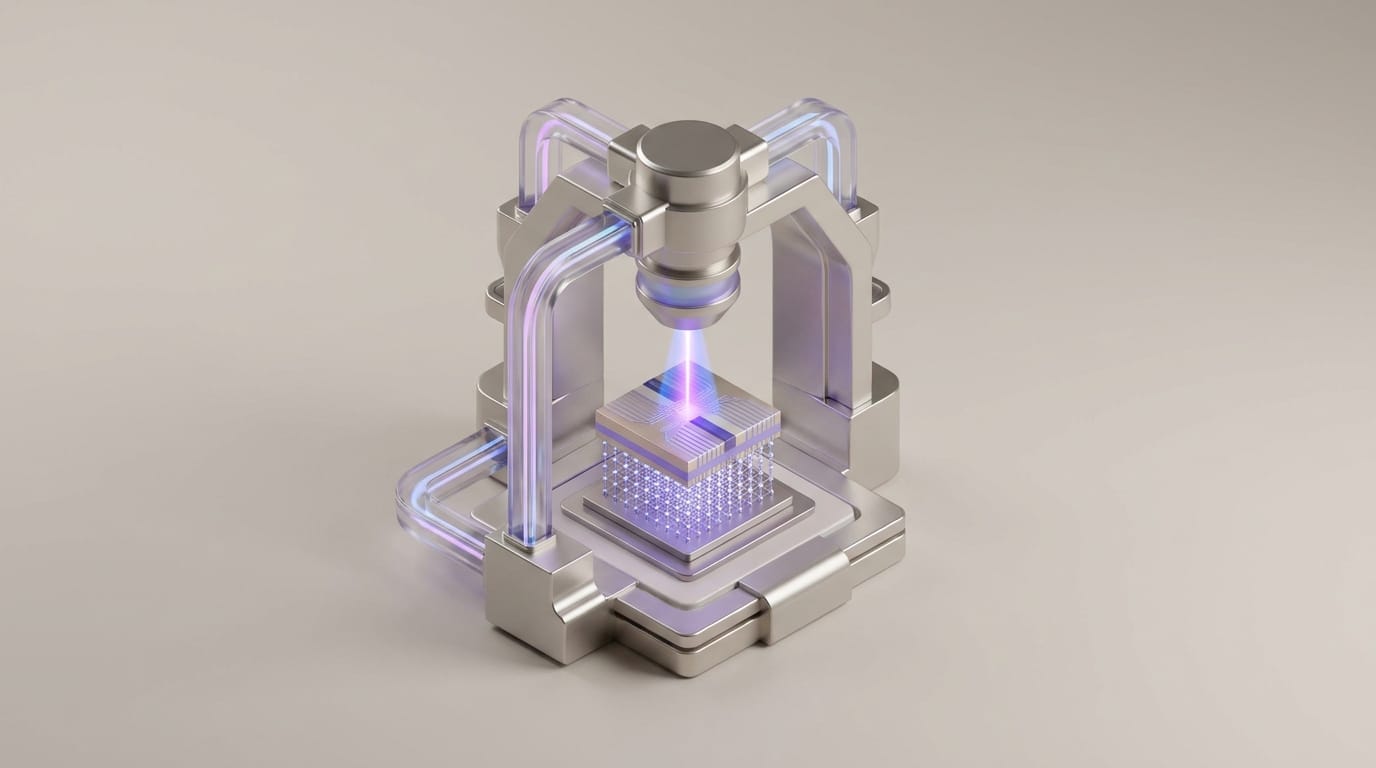
The transition to the 2nm node reveals that the fundamental limit of chipmaking is no longer simply the wavelength of light. Instead, engineers must now contend with the unpredictable, random behavior of individual photons. As the industry pushes toward this threshold, next-generation semiconductor fabrication moves beyond standard extreme ultraviolet (EUV) methods into a regime where the particle nature of light dictates the success or failure of a wafer. This shift represents a move from deterministic physics, where we could rely on a wave of light to land exactly where intended, to a world of probability and statistical noise.
For hardware engineers and industry analysts, understanding these new systems requires looking past the marketing labels to the actual tools used to resolve features at the atomic scale. The challenge is twofold. We must physically manipulate light at a 13.5-nanometer wavelength while simultaneously managing the stochastic errors that occur when there are too few photons to create a smooth, clean line. Solving this requires a radical overhaul of optics, chemistry, and computational correction. Every step in the lithography process now functions as a defense against the randomness inherent in high-energy light particles.
This article explains the mechanical and physical systems that make the 2nm node possible. We will examine how High Numerical Aperture (High-NA) optics and molecular resists work together to overcome the diffraction limit. Furthermore, we will explore how the industry manages the inherent randomness of light at the Ångström scale to ensure that modern chips remain reliable and powerful.
The Transition from DUV to EUV Photolithography
To understand the current state of 2nm manufacturing, we must first look at the transition from Deep Ultraviolet (DUV) to Extreme Ultraviolet (EUV) lithography. For decades, the industry relied on 193nm DUV light. To push resolution, factories used immersion lithography, placing a layer of water between the lens and the wafer to increase the refractive index. However, as features shrank below 7nm, DUV became prohibitively complex. It required multiple exposures and quadruple patterning, which increased costs and decreased the percentage of working chips on each wafer.
The physics of 13.5 nanometer wavelengths
The move to EUV lithography changed the physics of the scanner entirely. EUV uses a wavelength of 13.5 nanometers. This wavelength is so short that almost every material on Earth, including the air we breathe, absorbs it. This physical property requires a total vacuum environment for the entire optical path. Unlike DUV systems that use refractive glass lenses to focus light, EUV systems must use mirrors. Even then, these mirrors are not standard glass. They are Bragg reflectors made of dozens of alternating layers of molybdenum and silicon. These layers reflect a specific wavelength of light through constructive interference, essentially acting as a crystalline filter for high-energy photons.
Why reflective optics replaced refractive lenses
Refractive lenses face limitations from the transparency of the material. At 13.5nm, no known lens material is transparent enough to allow light through without massive power loss. Reflective optics solve this but introduce a new problem: reflection efficiency. Each mirror in an EUV system only reflects about 70% of the light that hits it. When a system uses a dozen mirrors in the path, less than 2% of the original light source power actually reaches the wafer. Managing this power loss while maintaining high throughput remains a central challenge in next-generation semiconductor fabrication. Engineers must constantly balance the intensity of the light source against the thermal stress placed on the mirror coatings.
Managing Photon Stochastics at Atomic Scales
At the 2nm node, the primary barrier is no longer just the wavelength of light, but the stochastic nature of photons. This is a statistical phenomenon where the random distribution of light particles causes pattern irregularities, known as roughness. Because EUV photons carry significantly more energy than DUV photons (about 14 times more), a given dose of light contains 14 times fewer individual particles. This shot noise becomes a critical failure point when you try to print lines that are only a few dozen atoms wide. If the photons do not land evenly, the circuit will not function.
The impact of photon shot noise on pattern fidelity
When you have a low number of photons, they do not land in a perfectly uniform curtain. Instead, they land like raindrops on a sidewalk, creating a random, uneven pattern. According to analysis from PatSnap, these stochastic defects manifest as missing contacts or bridging between lines. These errors occur when the lack of light in a specific area fails to trigger the chemical reaction in the resist. This leads to catastrophic circuit failure if even one of the 100 billion contacts on a modern chip is malformed. At 2nm, the margin for error disappears, as the features are nearly the same size as the random fluctuations in the light itself.
Statistical variation in light distribution
In modern chipmaking, we are transitioning from wave-based physics to particle-based probability. Engineers must now account for the stochastic resolution gap. This is the difference between what the optics can theoretically resolve and what the random nature of light allows us to print reliably. This randomness requires much higher light doses to ensure every pixel receives enough photons to prevent defects. However, higher doses slow down the production speed and increase heat. This creates a difficult engineering trade-off that forces companies to choose between the speed of manufacturing and the quality of the final product.
Next-Generation Semiconductor Fabrication and High-NA EUV
To reach 2nm and beyond, the industry is deploying High Numerical Aperture (High-NA) EUV. Numerical Aperture (NA) is a measure of the light-gathering power of the optical system. The higher the NA, the finer the resolution. Current EUV tools use an NA of 0.33, which works well for 5nm and 3nm nodes but requires double-patterning at 2nm. High-NA systems increase this to 0.55, allowing for single-exposure patterning at the 2nm scale. This leap in precision requires a massive increase in the size of the optics, making the machines significantly larger and more expensive than previous generations.
Anamorphic lens design in High-NA systems
The increase to 0.55 NA introduced a physical conflict. The angles at which light would have to hit the mask would be too steep, causing the light to be blocked by the three-dimensional features of the mask itself. To solve this, companies like ASML and Zeiss developed an anamorphic lens design. This system magnifies the pattern differently in the X and Y directions, using 4x magnification in one direction and 8x in the other. This allows the system to maintain the required resolution without the light being obscured by the mask geometry. It is a clever geometric solution to a fundamental physical limitation of light reflection.
Scaling the numerical aperture from 0.33 to 0.55
High-NA optics enable a resolution of roughly 8 nanometers, which is essential for printing the tight pitches required for advanced AI infrastructure hardware currently in development. However, this higher resolution comes at the cost of field size. Because of the anamorphic magnification, the area exposed in a single shot is half the size of a standard EUV exposure. This requires scanners to move twice as fast to maintain the same throughput of roughly 175 to 200 wafers per hour. Achieving this speed requires new motors and stages that can handle extreme acceleration without introducing vibrations that would blur the atomic-scale patterns, as ASML’s recent performance targets for the Twinscan series suggest.
Advancements in Molecular Organometallic Resists
The light is only half the battle. The material that receives the light, the photoresist, must also evolve to meet the needs of next-generation semiconductor fabrication. Traditional chemically amplified resists (CAR) have served as the industry standard for decades. CAR works by using a single photon to trigger a chain reaction of acid generators that change the solubility of the surrounding polymer. At 2nm, however, the acid molecules travel too far. This acid blur makes it impossible to keep the lines crisp. If the chemical reaction spreads even a few nanometers too far, it ruins the resolution provided by the expensive High-NA optics.
Metal Oxide Resists (MOR) for higher etch selectivity
To combat acid blur and stochastics, the industry is shifting toward Metal Oxide Resists (MOR). These resists use much smaller molecules containing metals like tin. Because the molecules are smaller, they can resolve finer features with significantly less line-edge roughness. Furthermore, metal-based resists are better at absorbing EUV photons than traditional carbon-based polymers. This helps mitigate the shot noise problem by making the most of every available photon. By capturing more energy in a smaller space, MOR allows for cleaner, more defined circuits that can survive the harsh processing steps that follow lithography.
Using MOR also provides higher etch selectivity. This means the resist can be thinner while still protecting the silicon underneath during the plasma etching process. Thinner resists are less likely to collapse or fall over due to surface tension when they are developed. This failure mode, known as pattern collapse, often haunts manufacturing at the sub-5nm level. By switching to metal-based chemistry, engineers can create taller, thinner structures that remain stable throughout the fabrication cycle.
Computational Lithography and Pattern Correction
Even with the best optics and chemistry, the patterns printed on the wafer will be distorted. To fix this, we use massive compute power to pre-distort the pattern on the mask so that it lands correctly on the wafer. This is known as Optical Proximity Correction (OPC) or, in its more advanced form, Inverse Lithography Technology (ILT). This process involves solving a massive inverse problem to determine exactly what mask shape will produce the desired output on silicon. The complexity of these calculations has grown exponentially as we approach the 2nm limit.
Inverse Lithography Technology (ILT) at the 2nm node
At the 2nm node, ILT becomes a requirement for the entire chip layout, not just the most critical layers. Traditional OPC uses rule-based models, but ILT treats the entire mask as a continuous optimization problem. The resulting mask patterns look like abstract, organic shapes rather than the rectangular transistors they will eventually create. This requires staggering amounts of compute power, often involving thousands of GPUs working in parallel to process a single chip design. These computational systems must run 24 hours a day to keep up with the design cycles of modern processors.
Machine learning models for stochastic prediction
Because stochastics are random, you cannot correct them with a static mask pattern. Instead, machine learning models are being integrated into the global semiconductor supply chain structure to predict where stochastic defects are likely to occur based on local pattern density. These models allow engineers to adjust the design rules in real-time. They effectively build guardrails around sensitive features that are prone to bridging or breaks. By using historical data from millions of wafers, these models can identify weak points in a design before the first wafer even enters the scanner.
The Infrastructure Costs of Moore’s Law
The systems required for 2nm fabrication are among the most expensive and complex machines ever built. A single High-NA EUV scanner costs approximately $400 million and is roughly the size of a double-decker bus. The infrastructure required to house these machines is equally specialized. It requires massive cleanrooms with zero-vibration floors and sophisticated power management systems. Transporting these machines often requires multiple cargo planes and a fleet of trucks, highlighting the massive physical scale of next-generation semiconductor fabrication.
Power density and heat management in plasma sources
Generating EUV light is an incredibly inefficient process. It involves hitting a microscopic droplet of molten tin with a high-power CO2 laser twice. The first hit flattens the droplet, and the second vaporizes it into a plasma. This plasma emits EUV light, but the vast majority of the energy is lost as heat. According to reporting by SemiAnalysis, the power required to generate a 250W EUV source is over a megawatt. This high power density contributes to the rising environmental cost of artificial intelligence and high-performance computing. Factories must now build dedicated power substations just to keep these scanners running.
The path toward the 1nm node and beyond
As we project toward the 1nm node, or the 10-Ångström node, the industry is already looking at Hyper-NA systems with numerical apertures exceeding 0.75. However, each jump in NA makes the depth of focus shallower. This means the wafers must be perfectly flat and the scanners even more precise. At some point, the cost of the scanner may exceed the economic return of the smaller transistor. For now, however, the demand for AI compute continues to drive the engineering of next-generation semiconductor fabrication forward despite these monumental costs. The industry is currently exploring new transistor architectures, such as complementary FETs (CFET), to make better use of the space these machines can resolve.
The 2nm transition proves that we are no longer just printing chips. We are managing the statistical chaos of the universe at an atomic level. This shift from deterministic engineering to probabilistic control is the true hallmark of the Ångström era. The success of our digital infrastructure depends on our ability to turn this random behavior of light into the reliable logic that powers our world. As we look toward the future, the next jump in resolution will likely come from a combination of better light management and a fundamental rethink of the materials we use to capture it.