
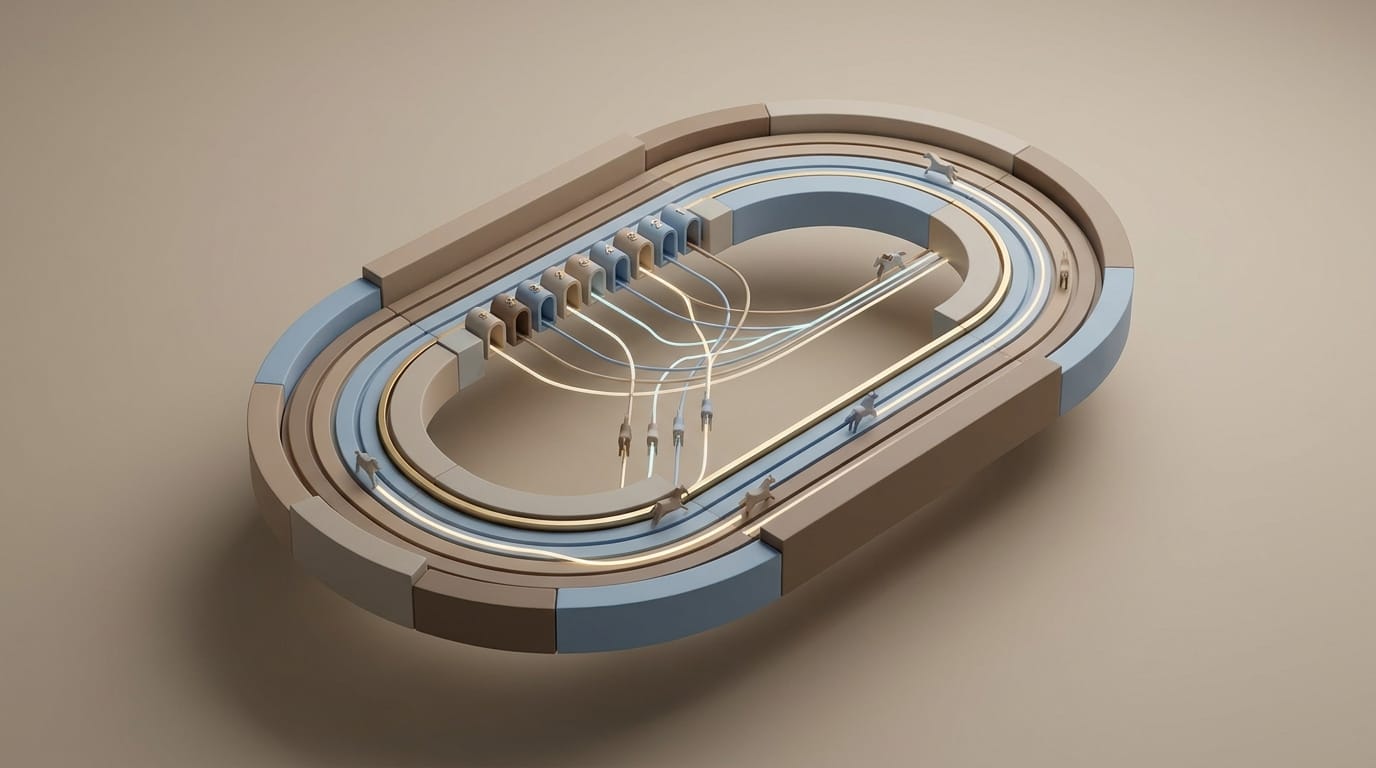
Most fans assume the shortest path around a track is the fastest, but the hidden physics of the rail can turn a geometric lead into a trap. Understanding post position bias helps anyone analyzing race results; the starting gate location dictates how much energy a horse spends before the first stride. While an inside draw offers the most direct route, it often forces a choice between early speed and tactical suffocation. In elite racing, fractions of a second decide the winner. A horse running wide around a turn loses significant yardage compared to a rival tucked against the rail. However, the ground saved often trades off for the tiring rail effect, where track maintenance and drainage create a deeper surface on the inside path. This mix of geometry and maintenance dictates the flow of every race.
To understand the reasons behind these results, one must look past speed figures and see the racetrack as a physical system. From the force of the turns to the way dirt packs together, the environment rarely stays neutral. By examining these structural penalties, we can better predict which athletes will thrive and which are fighting an uphill battle against the track itself. The physical layout of the course acts as a silent participant in every event, rewarding some and punishing others based on a few feet of starting distance.
The Mathematical Reality of Post Position Bias
The primary benefit of an inside post position involves geometry. On a standard one-mile oval, every lane of width added to a horse’s path through a turn increases the distance they must travel. Because turns represent a large portion of most American races, these extra feet add up quickly. If a jockey cannot secure a position near the rail, they effectively lengthen the race while their competitors take a shortcut. This creates a hidden handicap for those starting on the outside who cannot find a way to the inner lanes before reaching the first turn.
Measuring the Distance Deficit of Outside Posts
Mathematical models of track geometry show that for every lane a horse runs wide, they add about 25 to 30 feet of distance per turn. In a two-turn race, a horse caught three lanes wide for the whole event can cover an additional 60 feet. Industry data suggests that horses lose roughly 10 to 15 yards per lane when forced into wider paths on turns. This deficit is more than just footage; it translates directly into time. At high speeds, a horse covers about 55 feet per second, meaning 60 extra feet adds more than a full second to a horse’s final time. An analytical observer might see a horse that finished three lengths behind the winner while running wide as the superior athlete, simply hampered by the geometry of the post position.
How Turn Radius Impacts Energy Usage
The physics of the turn also impacts kinetic energy. Moving in a circle requires force, which a horse generates by leaning into the turn and pushing against the surface. A tighter turn radius (common on the inside lanes) increases the force pushing the horse outward. This requires the horse to work harder just to maintain its line, often leading to fatigue. Jockeys must balance this energy cost against the distance saved. A horse with a high cruising speed may prefer a wider, more gradual turn where it can maintain its rhythm without the physical strain of a tight corner. Some long-striding champions were often kept wide because the energy saved by maintaining a consistent stride outweighed the distance lost by staying away from the rail.
Tactical Risks of the Inside Bottleneck
While the rail offers the shortest distance, it is the highest pressure zone on the track. This bias often manifests as a squeeze during the break from the gate. Because every jockey wants the shortest path, horses in the middle and outside posts will angle inward, creating a funnel effect toward the first turn. For a horse on the rail, there is nowhere to go but forward or backward. This pressure forces the jockey to commit to a strategy immediately, leaving little room for adjustment once the pack begins to tighten. The mental strain on the animal also increases as horses crowd in from the right side.
The First Turn Squeeze and Position Battles
The break is the most volatile part of the race. If a horse in an inside post lacks the speed to outrun the horses to its outside, it risks being cut off as the pack moves toward the rail. This move allows outside horses to cross over and take the lead. If the inside horse is not fast enough to hold its spot, the jockey must pull back on the reins to avoid a collision, which causes a massive loss of momentum. This tactical pressure explains why middle post positions (typically posts 4 through 7) often find more success. These spots offer a balance of ground coverage and flexibility. A horse in the middle can see the speed developing to their inside and the pressure coming from their outside, allowing the jockey to make a move based on the flow of the pack. This flexibility mirrors how player positions and roles define team strategy in many other sports.
The Strategic Cost of Being Boxed In
One of the most difficult outcomes for a horse with an inside draw is being boxed in. This happens when a horse sits on the rail with a rival in front and another to their outside. Even with plenty of energy, the horse has no room to accelerate. The jockey must wait for a gap, which often opens too late. Slowing down a 1,200-pound animal and then asking for speed again requires immense energy. A horse that runs a smooth, uninterrupted race on the outside frequently outperforms a more talented horse that was forced to stop and start several times while navigating the inside bottleneck. Maintaining a steady momentum usually proves more efficient than saving distance at the cost of stride rhythm.
The Tiring Rail Paradox and Drainage Physics
The tiring rail is a common but misunderstood concept. While the rail is the shortest path, it is often the most taxing because of track maintenance. Most dirt tracks are built with a slight slope from the center toward the rails to help water drain. White papers from the Grayson-Jockey Club show that tracks maintain a 1% to 2% grade toward the inside rail to manage water runoff. Because of this, the inside rail becomes a collection point for moisture and fine sediment. After rain or watering, water sheds toward the rail, making the surface deep and heavy. This pudding-like consistency requires a horse to lift its hooves higher and push harder, making the shortest path the most difficult footing.
A horse running on a tiring rail effectively runs in deeper sand than a horse a few lanes out. Over a long race, this extra physical exertion can be more exhausting than the 50 feet of extra distance covered by a wide-running rival. Experienced observers spot a tiring rail by watching the kickback, which is the dirt thrown up by the hooves. If horses on the rail throw up large, wet clods while outside horses kick up dry dust, the rail is likely heavy. If jockeys move their horses outward during the homestretch, they clearly feel the inside path is too slow. This physical toll also impacts how the bone remodeling process adapts to physical stress, as racing on heavy surfaces can lead to long-term strain. Trainers must manage their athletes carefully when a track develops a severe inside bias to protect their skeletal health.
Surface Composition and Bias Patterns
The type of surface (dirt, turf, or synthetic) changes how post position bias operates. Dirt tracks are susceptible to maintenance-induced bias because they rely on surface drainage. Turf and synthetic surfaces behave according to different physical rules. Turf racing is sensitive to wear and tear. As horses gallop over grass, they create divots. To prevent the inside path from becoming a muddy trench, racecourses use portable rails. By moving the rail outward, officials give the inner grass time to regrow. This changes the geometry of the track for different race days. On turf, a firm course favors inside speed because the ground is consistent. However, when the course is soft, the inside becomes bogged down. Jockeys then sweep wide to find fresh grass on the outside. Understanding these shifts requires the same attention as using pattern recognition in everyday life to predict trends.
In dirt racing, the kickback is a tactical weapon. A horse trailing the pack is hit by a spray of dirt from the leaders, which can impair vision and restrict breathing. This creates a natural bias toward front-runners who avoid the spray. A leader on the rail has the dual advantage of saving ground and breathing clean air. Synthetic surfaces like Tapeta are designed to eliminate these biases. They drain vertically through a porous base, meaning moisture does not pool at the rail. They also produce almost no kickback. On these all-weather tracks, the advantages of the inside post are more purely geometric because the surface remains consistent across the entire width.
Quantifying Bias for Statistical Advantage
For the analytical fan, post position bias must be measured to be useful. Analysts use a metric called Impact Value (IV) to determine if a specific post is advantageous. An IV of 1.00 means the post wins as often as expected by chance. An IV of 1.50 suggests the post wins 50% more often than expected, indicating a strong positive bias. These numbers help separate raw talent from situational luck. Bias is rarely static; a track that favors the rail in the morning might favor outside closers by the afternoon as the sun dries the surface or maintenance crews rake the dirt. Identifying these shifts requires watching the positioning of winners across multiple races.
The interaction between a horse’s starting position and the track’s physical condition is the framework of the race. Recognizing the trade-offs between ground saved and energy spent moves us beyond simple cheering. We begin to see the racetrack as a complex system where geometry, physics, and maintenance decide the winner. This structural lens explains why even the fastest horses fail when trapped in a disadvantaged lane. As data analytics continue to evolve, the ability to decode these invisible patterns will remain a vital skill for anyone following the sport.