
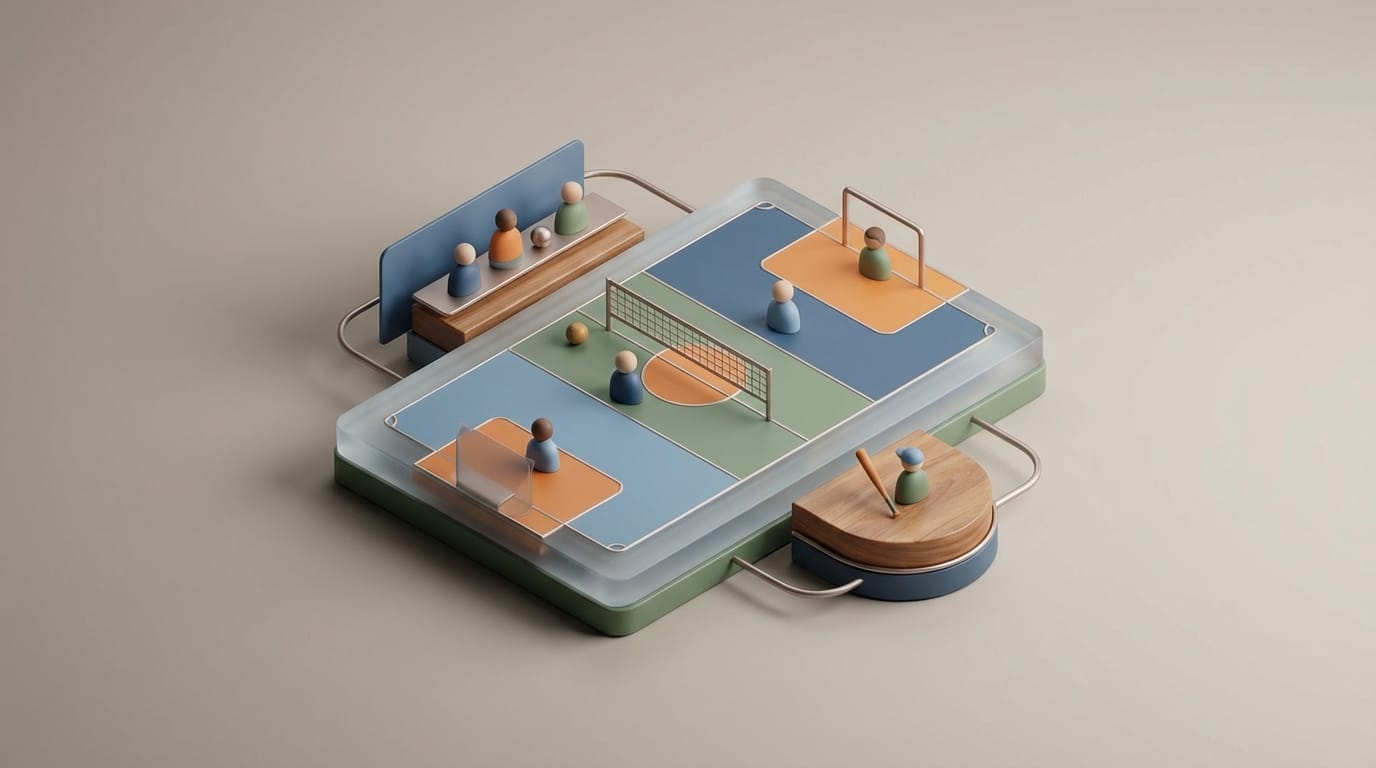
Most spectators focus on the ball, but the real outcome of a game depends on players moving into empty spaces. When you watch a professional game today, you aren’t just seeing athleticism; you are observing a system where every movement responds to others. Understanding sports player positions and roles is the first step toward seeing the game as a series of strategic problems solved in real time.
For a new fan or a parent watching their child play, position names often feel like rigid labels. We call someone a Forward or a Guard and assume their job is fixed by that title. Modern sports have moved toward a fluid reality where strategy is no longer about occupying a static spot on the field. Instead, players fulfill specific functional archetypes that allow the team to keep its structure while adapting to the chaos of play.
This shift in perspective transforms how we value athletes. A player who never scores might be the most valuable person on the field if their positioning creates the gravity that pulls defenders away from the goal. By breaking these roles into functional parts, we see the common DNA shared by athletes across soccer, basketball, football, and hockey. It is not just about the rules of the game, but the logic of the system.
The Evolution of Sports Player Positions and Roles
Historically, sports were defined by specialization. In the early days of American football, a lineman was a blocker and nothing else; in soccer, a defender stayed in the back third of the pitch. Today, those boundaries have largely dissolved. We have moved into an era of organized movement where players follow patterns rather than starting locations on a depth chart. Teams use performance analytics and team management software to track these movements and find the most efficient ways to score.
The rise of Relationalism in sports like soccer and basketball has replaced the traditional positional play that dominated the previous decade. Instead of players being assigned to specific zones on a grid, they form fluid micro-structures based on where their teammates are located. This means a defender might suddenly become a primary playmaker if the geometry of the defense allows it, according to research on modern basketball coaching success regarding positionless systems.
This shift from static assignments to fluid roles helps teams bypass complex defensive schemes. When every defender knows exactly where a traditional small forward will stand, that player becomes easy to stop. However, when that player functions as a hybrid who can screen like a center or pass like a guard, they become a systemic problem that cannot be solved with a simple man-to-man assignment.
Why positions are defined by movement rather than names
If you look at a starting lineup, you see labels, but a heat map of where players actually spend their time tells a story of transition. In modern hockey, the distinction between a left wing and a right wing is often less important than the role of the first player into the zone to pressure the puck. The name on the roster is a starting point; the role on the ice is a function of the puck’s location.
This movement-based definition requires high game intelligence. Players are no longer expected to just execute a pre-planned route; they must read the movements of the opposition. If a cornerback in football sees a receiver’s hips turn a certain way, their role may instantly shift from coverage to pursuit. The fluidity of these roles allows modern teams to maintain high-speed play without collapsing into chaos.
The Playmaker as the Strategic Hub
Every team needs a central processing unit, which is a player who sees the entire field and dictates the tempo of the game. In basketball, this is the point guard; in football, the quarterback; in soccer, the central midfielder. While the physical skills differ, the mental load is identical. They are the strategic hub responsible for distributing the ball or puck to the players most likely to score.
The hallmark of a great playmaker is vision. This isn’t just about seeing where players are now, but predicting where they will be in three seconds. In soccer, this often manifests as the pass before the assist, which is the ball that breaks the defensive line and allows a teammate to provide the final cross. These players manage the gravity of the game by holding onto the ball just long enough to draw defenders toward them, which creates a vacuum elsewhere on the field for teammates to exploit.
Comparing the quarterback to a point guard reveals the universal nature of this role. Both must manage clock and space. A quarterback reading a blitz performs the same task as a point guard reading a double-team by identifying which part of the defensive system has been weakened. Even in more static sports, players like the pitcher function as a similar hub, as explained in our guide on fundamental baseball rules for beginners.
Orchestrating the offense in field and court sports
In court sports, the playmaker uses spacing to create lanes. By positioning teammates at the perimeter, they force the defense to stretch. In field sports like soccer, the central midfielder uses diagonal passes to change the point of attack, which forces the entire defensive unit to shift its collective weight. This physical shifting of the opponent is the primary goal of the playmaker.
In hockey, the center often acts as the hub by supporting all three zones. They link the defensemen trying to exit their own zone with the wingers looking to score. Without this linking function, the offense becomes disconnected and relies on individual talent rather than systemic efficiency. The stress of this role is immense and often requires athletic recovery science and sleep to maintain the cognitive focus needed for high-stakes decision-making.
The Finisher and the Art of Converting Opportunities
If the playmaker is the architect, the finisher is the heavy machinery. The role of the finisher, whether a striker in soccer, a wide receiver in football, or a power forward in basketball, is to resolve the play. Their success depends on their ability to find the window, which means moving into a scoring position at the exact moment the playmaker is ready to deliver the ball. This interaction demonstrates how sports player positions and roles work in tandem rather than in isolation.
Finishers must possess high spatial awareness. They don’t just run to where the ball is; they run to where the ball will be once the defense has been pulled out of position. In soccer, elite strikers use small, deceptive steps to lose their defender. This isn’t about raw speed; it’s about timing the exploit in the defensive system. Modern analytics have changed how we view finishers through metrics like expected goals or xG.
A player who misses a shot might still be doing their job perfectly if they consistently find high-probability scoring areas. According to recent trends in tactical xG analysis, teams increasingly value players who create repeatable scoring chances over those who score rare, low-probability goals. This approach ensures a more consistent system of success over a long season.
Physicality vs speed in the finishing role
There are two primary ways to finish: through physical force or elusive speed. A target man in soccer or a tight end in the NFL uses their body to shield the ball and win physical duels. They are the anchors that allow the play to stabilize in the opponent’s territory. Conversely, a speedster relies on verticality, which forces the defense to drop back and opens up space in the midfield for others.
This creates a tactical trade-off. A team with a purely physical finisher may struggle against a quick, agile defense, while a team of speedsters might be bullied by physically dominant defenders. The most successful modern strategies often employ a mix. They use the speedster to stretch the defense and the physical finisher to occupy the space that opens up in the middle.
The Protector and the Logic of Space Denial
The goal of the defense is not just to get the ball, but to deny the offense the space it needs to function. The protector archetype includes linebackers, defensemen, and center-backs who serve as the physical and tactical barrier of the team. Their primary responsibility is to maintain the integrity of the line. If a single protector steps out of position, the system collapses and creates a seam that a playmaker will immediately exploit.
Protection is as much a mental discipline as a physical one. It requires patience. In soccer, a center-back who lunges for a tackle and misses leaves the goalkeeper exposed. In the NFL, a linebacker who bites on a play-action pass leaves the middle of the field open for a touchdown. The protector’s job is to remain disciplined and force the offense to earn every inch of progress. We now see the rise of the hybrid safety and the ball-playing center-back who can protect the goal while also initiating the offense.
These players act as the quarterbacks of the defense. They must organize their teammates and call out shifts to ensure the spacing of the defense remains airtight, as noted in recent defensive trends in hybrid safety usage. This dual responsibility makes them the most important tactical communicators on the field.
Comparing Linebackers, Defensemen, and Center backs
While the sports are different, the tactical requirements of these roles are strikingly similar. A hockey defenseman gapping up on a rushing forward performs the same action as a basketball defender closing out on a shooter. Both reduce the time and space the attacker has to make a decision. The goal is to force the attacker into a low-probability play, such as a long-distance shot or a contested pass.
The center-back in soccer and the safety in football both function as the last line of defense. Their positioning is dictated by the deepest threat on the field. If they miscalculate the speed of an attacker, the entire system fails. This is why these roles often have the longest careers; while they may lose a step of raw speed as they age, their ability to read the game and prevent scoring chances improves with experience.
The Transitional Support and Utility Roles
The most unsung heroes in sports player positions and roles are the transitional players. These include box-to-box midfielders, tight ends, and two-way forwards. Their job is to bridge the gap between the protectors and the finishers. When a team wins the ball back, the transitional player sprints to provide an outlet. When the ball is lost, they are the first to get back and support the defense.
These roles require the highest level of physical conditioning. In the NFL, the modern tight end is the ultimate utility player. On one play, they are an extra offensive lineman blocking a heavy defender. On the next, they run a route like a wide receiver. This versatility makes them difficult to defend because the opposition never knows which version of the player they need to account for. Utility players also fill the gaps during rapid transitions to keep the team balanced.
In basketball, a 3-and-D player who hits three-pointers and plays elite defense is the quintessential utility role. They don’t need the ball to be effective; they provide spacing for the playmaker and protection for the team. They are the glue that holds the different archetypes together. Every player must understand not just their role, but how their presence affects the roles of everyone else on the floor.
Universal Concepts of Spacing and Rotation
Regardless of the sport, the two most important tactical concepts are spacing and rotation. Spacing is the geometry of the offense. If players are too close together, one defender can cover two people. If they are too far apart, the passes become long and slow, which gives the defense time to react. The best spacing occurs where every player is a threat, forcing the defense to stretch until it fails.
Rotation is the fluidity of the defense. When a playmaker beats their initial defender, the rest of the team must rotate to cover the open man. This creates a chain reaction where every defender must move to cover someone else’s assignment. A well-drilled team can rotate indefinitely without giving up an open shot, while a poorly coached team will experience a system failure after the first or second rotation. You can see how fouls and violations enforce fair play when these rotations fail and defenders are forced to grab or trip opponents to stop a score.
How to Identify Player Impact Beyond the Scoreboard
To truly understand sports player positions and roles, you must watch the players who do not have the ball. When you do this, you begin to see gravity. If a superstar moves toward the corner, you will see two or three defenders lean toward them, even if the ball is on the other side of the field. Their mere presence is a tactical weapon that opens up lanes for their teammates.
Another key indicator of impact is defensive positioning. A great defender might go an entire game without making a tackle or an interception because their positioning was so perfect that the playmaker never tried to pass in their direction. In the NFL, this is the shutdown cornerback. Their impact is measured by the absence of plays made against them. To the casual viewer, they seem invisible; to the expert, they are dominating their half of the field.
- The pass before the assist: Look for the player who made the pass that broke the defense, even if they aren’t the one who gets the statistical credit.
- Screening and picking: In basketball and hockey, look for players who use their bodies to block defenders and create a clean lane for the ball carrier.
- Tracking back: Notice the forward who sprints back to help the defense when the team loses possession. This two-way play separates winning teams from talented individuals.
By looking for these patterns, you move from being a spectator to being an analyst. You begin to see that the score is just the final output of a complex system of human movement and strategic choice. Whether you are watching a local youth league or professional championships, the underlying logic of these roles remains the heartbeat of the game. The next time you watch a game, try to ignore the ball for a few minutes and watch the system breathe; you will find a much more interesting competition hiding in the shadows.