
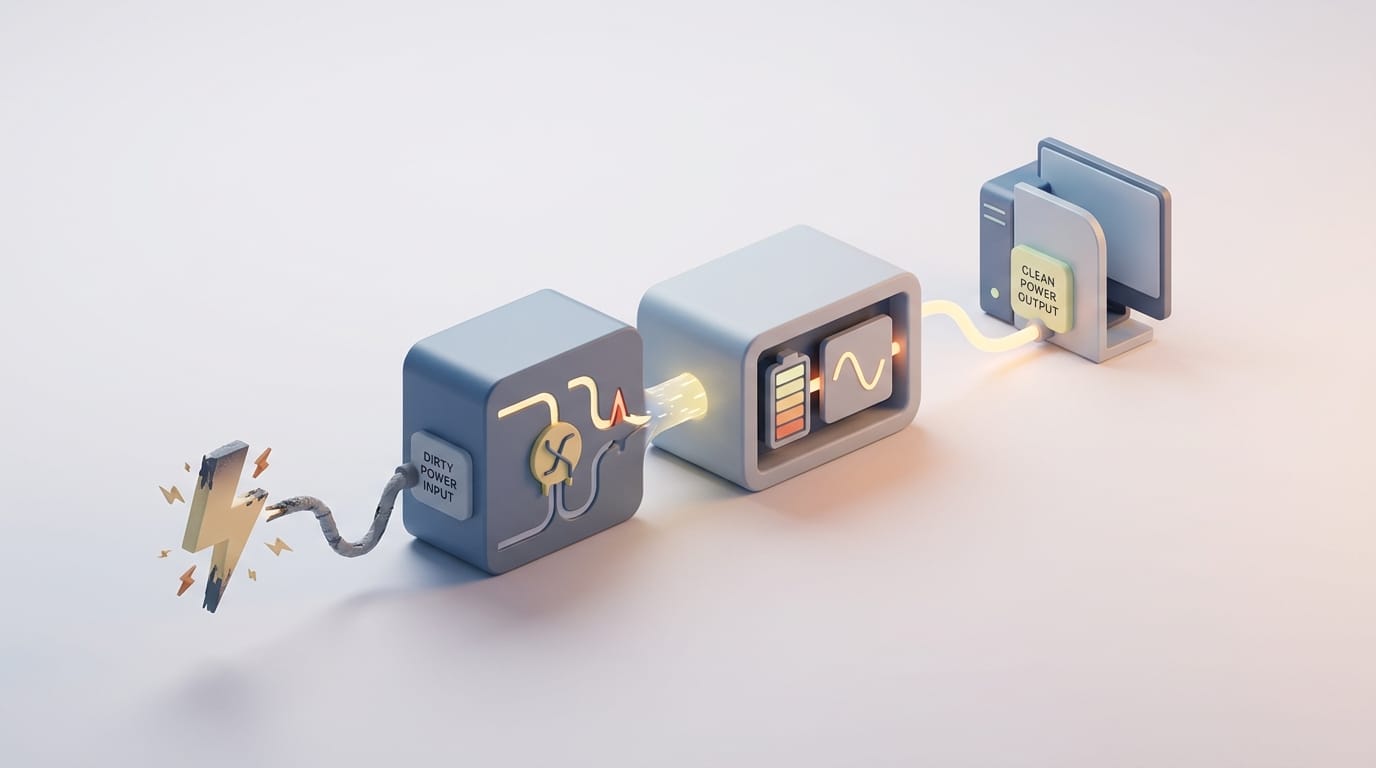
While most users fear a rare lightning strike, the true threat to your hardware is the silent damage caused by appliances already plugged into your walls. Effective dirty power protection is less about surviving a huge storm and more about managing the constant, tiny shifts that wear down sensitive silicon over years of use. Understanding these systems allows you to move beyond simple power strips to build a strong electrical defense for your home office or media room.
We often treat electricity as a steady utility, assuming the current flowing from a wall outlet is a perfect, consistent wave of energy. In reality, the power grid is a noisy, shifting system where the quality of energy changes constantly due to local demand and aging power lines. If you do not account for these changes, you allow your high-end PC or audio equipment to absorb the stress of the entire local grid. This friction slowly kills electronics from the inside out, leading to failures that seem random but are actually predictable.
The Reality of Unstable Electrical Current
Dirty power is a broad label for any change that breaks a smooth electrical wave. These issues appear as distortion or noise that hit your devices thousands of times a day. While a basic lightbulb might not care about a messy wave, the tiny switches inside a modern processor are much more sensitive. When the power is not clean, these components have to work harder to stay stable, which leads to heat and errors.
Voltage shifts usually fall into two groups: sags and surges. A surge is a quick jump in voltage that can hit your parts harder than they can handle; a sag happens when the voltage drops below what the device needs to run. Both cause trouble because power supplies must work harder to make up for the lack of steady energy, creating heat that mimics the chemical stress found in overworked batteries. Over time, this extra heat breaks down the internal parts of your computer.
Line noise is the most common form of dirty power, consisting of high-frequency signals that ride on the electrical current. This noise often comes from nearby radio towers or the small power supplies of other devices in your home. Without proper filters, this noise leaks into your system. You might hear it as a hum in your speakers or see it as static in high-quality video signals. While it might seem like a small annoyance, it indicates that your hardware is fighting against the energy it receives.
Why Micro-Surges Cause Cumulative Electronic Rust
The term electronic rust describes the slow, microscopic breakdown of silicon and metal joints caused by small, repeating jumps in power. While a massive lightning strike will melt a circuit instantly, a small surge of only 10 or 20 volts is too small to trip a standard breaker. Instead, that extra energy goes straight into your hardware. The parts inside, like capacitors and resistors, absorb this energy, which slowly ruins their ability to function.
Most people buy surge protection for the big disasters, but the main goal of dirty power protection is stopping the dozens of small spikes that happen every day. These hits stress the layers inside your components until they can no longer hold a stable charge. This is a major reason for the hardware constraints that limit device life spans over time. When a device fails after three years, it is often because these small hits finally broke the internal parts.
Research shows that more than half of all power surges come from inside the home, happening hundreds of times a day. When these spikes occur every hour, your hardware lives in a state of constant electrical friction. This leads to system crashes, blue screens, and short lives for your parts. Most users blame old age for these problems, but poor power quality is usually the real culprit behind the hardware failure.
Identifying Internal Sources of Dirty Power Protection
Your home is a complex network of electrical loads that fight for energy. Devices with large motors, such as refrigerators, air conditioners, and vacuum cleaners, need a huge burst of current to start. When these motors turn off, the leftover energy in their coils snaps back into the circuit. This creates a sudden voltage spike for every other device on that same line, hitting your sensitive computer or TV with a surge of energy.
Cheap power supplies also cause significant problems. Low-quality wall plugs and LED lights often lack the parts needed to clean the electricity they use. These devices can push noise back into your home wiring, which affects sensitive tools like USB microphones or audio gear. This noise creates a floor of electrical static that makes it harder for your high-end gear to perform at its best.
Even cables without good shielding can act like antennas, picking up signals from Wi-Fi routers or cell phones. When this noise enters your PC through the power cord, it forces the internal parts to work harder to fix the voltage. This constant correction creates extra heat and contributes to the structural power volatility that engineers must fight when building modern power systems. Reducing this noise is the first step toward a stable system.
Mechanics of Modern Surge Suppression Technology
The main part of most surge protectors is the Metal Oxide Varistor (MOV). An MOV acts like a pressure valve; under normal power, it stays idle and lets electricity flow. When a surge hits, the MOV instantly changes and pushes the extra power to the ground wire before it can reach your computer. This happens in a fraction of a second, shielding your gear from the sudden jump in energy.
You must understand that MOVs are sacrificial parts. Every time an MOV stops a surge, it takes a small amount of physical damage; eventually, the material wears out and can no longer protect your gear. Most good units have a light that shows they are working. If this light goes out, the device is dead and is now just a basic power strip. Checking this light once a month is the simplest way to keep your gear safe.
Beyond simple parts, professional dirty power protection includes cleaning stages. These units use coils and capacitors to scrub the noise from the line. By smoothing out the static on the power wave, these filters make sure your gear gets the clean energy it was built to use. This reduces the heat inside your devices and helps them run faster and longer without errors.
UPS Systems and Active Voltage Regulation
An Uninterruptible Power Supply (UPS) offers better protection by adding a battery and a brain to your setup. While a surge protector only cuts off the high peaks of power, a UPS with Active Voltage Regulation (AVR) can also fix the low points. When the grid power drops, the UPS uses an internal tool to boost the voltage back to the right level without using up the battery. This keeps your computer running smoothly even when the lights flicker.
There are two main types of UPS designs for home use: line-interactive and online. Line-interactive units are common for home PCs and handle shifts well; however, online units are the best choice for high-end audio or servers. These units constantly turn power from AC to DC and back to AC again. This creates a perfect, isolated wave that is completely disconnected from the messy power grid outside your home.
For gamers and creators, the shape of that power wave matters. Modern power supplies use special tech to stay efficient, but research from manufacturers like CyberPower shows that cheap, blocky waves can cause these systems to shut down or make a buzzing sound. To keep your hardware safe and quiet, you should choose a Pure Sine Wave UPS. These units provide the exact type of energy your computer expects, preventing stress on the internal parts.
Matching Protection Levels to Hardware Requirements
When you choose dirty power protection, the two most important numbers are the joule rating and the clamping voltage. The joule rating tells you how much total energy the device can take before it breaks; a higher number means the protector will last longer. For an expensive gaming PC or a home theater, you should look for a rating of at least 2,000 to 3,000 joules to ensure it can handle years of small hits.
The clamping voltage is the point where the protector starts to move the surge away from your gear. A lower number is better because it means the protector reacts faster to smaller spikes. Most basic units start at 330V or 400V; for sensitive electronics, you want to stay as close to 330V as you can. This keeps the voltage low enough to protect the tiny, delicate parts inside your processor.
For people who work with high-end audio or video, power conditioners provide even more help by separating outlets from each other. This stops a noisy device, like a printer, from sending static into the same strip used for a high-quality amp. In professional studios, people often use dedicated lines and these conditioners to create a baseline of electrical silence. This allows the equipment to reach its full potential without any background noise.
Understanding dirty power protection changes your focus from fearing a rare lightning strike to managing the hundreds of small shifts that happen every day. By using a layered defense of surge stops, voltage fixing, and clean power delivery, you move the stress of the power grid away from your expensive gear. This proactive step does more than just prevent failure; it ensures your system runs with the stability and cool temperatures it was meant to have. You should check the protection light on your power strip today to see if your gear is actually safe.