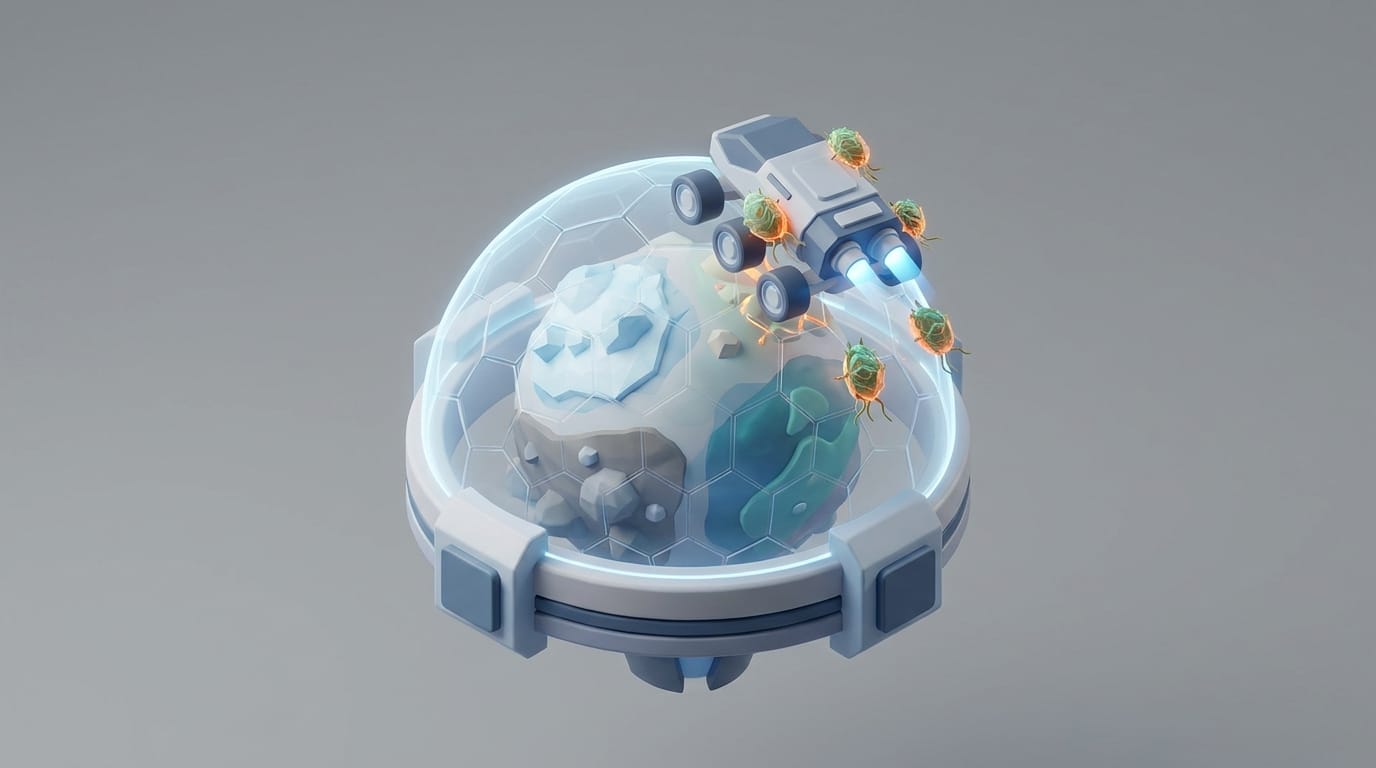
The search for life elsewhere could stop before it starts if we accidentally seed the stars with our own microscopic hitchhikers. This risk drives planetary protection, which is a set of rules meant to stop the cross-contamination of planets and moons during space missions. As we reach further into the solar system, this challenge has grown from a technical hurdle into a serious ethical and legal issue.
Microbes are tougher than the tools they ride on. We spend billions on sensors to find signs of life on Mars, but a single spore from Earth could survive the trip and grow in underground water. If that happens, any discovery we make in the future might just be our own cargo. This would make decades of work useless. For mission architects, these stowaways represent a failure of containment that bridges the gap between biology and aerospace engineering. To understand why this threat is growing, we must look at the systems designed to stop it and why those systems are currently being tested by both nature and the rise of private space flight.
How Planetary Protection Sets Mission Limits
The Committee on Space Research (COSPAR) set these safeguards in motion in 1958. Their framework sorts every mission by how likely a target is to host life or hold clues to how life began. A trip to the Moon faces little review because it is hostile to life, but a mission to the liquid oceans of Europa or the craters of Mars requires strict care. At the center of these rules is “biological bioburden,” which is the total number of microbes on a spacecraft. Missions landing on Mars must often have fewer than 300,000 spores. This keeps the chance of polluting a potential habitat below a specific math limit.
These rules keep our science honest. If a rover finds an amino acid, researchers must know it did not come from a technician in a cleanroom years before. In this case, how scientific laws and theories shape our understanding of truth depends on the cleanliness of the tools providing the data. Cleaning a ship is a long process that begins with assembly in rooms where filtered air and protective suits limit human germs. Parts then go through heat treatments where hardware is baked for hours. However, as missions use more sensitive electronics and optics, these high temperatures become harder to use without breaking the ship.
How Microscopic Hitchhikers Survive the Vacuum of Space
Space was once seen as a wall that killed all life, but we now know that certain organisms can survive there. These extremophiles enter a deep sleep and turn off their metabolism until conditions improve. They do not just survive the journey; they wait it out. One famous example is Deinococcus radiodurans, which can handle radiation doses thousands of times higher than what would kill a human. Research published in the Journal of the Indian Institute of Science shows that some bacteria survive for years outside the International Space Station, proving that travel between planets is likely for microbes.
The ship itself acts as a shield for these stowaways. While the outside gets hit with solar radiation, the cracks and joints inside stay stable. Fungal spores use pigments to protect their DNA from high energy. When they hide inside a rover, they are essentially passengers in a protected cabin. This protection allows them to stay viable for the entire duration of a multi-year flight through the void.
The Difference Between Forward and Backward Contamination
The strategy of planetary protection is split into two fronts. Forward contamination is the transfer of Earth life to another world. The main risk here is a “false positive” where we think we found alien life that we actually brought with us. These microbes might even kill off native life before we ever find it, making it impossible to study a pristine environment. Managing these risks is as hard as the flight itself. Much like how a space mission countdown coordinates many parts, biological safety needs a perfect chain of custody from the factory to the lab.
Backward contamination involves the risk of bringing something back to Earth. While a “space plague” is unlikely, the danger is high enough that we use extreme safety measures. Future missions will use high-level labs to hold samples, as current NASA and ESA plans describe. The safety of our own world requires that these samples never touch our air or water until they are proven safe. This requires a level of security that exceeds most medical labs on Earth today.
Why Cleaning Methods Often Fail Against Extremophiles
Astrobiologists worry that our cleanrooms might be creating super-microbes. By using alcohol and peroxide to clean, we are forcing life to adapt. We kill most bacteria, but the ones that survive are the toughest ones ever found. At the NASA Jet Propulsion Laboratory, scientists found bacteria that eat cleaning agents. These organisms use ethanol as food. This shows how the design of a system can lead to unexpected outcomes because life evolves to bypass the ways we try to stop it. If a system is built to kill using a certain chemical, life will eventually find a way to use that chemical to grow.
Microbes develop thicker cell walls to fight chemicals while others stay dormant for years to ignore surface wipes. Some groups even create a protective slime layer called a biofilm that prevents cleaning agents from reaching the center of the colony. These survival traits mean that even our best efforts may leave behind a small but strong population of survivors ready to wake up once they reach their destination.
The Growing Legal Crisis of Private Space Exploration
While government agencies follow COSPAR rules, private companies create a new challenge. The Outer Space Treaty says nations are responsible for their citizens, but it lacks clear ways to enforce biological safety. We are entering a time where private companies launch missions with far less review than traditional government flights. This creates a gap where planetary protection is currently a voluntary standard. The latest COSPAR policies call these rules non-binding, which creates a legal grey area. If a private mission pollutes an area with water on Mars, no court can easily hold them responsible. Competition between countries may even push some to cut safety steps to reach goals faster or save money.
This is where middle power diplomacy can help stabilize international rules. As more countries go to space, the need for binding laws grows. Without them, the lack of control could lead to a biological disaster that cannot be fixed. The international community must decide if space safety is a choice or a requirement for anyone leaving Earth’s orbit.
Protecting the Scientific Integrity of Future Mars Missions
The cost of a mistake is final. Once an Earth microbe enters Martian water, we can never get it out. We might destroy the record of alien life before we read it. This is about our duty as travelers to protect the places we visit. To solve this, planetary protection must evolve from a technical list into a global ethical rule. We need new ways to track microbes during flight and better tools to clean ships as they land. These tools must work on their own to ensure no human error allows a leak.
We never travel alone; we carry Earth’s history with us. Whether that history stays on the ship or spills into Martian soil is a choice that will define our legacy. We have one chance to find life in its natural state, and we must not let our own baggage ruin the discovery. Our ability to keep these worlds clean shows how we have grown as a civilization. If we let haste or weak laws ruin the search for life, we are losing a piece of our own story. The challenge for the next decade is to ensure that when we finally walk on the Red Planet, our footprints are the only thing we leave behind.