The physics of the tides involves much more than a simple gravitational tug on the ocean. While most people see tides as the rhythmic rise and fall of water along a beach, the reality involves complex planetary stretching and fluid motions that keep satellite navigation systems accurate. To understand these forces, one must look beyond the shoreline and see how the Moon and Sun exert pressure across the entire volume of our planet. This system is a constant exchange between gravity and inertia that reshapes the Earth twice every day.
Most observers focus on the water, but the same forces that pull on the sea also warp the solid ground beneath our feet. This mechanical reality is a foundational principle of geophysics. The interaction of the Earth with the Moon and Sun creates a dynamic environment where the planet expands and contracts vertically. This phenomenon has large effects on everything from local maritime safety to global space flight. By studying how gravity and acceleration work together, we can explain why the tides follow such a strict schedule. It is a system defined by distance, mass, and momentum, where the fluid layer of the Earth acts as a sensor for movements occurring hundreds of thousands of miles away.
The Mechanics Behind the Global Tidal Bulge
The primary driver in the physics of the tides is the gravitational gradient. Newton’s Law of Universal Gravitation states that the pull between two masses grows weaker as the distance between them increases. Because the Earth is a large body with a diameter of about 12,742 kilometers, the Moon pulls much harder on the side of the Earth facing it than on the center or the far side. This difference in pull across the planet creates the tidal force.
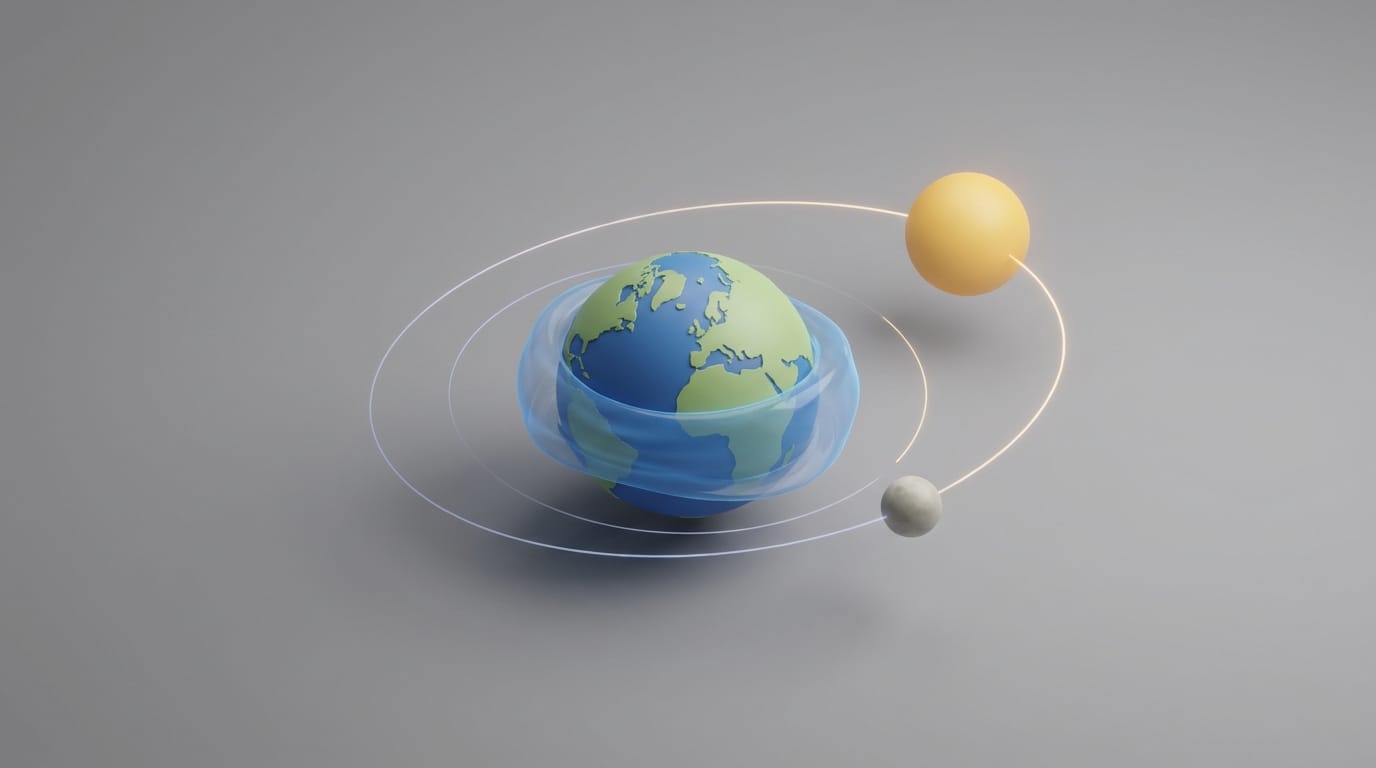
It is not the total gravity of the Moon that creates tides, but the difference in gravity from one side of the Earth to the other. On the near side, the Moon pulls water toward it with more force than it pulls the center of the planet. On the far side, the Moon pulls the center of the Earth more strongly than the water, which effectively leaves the water behind. This creates two distinct bulges of water on opposite sides of the globe at the same time.
While the near-side bulge is easy to visualize, the secondary bulge on the opposite side requires an understanding of how the Earth and Moon move together. They both orbit around a common center of mass called a barycenter, which sits about 1,700 kilometers below the Earth’s surface. As the Earth revolves around this point, it creates inertia. On the side farthest from the Moon, this outward force exceeds the weakened lunar gravity and pushes the water away from the Moon. The result is an oval-like stretching of both the water and the solid layers of the planet.
Lunar vs Solar Influence on Oceanic Movement
A common point of confusion in the physics of the tides is why the Moon remains the main driver of tides when the Sun is so much larger. The answer lies in how tidal forces scale compared to standard gravity. While gravity follows an inverse-square law, tidal forces follow an inverse-cube law. This means that distance matters far more than mass when calculating a tide.
The tidal force is the change in gravity over a specific distance. Mathematically, the strength of this force is proportional to the mass of the object but inversely proportional to the cube of its distance. Because the Sun is 390 times farther away than the Moon, its tidal influence is much weaker than its total gravitational pull. The Sun pulls on the Earth nearly 180 times harder than the Moon does, yet its tidal force is less than half as powerful.
The Moon provides the majority of the force that moves the oceans. According to data from the National Ocean Service, the Sun’s great distance ensures that its gravitational pull is relatively even across the Earth. In contrast, the Moon’s proximity creates a much steeper change in force from one side of the planet to the other. This dominance is also visible in how lunar eclipse science explains the blood moon effect, where the alignment of these bodies shows the scale of the Earth-Moon system. The Sun acts as a modifier that either adds to or subtracts from the lunar signal based on where it sits in the sky.
Spring Tides vs Neap Tides and Orbital Alignment
The total tidal range at any time is the sum of the lunar and solar forces. When these two bodies align, we see the strongest tides. When they sit at right angles to each other, the forces partially cancel out. This monthly cycle is predictable because it follows the phases of the Moon. When the Earth, Moon, and Sun align in a straight line, their tidal bulges overlap. This occurs during both New Moon and Full Moon phases. The combined forces create Spring Tides, which feature the highest high tides and the lowest low tides. The name does not refer to the season; it describes the water springing forward.
When the Moon is in its first or third quarter, it sits at a 90-degree angle from the Sun. In this position, the Sun’s pull works against the Moon’s pull. This interference results in Neap Tides, where the difference between high and low tide is at its smallest. These variations are important for understanding exomoon formation mechanics, as tidal forces often provide the internal heat for moons in other solar systems. On Earth, these cycles dictate the movement of nutrients in the ocean and the safety of coastal shipping lanes.
The Invisible Deformation of the Solid Earth
One of the most ignored parts of the physics of the tides is that the solid Earth also responds to gravity. The ground is elastic enough to stretch under the same forces that move the seas. This phenomenon is known as terrestrial tides or Earth tides. At the equator, the surface of the Earth can rise and fall by up to 55 centimeters twice a day. This means nearly two feet of solid rock moves up and down beneath our feet every twelve hours.
We do not feel this movement because everything around us moves at the same time. However, it has a major impact on modern technology. Global Positioning Systems (GPS) and other high-precision tools must account for this 55cm shift to give accurate location data. Failure to adjust for these crustal movements would make modern flight navigation and land surveying impossible. Specialized models are required to predict these shifts, as research from the International Center for Earth Tides shows that calibration is a primary source of error in geodetic sensors. This breathing of the planet reminds us that the Earth is a flexible system rather than a static rock.
Physical Barriers and Regional Variations
If the Earth were a smooth sphere covered only in water, tides would follow the Moon in a perfect wave. The reality is much more chaotic because of continents, the shape of the seafloor, and the rotation of the planet. These factors explain why some areas have 16-meter tides while others have almost none. The rotation of the Earth creates the Coriolis effect, which causes tidal waves to spin around specific points in the ocean called amphidromic points. At these exact spots, the tidal range is zero. As you move away from these points, the tides become larger. These rotations create tidal cells that act like slow-moving whirlpools across the ocean basins.
Regional differences often come from resonance. Every body of water has a natural frequency at which it sloshes back and forth. If the length and depth of a bay match the 12.4-hour period of the lunar tide, the incoming wave grows much larger. The Bay of Fundy is a famous example of this effect. Its natural frequency matches the lunar tide almost perfectly, leading to the highest tides on the planet. This link between planetary motion and local geography is part of why Earth’s rotation replaced ancient myths in our scientific history. The rotation itself shapes the physical path the water takes around the continents.
The Long-Term Decay of the Earth-Moon System
The energy in this system is not infinite. As tidal bulges travel across the Earth, they bump into continents and rub against the seafloor. This friction acts like a brake on the planet, slowly draining its rotational energy. Because the Earth rotates faster than the Moon orbits, the tidal bulge is dragged slightly ahead of the Moon. The gravitational pull between this lead bulge and the Moon creates a torque. This force slows the Earth’s rotation and lengthens our day by about 2 milliseconds every century. Millions of years ago, a day on Earth was much shorter than 24 hours.
To keep momentum balanced, the energy lost by the Earth moves to the Moon. This causes the Moon to move into a higher and more distant orbit. The Moon currently moves away from Earth at a rate of about 3.8 centimeters per year. Billions of years from now, the Moon will be so far away that it will no longer cause total solar eclipses, and the tides will be much weaker. This energy exchange is a core part of Earth’s energy budget. The heat generated by tidal friction in the ocean and the crust is a small but real part of the internal heat of our planet.
Understanding the tides requires us to view the Earth as a responsive and elastic object. From the 55cm lift of the crust to the massive surge in deep bays, these forces show a planet in constant motion. This motion is not just a background for coastal life; it is a critical variable in global navigation and a force that defines our long-term relationship with the Moon. Tides are a global stretching system, not just a movement of water. This realization changes how we handle precision measurements and satellite tools. As the Moon continues to drift away, the Earth’s day will keep lengthening, showing that even the most stable systems change over time. Our future technologies will eventually need to adapt to a planet that rotates differently than it does today.