
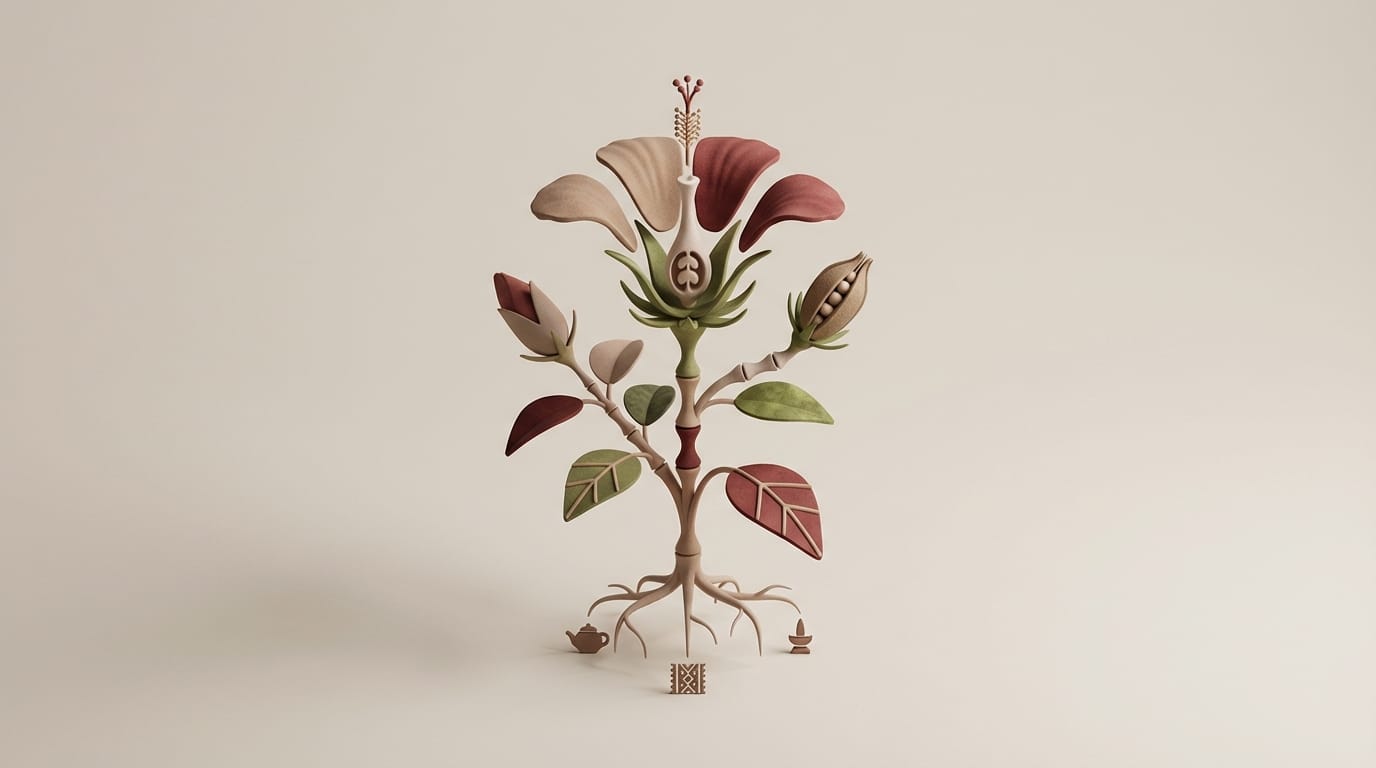
While many people admire the hibiscus for its vibrant petals, the true power of the plant lies in an evolutionary adaptation that allowed it to cross continents and anchor itself in human tradition. Understanding hibiscus botanical properties and cultural significance requires looking past the ornamental surface to the structural systems that made this genus a global staple. From the deep red teas of West Africa to the sacred rituals of Hindu practice, the hibiscus serves as a bridge between wild biological evolution and domestic human necessity.
The hibiscus represents a sprawling genus within the Malvaceae family, sharing a lineage with other vital plants like cotton, okra, and cacao. This familial connection appears in the structural commonalities of their reproductive organs and the fibrous nature of their stems. For the enthusiast or the ethnobotanist, the plant represents a masterclass in how a species can optimize its physical form to survive in specific niches while remaining adaptable enough to thrive under human cultivation across vastly different climates. Misunderstanding the hibiscus often stems from treating it purely as a garden aesthetic. In reality, the plant is a complex system where morphology, chemical composition, and historical migration patterns intersect.
Hibiscus Botanical Properties and Cultural Significance in Taxonomy
The taxonomic classification of hibiscus places it firmly within the mallow family, a group defined by specific floral structures. There are over 200 species within the genus, though two primary varieties dominate human interaction: Hibiscus rosa-sinensis, the ornamental China rose, and Hibiscus sabdariffa, commonly known as roselle or Jamaican sorrel. While they share a genus, their roles in history diverged based on their unique physical traits and chemical profiles.
The most striking feature of the hibiscus is its large, trumpet-shaped corolla, which evolved to attract a wide array of pollinators like hummingbirds, bees, and butterflies. A central feature of this morphology is the staminal column, a protruding structure where the filaments of the male stamens fuse together to surround the female style. This arrangement ensures that as a pollinator enters the flower to reach the nectar at the base, it must brush against the pollen-laden anthers before reaching the receptive stigmas.
Hibiscus leaves are typically alternate and often ovate with serrated margins that help regulate water loss in humid environments. The stems are semi-woody, providing a balance of flexibility and strength that allows the plant to withstand the heavy winds and rains common in its native habitats. This structural resilience is a hallmark of the Malvaceae family, which often produces high-tensile fibers used in textiles and rope making.
Species exhibit a broad range of genetic diversity, allowing them to occupy niches from the sweltering tropics to temperate zones. For instance, the Rose of Sharon is a deciduous shrub capable of surviving freezing winters, whereas the China rose is strictly tropical and will perish if exposed to sustained frost. This adaptability is the result of millions of years of natural selection, though animal adaptation and evolution never reaches perfection, and the same remains true for plants. They optimize for survival within their current environmental constraints rather than aiming for a universal ideal.
Evolutionary Success Through the Fleshy Calyx
The transition of hibiscus from a wild shrub to a global commodity was facilitated by a specific evolutionary trait that humans found useful. While most flowers lose their petals and fade away after pollination, the Hibiscus sabdariffa species possesses a calyx that begins to enlarge and become succulent after the bloom falls. This fleshy calyx serves as the primary source for the tart, ruby-red infusions enjoyed worldwide.
In most flowering plants, the calyx is a minor structural support that dries up once its protective duty is done. In roselle, however, the calyx becomes a storage vessel for water and nutrients, protecting the developing seed pod inside. This thickening is a survival mechanism designed to keep the seeds viable in harsh or erratic climates. The tartness of the calyx, caused by a high concentration of organic acids, also acts as a deterrent against herbivores that might otherwise consume the seeds before they reach maturity.
For humans, this biological adaptation provided a shelf-stable, nutrient-dense resource. The calyx is durable, easy to harvest, and retains its flavor and chemical potency even after being dried and transported over long distances. Research regarding hibiscus botanical properties and cultural significance published in the GSC Biological and Pharmaceutical Sciences journal suggests the calyx is the most economically significant part of the plant due to its unique concentration of bioactive compounds.
The durability of the calyx effectively turned the hibiscus into a traveling plant. Unlike delicate fruits that spoil quickly, dried hibiscus calyces could be carried across oceans by traders, maintaining their nutritional value for months. This relationship between plant morphology and human movement is a core tenet of ethnobotany. The physical evolution of the calyx enabled the species to travel across the Atlantic and Pacific, ensuring its survival by becoming indispensable to the human diet.
Global Traditions and National Identity
The interaction between the plant and society is most evident in how different cultures integrated the plant into their national identities and spiritual practices. Because the plant is both visually spectacular and functionally versatile, it has taken on meanings ranging from political sovereignty to divine worship. Its presence in a region is often a biological record of historical trade routes and migrations.
In West Africa, roselle has been a staple for centuries, valued for its cooling properties and high vitamin C content. During the era of the Trans-Atlantic slave trade, seeds and dried calyces were transported to the Caribbean and the Americas. In Jamaica, the plant became known as sorrel, and the red drink made from it became a central part of holiday traditions. This migration was a deliberate preservation of cultural heritage by people who recognized the plant’s medicinal and nutritional value in an unfamiliar landscape.
The plant’s resilience in the Caribbean climate allowed it to flourish, and it remains a symbol of resistance and survival. The deep red hue of the tea is often associated with vitality and the blood of ancestors, anchoring the botanical properties of the plant in a profound social context. This is a clear example of how a plant’s physical traits, such as its vibrant pigment and ease of growth, can become woven into the history of a people.
In Asia, the hibiscus takes on an ornamental and symbolic role. Hibiscus rosa-sinensis is the national flower of Malaysia, where it is called the Great Flower. The five petals of the flower were chosen in 1960 to represent the five national principles of Malaysia: belief in God, loyalty to King and country, supremacy of the Constitution, rule of law, and courtesy. The red color symbolizes the courage and vitality of the Malaysian people, according to historical records of its adoption as a sovereign symbol.
Beyond politics, the hibiscus holds a sacred place in Hinduism. The red hibiscus is frequently offered to the goddess Kali and the god Ganesha, as the vibrant red color is believed to represent energy and the ability to destroy obstacles. These associations stem from the plant’s physical presence, particularly its tongue-like protruding stamen and its relentless blooming cycle.
The Phytochemistry of Hibiscus Compounds
From a chemical perspective, the output of the hibiscus plant is the result of a specific architecture. The primary bioactive components exist in the calyx and petals, where the plant synthesizes secondary metabolites to protect itself from UV radiation and oxidative stress. When we consume hibiscus, we tap into this internal defense system.
The deep crimson color of hibiscus tea comes from anthocyanins, a class of water-soluble pigments. These compounds are effective at scavenging free radicals, which are unstable molecules that can damage cells. The physics of how these pigments interact with light is similar to how light scattering explains why your veins look blue even though blood is red. The molecular structure of anthocyanins determines which wavelengths are absorbed and which are reflected back to our eyes as vibrant red.
In biological systems, these anthocyanins do more than provide color. They have been shown to inhibit the oxidation of low-density lipoprotein (LDL), a key step in the development of heart issues. By preventing this oxidation within the arteries, hibiscus compounds help maintain the integrity of the cardiovascular system. This is why the plant’s phytochemistry is a subject of interest for those looking for natural ways to manage metabolic health.
The characteristic tartness of hibiscus is due to a high concentration of organic acids, including citric, malic, and tartaric acid. These acids contribute to the plant’s role as a natural diuretic. By increasing the filtration rate of the kidneys, they help the body flush out excess sodium and water, which reduces the volume of blood the heart must pump. This mechanism is one of the primary ways hibiscus manages blood pressure. The health effects of hibiscus are the result of a relationship between its acids and its pigments, much like why choosing matcha vs coffee for energy changes your focus through the interplay of different compounds.
Modern Pharmacology and Clinical Evidence
Modern clinical science is validating what traditional practitioners in Africa, China, and India have known for millennia. Hibiscus is no longer viewed merely as an herbal remedy but as a potent nutraceutical with measurable impacts on human physiology. Recent trials have focused specifically on its role as a cardiovascular intervention, comparing its efficacy to standardized pharmaceuticals.
Systematic reviews of clinical trials have shown that daily consumption of hibiscus tea can lead to reductions in both systolic and diastolic blood pressure. In some studies, the effect was comparable to common ACE inhibitors without the usual side effects. According to a review published in the journal Nutrients, the anthocyanins in hibiscus act as natural ACE inhibitors, relaxing the blood vessels and allowing for smoother blood flow.
Beyond blood pressure, hibiscus is being investigated for its impact on blood sugar and cholesterol levels. Preliminary evidence suggests that hibiscus extracts can lower blood glucose and improve the ratio of good to bad cholesterol. These findings are relevant for managing metabolic syndrome, a cluster of conditions that increase the risk of heart disease and stroke. By acting on multiple systems simultaneously, the plant offers a holistic approach to metabolic maintenance.
The plant’s benefits also extend to inflammation. The high concentration of polyphenols and vitamin C gives hibiscus anti-inflammatory properties, which can be useful in optimizing post-workout recovery through system synergy. Reducing systemic inflammation helps the body repair tissue more efficiently and can alleviate joint pain. Some studies have even demonstrated that hibiscus extracts possess antimicrobial activity against various strains of bacteria, making it a traditional choice for treating infections.
The hibiscus is more than a decorative bloom; it is a highly evolved biological system that has successfully integrated itself into the human story. By understanding the hibiscus botanical properties and cultural significance, we gain a clearer picture of why this plant remains a global constant. Whether it is used to symbolize a nation’s courage or to support cardiovascular health, the hibiscus remains an enduring testament to the connection between botanical evolution and human culture. As modern research continues to bridge the gap between traditional use and clinical validation, the hibiscus will likely play an even larger role in our understanding of natural health systems.