
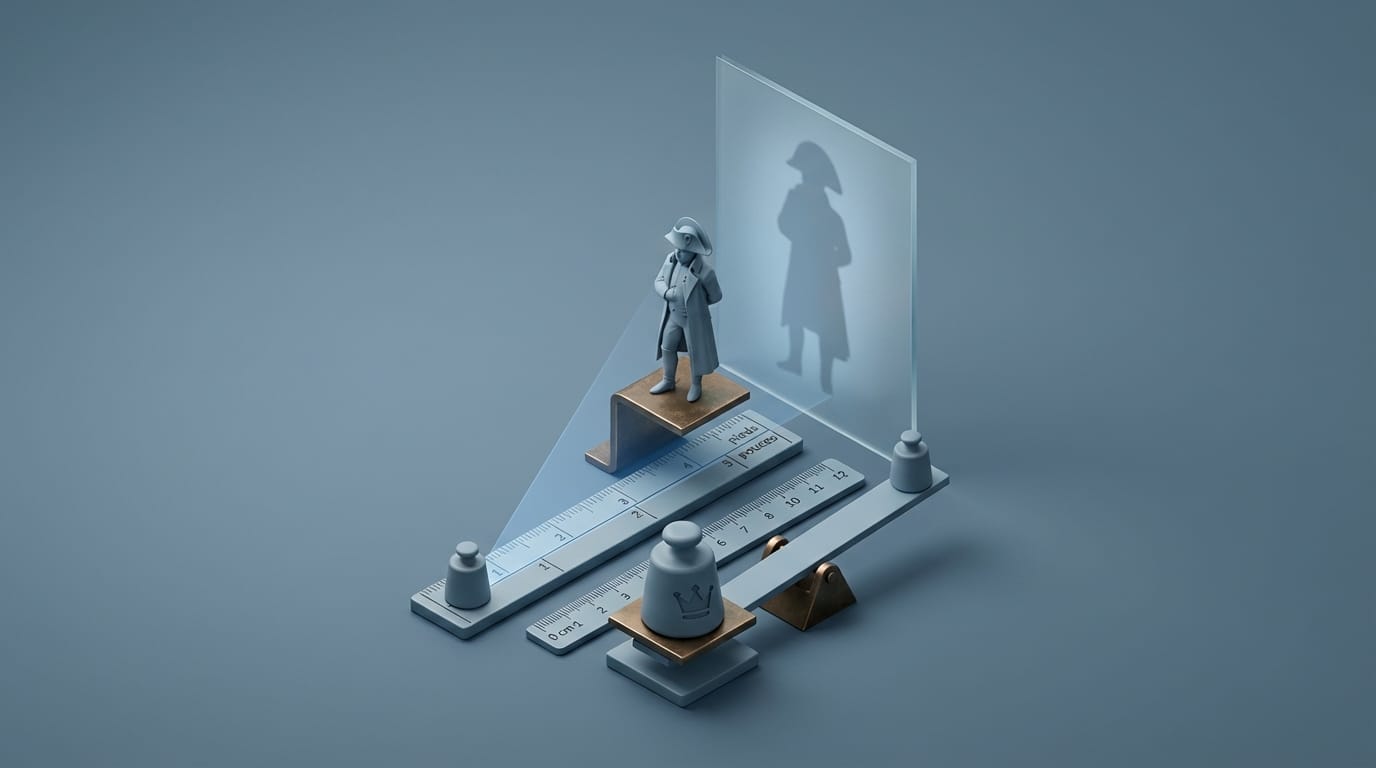
History remembers Napoleon Bonaparte as a short conqueror, yet this perception is the result of a math error and a clever psychological campaign by his enemies. While the image of a tiny general remains a staple of modern pop culture, the reality of the napoleon height myth rests in mundane paperwork and the visual tricks of the 19th-century battlefield. To understand why this falsehood has lasted over two centuries, we must look past the cartoons and examine the measurement systems and military structures that defined Napoleon’s world. By deconstructing the way doctors measured him, how the British press marketed his image, and how his own elite guard changed public perception, we can clarify a historical record distorted by centuries of satire.
The Mathematical Origins of the Napoleon Height Myth
The foundation of the napoleon height myth lies in a simple failure to convert units. When Napoleon died on the island of St. Helena in 1821, his autopsy recorded his height as five feet, two inches. To a modern English speaker, this sounds short, but the doctors used “Mesures usuelles,” the French system used before the country fully adopted metric units.
The difference between French and British inches
In the early 1800s, the French inch, or pouce, was longer than the British inch. A French inch measured about 2.71 centimeters, while the British imperial inch was 2.54 centimeters. This difference meant that any height recorded in French units seemed much smaller to a British audience who assumed the doctors used English units. This discrepancy created a data error where the numbers remained accurate within the original French framework but became misleading once they crossed the English Channel.
How five feet two inches became five feet six inches
When you apply the correct conversion factor, Napoleon’s recorded height of 5’2” in French units translates to roughly 5 feet 6.5 inches (169 cm) in modern English units. Historians at the National Gallery of Victoria note that this measurement was slightly above the average height for a Frenchman at the time. His nickname, “Le Petit Caporal” (The Little Corporal), compounded the confusion; his soldiers used the term to celebrate his youth and his habit of working alongside his men rather than to describe his physical stature.
British Propaganda and the Birth of Little Boney
While math errors provided the fuel, British propaganda provided the spark that turned a measurement mistake into a permanent fixture of history. During the Napoleonic Wars, information served as a weapon, and the British press used satire to diminish the threat of the man they called the Corsican Ogre.
The role of James Gillray in shaping public perception
The primary architect of Napoleon’s shortness was the influential British caricaturist James Gillray. He began depicting Napoleon as “Little Boney,” a tiny, childish figure often seen standing in the palm of King George III or throwing tantrums in boots that were far too large for him. Gillray’s cartoons worked so well that Napoleon himself reportedly said that Gillray did more than all the armies of Europe to bring him down by eroding his authority through ridicule.
Satire as a weapon of war against the French Empire
By shrinking Napoleon in print, the British media made the prospect of a French invasion seem less terrifying. It shifted the narrative from a clash of titans to a struggle against an annoying, tiny upstart. This visual shorthand worked so well that it bypassed the need for factual accuracy. Even after Napoleon’s defeat, the image of the small emperor was too useful a story tool to abandon, ensuring authors passed the myth down through textbooks and popular media alike.
The Optical Illusion of the Imperial Guard
Beyond the math and the media, a physical reality on the ground contributed to the misunderstanding. Napoleon’s own military systems, designed to project power, created a permanent visual contrast that made him appear smaller than he was.
Meritocracy and the physical requirements of the elite
Napoleon built his Grande Armée on the principle of merit, especially within his elite Imperial Guard. To join the Old Guard, soldiers needed to serve in several campaigns and meet strict height requirements. Grenadiers of the Guard were generally expected to be at least 5’10”, making them giants in an era where the average male was several inches shorter. By surrounding himself with these soldiers, Napoleon was constantly flanked by the tallest men in Europe.
The visual contrast between the Emperor and his soldiers
When onlookers saw Napoleon inspecting his troops, they did not see a man of average height; they saw a leader standing next to a wall of six-foot-tall elite soldiers. These guards also wore tall bearskin hats that added another foot to their perceived height, creating a profound optical illusion. If you stand a person of average height next to professional basketball players today, they look small by comparison. Contemporary observers documented this visual deficit and solidified the “Little Corporal” image for those who only saw him near his guard. This illustrates how the systems surrounding a leader can dictate public perception regardless of the underlying facts.
Comparing Napoleon to His Contemporaries
To debunk the napoleon height myth, we must place Bonaparte within the context of his peers. Comparing a 19th-century figure to a modern person is a mistake because better nutrition and healthcare have increased the global average height over the last two centuries.
Average height statistics in the early 1800s
In the early 19th century, the average height for a French male was about 5 feet 5 inches. Napoleon, at 5’6.5”, was taller than many of the men he led. This misunderstanding parallels modern health data, such as the way muscle soreness is often incorrectly linked to growth; our assumptions about physical indicators can lead to wrong conclusions about a person’s capability or status.
Comparison with other European leaders and generals
Napoleon’s rivals varied in stature, but he was not an outlier. The Duke of Wellington stood around 5’9”, and Tsar Alexander I of Russia was also a tall man for the era at roughly 5’10”. However, compared to his predecessor King Louis XVI, who stood about 5’4”, Napoleon was a man of substantial presence. He was of average height for a European aristocrat and above average for the common population of France.
The Evolution of the Napoleon Complex Myth
Psychologists ensured the myth’s survival long after the wars ended. In the early 20th century, the “Napoleon Complex” became a formal term in behavioral science, which further distanced the name from the actual historical man.
Alfred Adler and the psychological misnomer
Psychologist Alfred Adler popularized the concept of the inferiority complex. The idea that shorter men compensate for their stature through aggression became known as the Napoleon Complex. This label relied on the existing napoleon height myth as its primary evidence. By naming a psychological condition after him, the scientific community gave the historical falsehood a new life in the classroom.
Why the myth survives in modern popular culture
Society often prefers a clean story over a complex truth. The short, angry conqueror is a more compelling character than an average-height administrative genius. Much like misunderstandings of digital privacy lead people to use the wrong tools, historical misunderstandings lead us to draw the wrong lessons from the past. We cling to the myth because it provides a simple psychological explanation for Napoleon’s massive ambition, even though that ambition grew from the political and social systems of post-revolutionary France.
The napoleon height myth serves as a potent reminder that history is often a game of telephone. A single unit conversion error can be amplified by propaganda and solidified by the visual context of the time. When we peel back the layers of British satire and the shadows cast by the Imperial Guard, we find a man whose stature was entirely unremarkable for his era. This realization does not diminish Napoleon’s legacy; it emphasizes that his impact on the world came from his intellect and the systems he built, rather than a compensation for physical limits.