
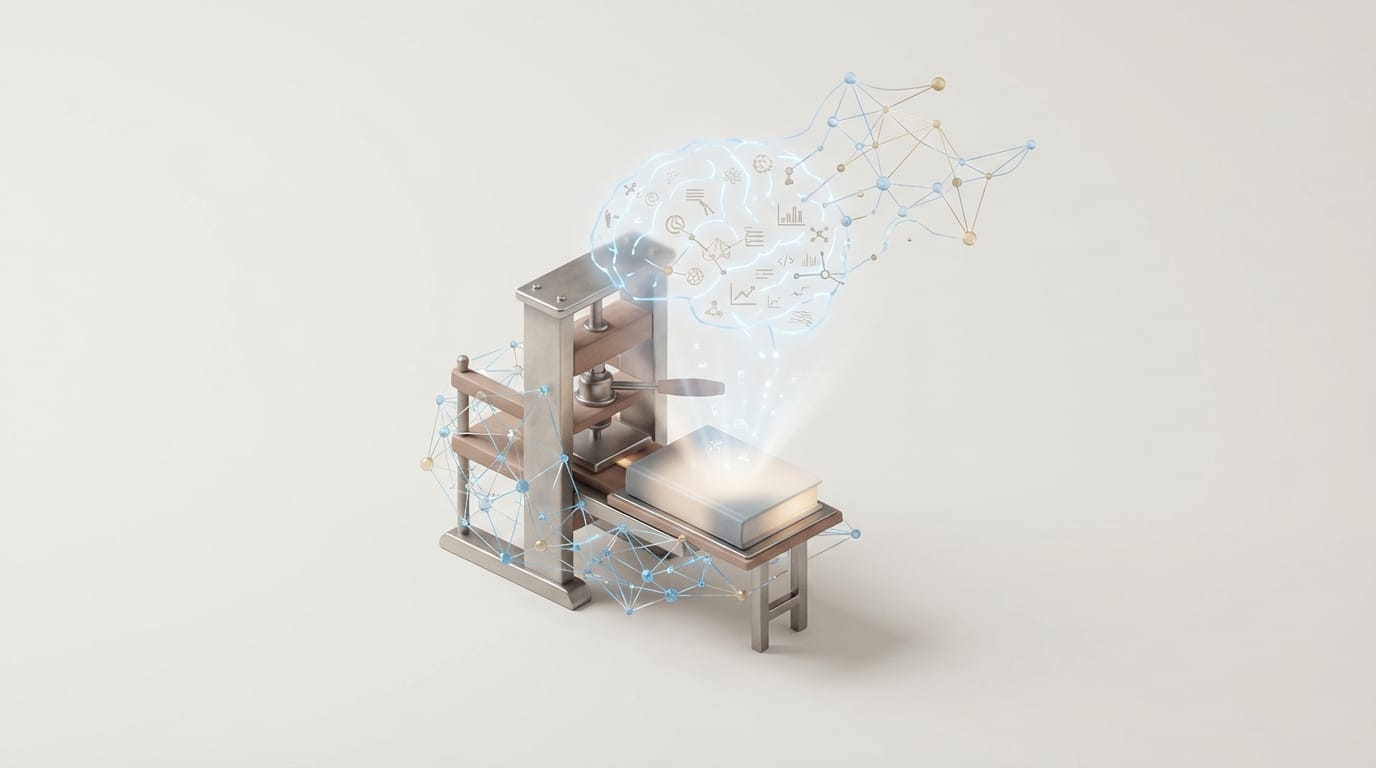
If we treat modern software as a simple search tool, we miss a shift in human thought as deep as the invention of movable type. Comparing the augmented intelligence printing press allows us to see a move from a time of scarce data to a time of endless synthesis. This change shifts how society builds meaning, just as printed books ended the era of hand-copied scrolls. The press did more than lower the cost of books; it changed how the mind worked. Before the mid-15th century, knowledge was a fragile thing kept in a scholar’s memory or on a few expensive pages. When Gutenberg introduced his press, he built an external brain for the collective mind. We now see the next phase of this growth, where systems do not just store data but actively help sort and shape it.
To understand why this matters now, we must look past the screen and into the way the system works. Just as the printing press broke the power of those who could read, these new tools break the power of those who can find complex answers. We are moving from a world where we value people for what they remember to a world where we value them for how they direct the engines of discovery. This shift creates a new kind of shared mental infrastructure that reaches every part of our lives.
The Evolution of Shared Cognitive Infrastructure
The augmented intelligence printing press represents a transition similar to the move from manuscript culture to print culture. In the manuscript era, every copy of a text was a unique product. These books often had errors from the person who copied them. Because work was slow and costly, only a few schools and churches held the knowledge. This scarcity created a natural gatekeeping system where leaders decided which ideas were worth the labor of copying. The printing press changed this by creating mass-produced, standard text. By making data cheap and easy to find, it let more people learn to read and think for themselves. This led to a rise in literacy and helped start the scientific revolution. Researchers could finally rely on matching copies of data shared across long distances. Knowledge moved from a series of lonely islands to a unified network of shared facts.
While people often use artificial intelligence and augmented intelligence to mean the same thing, the difference matters. Artificial intelligence implies a replacement, like a bot that solves problems without a person. Augmented intelligence, or intelligence augmentation, follows the idea that computers should change how we think and act. In this view, the machine is not a master to be obeyed but a tool for the mind. It handles fast, simple tasks like finding patterns so that humans can focus on hard choices, ethics, and plans. If the press was a tool to share thoughts, this new tech is a tool to think faster and better.
Transitioning from Consumption to Active Synthesis
The historical importance of the augmented intelligence printing press lies in how it moves us from reading to creating. The first press changed the world by making reading a private, internal act. This shift grew the idea of the individual self. It was no longer a question of finding a book, but of having the skill to engage with it. The press created a society of people who could join the great conversations of history from their own homes, which changed the power balance of the world. Now, we see a similar change in how we produce ideas. In the old model, writing a deep technical report or building an app took years of training. That skill served as a wall that kept people out. Only those who knew the technical details could produce the work.
Modern tools shift human value from the person who knows to the person who directs. By lowering the skill wall, these systems let anyone blend knowledge from different fields without needing to master the small details of each one. You can see this clearly in how creative fields change human artistic value by focusing on the idea rather than the manual work. The system handles the how so the person can focus on the why. This shift allows for a level of creation that was once impossible for a single person to achieve.
Structural Parallels in Knowledge Decentralization
The printing press was a direct threat to the leaders of the 15th century. By letting people print their own ideas, it weakened the control of the church over the stories people told. Martin Luther’s ideas might have stayed in one small town without the speed of the press. The tech allowed for a new kind of power where a good idea mattered more than the rank of the person who wrote it. Today, we see a similar drop in the power of experts. Professional groups once relied on degrees to prove someone was good at their job. Now, these tools let people skip those guards by giving them the power to work at a high level. This does not mean the expert is gone. Instead, the expert becomes a designer who builds the system rather than someone who just guards the door.
This shift toward individual power is a sign of a move away from top-down sharing of facts and back into a time of fluid creation. As people gain the power to blend data, the lines between jobs begin to fade. A biologist might use tools to write code for data study, while a historian might use those same tools to model social trends. However, this change brings risks. The press led to an explosion of pamphlets that fueled wars. Our current change faces the risk of wrong data. We must learn to handle technical causes of machine fabrication to ensure our work rests on truth. When the cost of making content drops to zero, the amount of noise grows fast. We must build our new power on facts we can trust.
How Technical Environments Redefine Literacy
In the age of the press, literacy meant the skill to read symbols on a page. Today, literacy is the skill to direct automated systems. This new literacy is not just about typing a request into a box. It is about knowing the logic of the model and its limits. It is the difference between being a passenger in a car and being the person who knows how the engine works. This shift makes memorizing facts less useful. The value of knowing a fact is now less than the value of knowing how to check it and blend it with others. We are moving toward a model where our main skill is the ability to map out the data our tools provide. The system acts as a guide, but the human still decides where the path should lead.
As the machine does more of the doing, the human must do more of the deciding. When you can make ten versions of a design in a second, your skill lies in picking and fixing those results. This requires a higher level of thinking than manual labor. We are no longer training the hand; we are training the eye and the mind. To stay useful, professionals must learn the art of adding productivity assistants to daily work as partners. This involves a loop where the human provides the goal and the machine provides the options. The literacy of the future is the skill to lead this partnership without losing the original goal.
Long Term Impacts on Strategy and Education
The economic impact of the press was not seen right away, but it changed how cities worked by allowing for shared knowledge. Modern tools provide a similar boost to how much we can get done. Small firms can now use these tools to do deep research at a low cost, according to research from the MIT Initiative on the Digital Economy. This levels the field and shifts the focus of a company from what one person can do to how the whole system works. For workers, this means moving away from small, narrow roles. The most valuable people will be those who can work across many fields by using tools to fill the gaps in their skills. The professional who has deep skill in one area and broad knowledge in others is now the standard. Teams will become more fluid as they focus on projects rather than rigid roles. Understanding how automation changes the future of work is key for anyone trying to navigate this new world.
Our schools were built for an age where people followed rules and did the same tasks over and over. This does not work in a world where a machine can follow rules better than any human. Education must shift from what to how. We need to teach students how to check if a fact is true and how to use tools to solve real problems. By moving the simple work of making knowledge to the machine, we free the human mind for better things. We are building a system that is an extension of our own minds. Like the readers of the 15th century who found their world changed by the printed page, we are only beginning to see what a society of directors can do.
The core lesson of the augmented intelligence printing press is that this tech does not replace human thought but refines it. While the press let us listen to the thoughts of others, this new tool lets us speak our own ideas with the power of many experts. This shift from taking in facts to blending them represents a deep change in human value. We are moving beyond the limits of memory into a time of shared wisdom. This matters because the hard problems of our world need a speed of thought that no person can reach alone. We must choose to use this tool to solve these problems rather than just using it to make more noise. Our success depends on how well we lead this new system.