
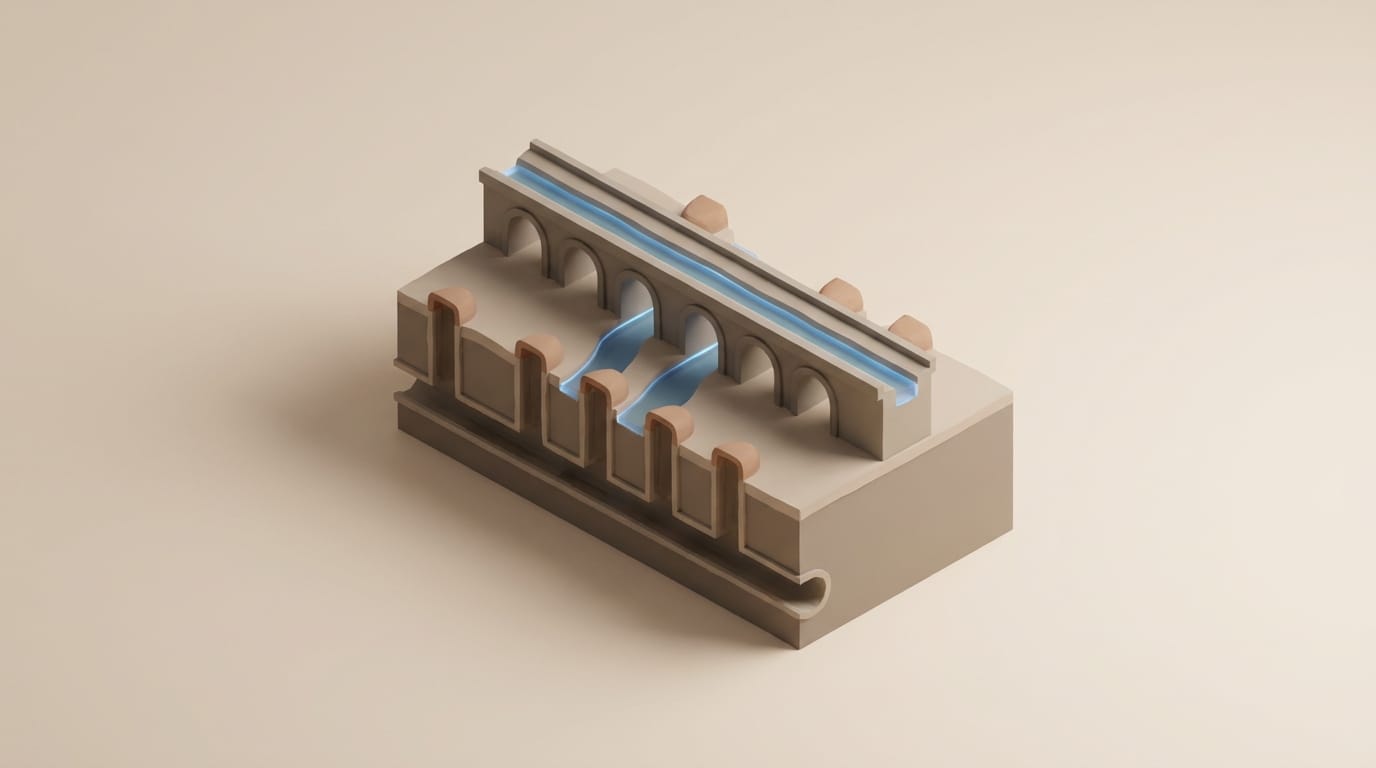
Long before the arrival of fossil-fuel-powered pumps, ancient societies engineered water systems that functioned for centuries by working with gravity rather than fighting it. These ancient water management systems represent more than mere primitive plumbing; they are works of social engineering that often outlasted the civilizations that built them. While modern infrastructure often relies on intensive energy and central control, these historical models prioritized passive flow and community-led strength.
When we look at how these networks survived, we see a recurring pattern of design that limits mechanical failure. Modern systems are frequently built to last fifty to one hundred years before major parts require total replacement. In contrast, many qanats in Iran and acequias in New Mexico have functioned without stop for over a thousand years, proving that durability comes from working within natural limits.
The Physics of Persistent Gravity-Fed Infrastructure
The primary reason ancient water management systems achieve such a long life is their reliance on the constant pull of gravity. The qanat, a Persian innovation dating back 3,000 years, uses the natural slope of hills to move water through underground tunnels. By tapping into mountain aquifers and maintaining a precise, gentle tilt, these tunnels deliver water to distant plains without the need for a single watt of outside energy.
The engineering skill required for this is immense. Persian well-diggers used simple levels and weighted lines to maintain slopes as low as one foot of drop for every thousand feet of length. This slow movement prevents the internal wear that ruins modern high-pressure pipes; it ensures that the water carries very little silt while maintaining a steady, predictable flow. Unlike modern pumps that fail during power outages, a qanat’s delivery is as certain as the Earth’s pull.
Mastering Slope Without Modern Tools
Roman engineers pushed this passive logic further by adding distribution basins. At sites like Nimes, the aqueduct would end in a circular basin that used tiered outlets to manage pressure. The lowest pipes fed public fountains, the middle tier served public baths, and the highest outlets—which were most likely to see flow changes—went to private homes.
This setup ensured that even during dry spells, the most vital public services kept running. When crossing deep valleys, the Romans built siphons that could hold high pressure. To manage these forces, they often used multiple parallel lead pipes rather than one large one; this backup allowed for easier repair and limited the impact of a single break on the whole network.
Building for Thermal Stability and Drought Resilience
A major challenge in hot climates is the loss of water through evaporation, a problem that modern open canals still face. Ancient designs solved this by moving the entire network below ground. By moving water through tunnels, these systems used the Earth’s mass to keep the liquid cool and shielded from the sun.
The cooling effect of these underground networks did more than just protect the water. In cities like Yazd, these cool, flowing streams beneath buildings created a natural form of air conditioning for the rooms above. This thermal stability also prevented the growth of algae and germs that thrive in warm, still water, ensuring a supply that was safe to drink without the heavy chemical treatments used in modern city plants.
Maintaining these systems also required a deep grasp of soil health and filtering. In many farming zones, the water passed through a series of ponds to remove dirt before it reached the fields. This prevents the clogging of irrigation channels and avoids the common modern problem where fixing soil that repels water becomes a constant struggle for farmers.
The Social Secret to Long-Lasting Infrastructure
While the tunnels are impressive, the true secret to why these ancient water management systems lasted so long is their social model. Most modern water systems are managed by private firms or distant government agencies, which creates a gap between the user and the resource. Ancient systems, however, were almost always run through shared ownership and fair laws.
In Central Asia and parts of the Middle East, this was known as the Mirab system. A community-elected official, the Mirab, was responsible for the fair sharing of water and the oversight of upkeep. Because the survival of the whole village depended on the tunnels, every home gave labor to the yearly cleaning and repair of the shafts. This shared duty prevented people from overusing the resource and ensured that small issues were fixed before they became total failures.
This shared approach is very different from today’s models that often put profit or industrial scale over long-term stability. When water is treated as a shared asset rather than a product for sale, the focus shifts toward saving it for the future. The social laws governing these systems acted as a set of rules that were just as vital as the stone and mortar of the tunnels themselves.
Fair Sharing vs. Deep Extraction
In many areas, the shift to mechanical pumps has led to what experts call water bankruptcy. Unlike qanats, which only take the natural overflow of an aquifer, modern deep pumps can pull water out faster than the rain can replace it. This leads to the collapse of local nature and the eventual failure of the very tools built to provide plenty.
Ancient social models understood that resource limits are not hurdles to jump over, but boundaries to honor. This view is vital today, as the impact of water scarcity on food systems begins to change how nations manage their internal peace. By weaving water care into the daily life of the community, these societies avoided the fights that often break out in modern situations where people must choose to cooperate for the good of the group.
Applying Ancient Hydraulics to Modern Planning
As we look toward modern smart cities, there is a growing movement to bring back passive, local water logic. The goal is not to give up on new technology, but to use it to improve old principles. By shifting from huge, energy-hungry central pumps toward local gravity-fed networks, planners can create cities that are far better at handling disasters and power failures.
Modern sensors and AI can now track these passive systems with great detail. For example, evolving business social standards are leading companies to help restore old water networks in dry regions to ensure they can last for the long term. These projects prove that the best solution is often one that has already worked for a thousand years.
The use of ancient hydraulics in modern building could include:
- Small, local tunnels for city cooling and watering parks.
- Passive pressure tools that reduce the strain on city pipes.
- Shared water-sharing rules that give residents a reason to care for their local pipes.
Ancient systems show that true efficiency is found when there is no waste, not just when there is new technology. Many researchers have found that traditional qanats remain one of the most stable and energy-saving ways to supply water in dry lands, according to data from ScienceDirect. At the same time, the UNESCO Water Heritage programs point to these systems as vital assets that teach us how to adapt to a changing climate.
The engineering of the past was built to last forever. By studying how these societies provided water for centuries without the aid of power or complex chemicals, we can find a plan for a more stable world. The durability of ancient water management systems reminds us that when we align our designs with natural laws and fair social rules, we create infrastructure that can truly last.
The core lesson of ancient water management is that technical skill is empty without a strong social bond. When the people who use a system also maintain it, and the design works with the environment, the infrastructure becomes a permanent part of the land. As we face a warmer world and fewer resources, the most creative path forward might be to look back at the systems that never stopped working. We must ask if we can design our future cities with the same long-term view, or if we will continue to build systems that need constant energy just to survive.