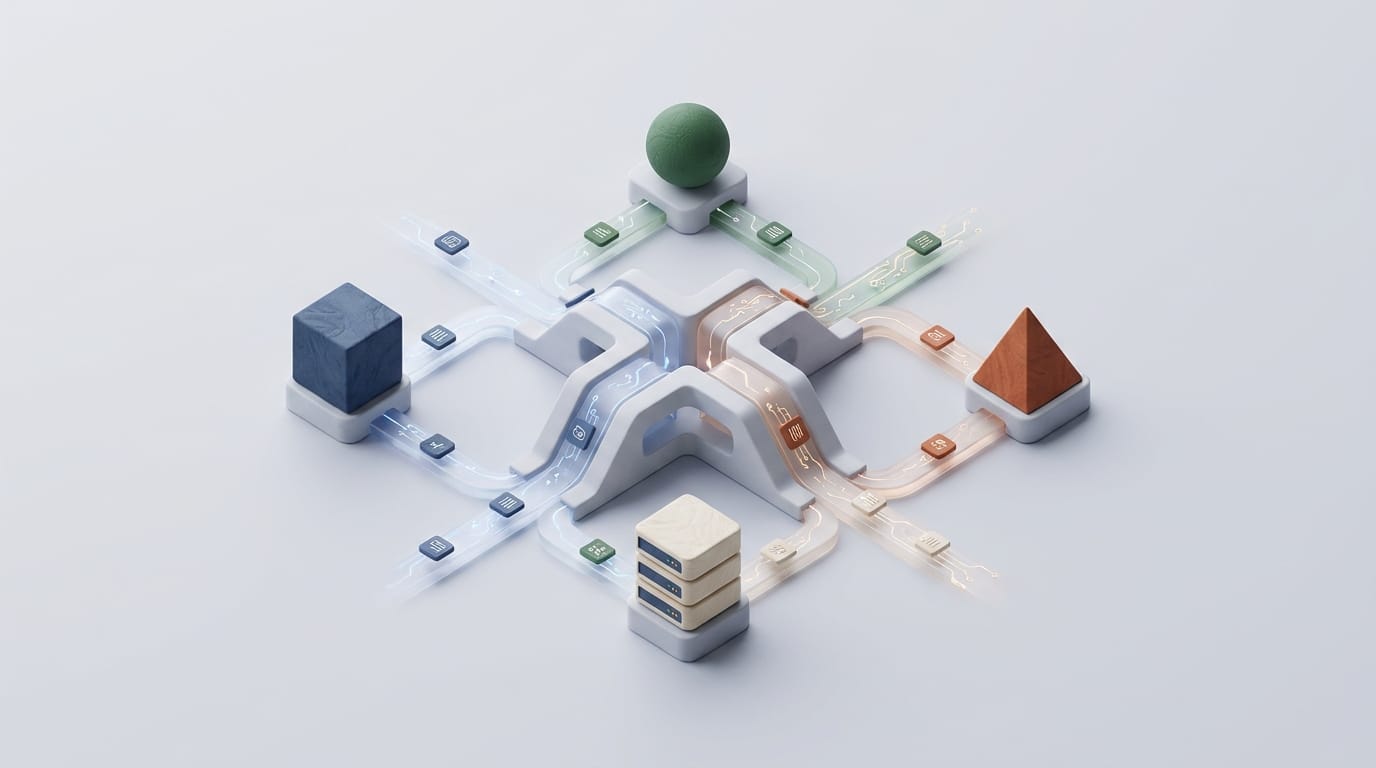
The current state of custom AI integrations forces developers to rebuild data bridges for every new model; this creates a fragile setup that puts vendor lock-in over data use. To solve this, the Model Context Protocol (MCP) offers a universal standard to connect AI systems with data. This protocol replaces messy, custom code with a single interface, shifting the focus from managing individual API tunnels to building a unified layer that any model can use.
The rapid growth of large language models (LLMs) has introduced a classic integration problem where every new model must manually connect to every private data source. For tech leaders, this means maintaining a growing library of connectors that break when a model updates or a data source changes its API. Standardizing this connectivity offers more than just convenience; it helps build a future-proof stack where the company keeps control of its data even if they swap the model.
By using an open standard like MCP, organizations can move past the manual work that currently limits AI agents. Instead of treating the AI as a black box that needs constant feeding, the protocol allows for automatic tool discovery and real-time data retrieval. This enables a smoother architecture where models navigate complex business environments as easily as a web browser navigates the internet.
The Fragmentation Cost of Custom AI Integrations
Maintaining custom APIs for every data-to-model pairing drains engineering resources. When each model requires a unique connector, organizations end up with a “spaghetti” architecture where teams duplicate logic across dozens of places. This fragmentation prevents teams from using private data across different LLMs, as the context gathered for one agent may not work for another without heavy re-engineering.
The custom connector bottleneck
Every time a team integrates a new tool, such as a task board or a database, they usually write a custom integration layer. This layer must handle security and data changes specifically for that AI’s format. This approach does not scale; currently, experts estimate that developers spend nearly 30% of their AI implementation time just on data connectivity rather than the actual AI logic.
Why vendor lock-in slows AI scaling
Fragmentation also leads to vendor lock-in. When data access logic ties directly to one provider’s framework, switching models becomes a major project. This creates a trap where the effort to maintain the system offsets the gains from the AI itself. In many cases, new software creates a productivity trap because managing these fragmented bridges eventually becomes harder than the work the software was meant to solve.
How the Model Context Protocol (MCP) Standardizes Information Flow
The Model Context Protocol (MCP) solves the integration bottleneck by separating the AI application from the data source. Similar to how standardized protocols changed how coding tools work, MCP provides a structured way for models to talk to external systems. This allows an AI application to ask a server what it can do—like searching files or running a script—without the developer writing new code for every model.
The Host-Client-Server model
Three distinct roles work together to deliver context. The Host is the main AI application the user sees. The Client is the part within that host that connects to various Servers. The Servers act as gatekeepers for the data; they show specific resources and tools that the AI can use. This modular design ensures that one MCP server can work with many different AI hosts at the same time.
Standardizing the transport layer
The protocol uses a standard communication layer to keep messages predictable. This removes the need for custom translation layers. The official MCP specification shows that the protocol supports steady connections and allows the client and server to agree on features at the start of every session. This change turns a complex integration problem into a simple task: build the server once, and any compatible client can talk to it.
Decoupling Data Sources from Model Providers
One major benefit of the Model Context Protocol (MCP) is how it separates private data from the “walled gardens” of model providers. In the past, giving an AI access to files meant using a provider’s specific portal or tool, which often meant giving up control of how the data was accessed. MCP reverses this by letting you host your own data connectors that work with any model.
Writing once for any compatible AI model
With MCP, a developer can write one server for company documents and immediately use it with any major AI model. This “write once, run anywhere” style for AI context reduces technical debt and allows for fast testing. If a new model comes out that performs better, you can swap it into your system without touching your data pipeline. This flexibility helps companies gain data sovereignty with open source software alternatives, as it prevents core intellectual property from being trapped with one vendor.
The end of closed context layers
By standardizing how context reaches a model, MCP makes the models themselves easier to replace. When the context layer is a shared tool, the competition between providers shifts to who can think better with the data provided. This empowers organizations to keep full control over their data access rules. They can decide exactly what data to show, under what conditions, and to which models, all through one interface they manage.
Security Architecture of Local and Remote Connectors
Security is the main concern when connecting LLMs to sensitive data. The Model Context Protocol (MCP) handles this by supporting both local and remote connectors. Because MCP is a protocol and not a central service, data does not have to pass through a third party before reaching the model.
Access control at the protocol level
The protocol allows for strict permissions at the server level. For example, an MCP server can limit access to specific folders or database tables. This prevents “over-sharing,” where an AI might see sensitive HR or financial files because it has too much access. In the current security environment, the identity of the user or agent must be checked at every step, and MCP provides the ways to do this within the context layer.
Managing file and API permissions
One powerful way to use MCP is through a local server. A developer can run a server on their own machine that has access to local files. The AI host connects to it, but the model provider never sees the whole file system; they only see the specific text the server sends back. For remote systems, the use of standard authentication ensures that AI agents can safely move between tools without needing manual password management.
Turning AI Context into a Standard Operating Layer
Beyond being a simple connector, the Model Context Protocol (MCP) acts like an operating system for AI. If we view the LLM as the brain, then MCP is the nervous system that connects it to the rest of the world. This setup places the real value on a company’s private data and specialized tools rather than just the raw power of the AI model.
MCP as the operating system for AI agents
In complex environments with many agents, reliability is the biggest challenge. When agents must use dozens of different APIs, the chance of failure goes up. By providing a standard layer, MCP makes autonomous AI agent architecture more stable. Agents can move from being simple chatbots to systems that understand their tools through a common language. They can find new skills as they go, much like a computer finds a new printer when it is plugged in.
Focusing on data over model weights
As models become more common and their abilities begin to look similar, the real advantage for a business lies in its data quality. MCP acts as the bridge that makes this data useful. By standardizing the context layer, organizations can treat their data as a live asset. This ensures the AI operates on live, verifiable context from business systems, as noted by industry experts who focus on data integrity.
Strategy for Implementing MCP in Business Environments
For organizations looking to grow their AI use, moving to the Model Context Protocol (MCP) should happen in stages. It begins with looking at current data silos and finding where manual integration is slowing things down.
Finding data silos
The first step is to find data trapped behind custom interfaces. Document folders, internal wikis, and project tools are the best places to start. By building reusable MCP servers for these sources, you create a foundation for every AI project in the company. This approach is similar to how teams connect relational data in spreadsheets to build internal systems; the goal is to create one source of truth for information.
Moving to standardized connectors
A phased move involves replacing old connectors with MCP servers one at a time. Start with less critical data to test your security patterns. As the system grows, with thousands of servers already available for tools like Google Drive or GitHub, businesses can rely more on community-built servers. This allows internal teams to focus on building servers for their most unique data, keeping their AI setup ready for whatever new model arrives next.
The Model Context Protocol (MCP) is more than a technical fix for a data problem; it changes how we build intelligent systems. By standardizing the flow of information, we move from isolated AI experiments to a stable system where data use drives value. This protocol ensures that the context an AI uses is not a static snapshot but a secure, live stream of reality. As models become interchangeable, the organizations that control the standardized bridges to their data will be the ones that truly succeed.