
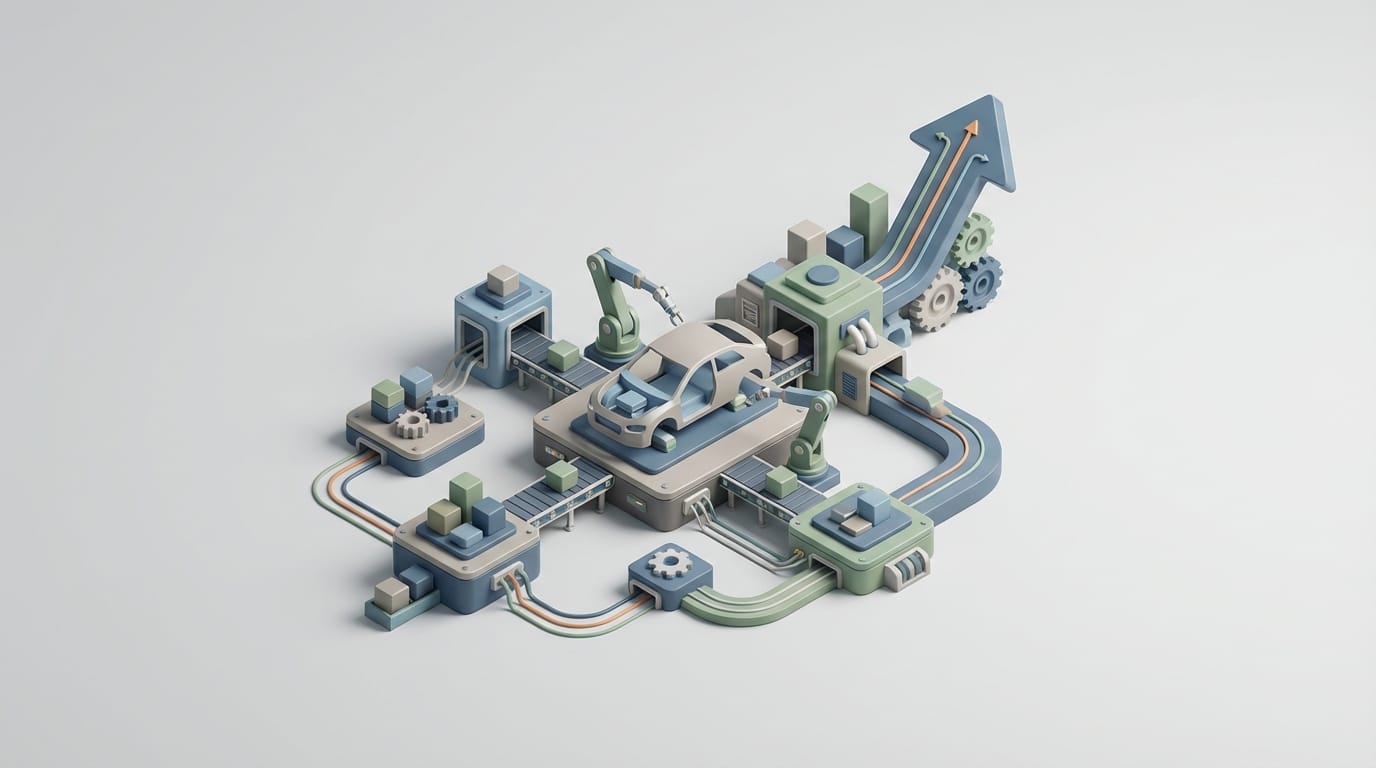
For automotive executives and industrial investors, successful automotive manufacturing capacity expansion requires a fundamental distinction between a physical building footprint and actual production capability. Confusing these two variables often leads to billions in stranded assets and inefficient capital allocation during market shifts. Modern industry has moved beyond the “bricks and mortar” era, focusing instead on the fluid synchronization of tooling, labor, and software.
The transition from internal combustion engines to electric vehicles has fundamentally altered the geometry of the factory floor. While the raw square footage of a plant may remain constant, the systems contained within must now support higher levels of modularity and rapid reconfiguration. This shift is not merely about adding more robots; it is about architectural flexibility in how those robots work across shifting product life cycles.
Understanding the mechanics of expansion begins with a systemic view of the assembly line. Every plant exists as a series of interconnected bottlenecks where the ultimate output follows the constraints of the slowest station rather than the fastest one. To scale effectively, a firm must manage the tension between theoretical maximums and the friction of daily operations.
How Automotive Manufacturing Capacity Functions as a System
Defining Theoretical versus Effective Throughput
Every facility has a “nameplate capacity,” which represents the maximum number of units the plant can produce under ideal conditions. This figure assumes a three-shift, 24/7 schedule. Managers typically see effective throughput drop 15% to 20% below this nameplate figure. This gap comes from scheduled maintenance, model changeovers, and the natural variability of human-machine interaction.
Systemic constraints often hide in specific segments of the assembly process. While a body shop might have the capacity to weld 60 frames per hour, a paint shop with a slower drying cycle or limited booth space acts as a hard ceiling for the entire facility. Identifying these bottleneck anchors is the first step in any expansion strategy. It determines whether the solution requires a new wing of the building or simply a more efficient thermal management system in the curing oven.
The Role of Overall Equipment Effectiveness in Scaling
Overall Equipment Effectiveness (OEE) serves as the primary metric for measuring how well a manufacturing system works. It combines availability, performance, and quality into a single percentage. When considering automotive manufacturing capacity expansion, an OEM must first exhaust the potential of its current OEE. Scaling a plant with an OEE of 65% simply multiplies inefficiency. A more sustainable path involves reaching 85% through predictive maintenance and AI-driven workplace automation.
As equipment ages, its performance inevitably drifts from the baseline. Systems that were once optimized for a specific high-volume sedan may struggle with the heavier payloads and different center-of-gravity requirements of modern SUVs or battery packs. Scaling capacity in this context often involves “brownfield” reinvestment, where managers upgrade specific high-friction nodes within an existing facility to restore the original velocity of the system.
Triggers for Automotive Manufacturing Capacity Expansion
Identifying Long-Term Demand Shifts Over Cyclic Fluctuation
The most difficult decision in automotive manufacturing is distinguishing between a temporary sales spike and a structural shift in market demand. Building a new assembly plant is a multi-billion dollar commitment with a lead time of three to five years. If a firm expands based on a cyclical peak, they risk entering the market just as demand cools. This leads to the high fixed costs of an underutilized facility. Such sensitivity drives cyclical technology investments where capital flows toward flexible platforms rather than static sites.
The move toward electric vehicles represents a structural shift that justifies physical expansion only when the legacy footprint cannot adapt. Electric vehicle manufacturing requires different safety protocols for high-voltage battery assembly and different logistics for heavy component staging. When the cost of retrofitting an internal combustion plant exceeds 60% of the cost of a new “greenfield” site, the strategic math usually tips toward physical expansion.
Strategic Relocation for Tax Incentives and Labor Pools
Expansion is rarely just about volume; it is frequently about geography. OEMs look for regions where state-level incentives offset the massive initial capital expenditure of new assembly lines. Furthermore, the proximity to a specialized labor pool skilled in mechatronics and software integration is now more valuable than traditional low-cost manual labor. Relocation allows a firm to reset its cost structure while simultaneously expanding its total capacity to meet regional trade requirements.
Solving the Global Manufacturing Capacity Paradox
Reclaiming Unused Capacity in North American Facilities
The “Capacity Paradox” describes a scenario where the industry builds new mega-factories while millions of units of existing capacity sit dormant. Recent data shows the North American auto industry has the capacity to build millions more vehicles than it currently produces. According to reports from the United Auto Workers, this unused capacity represents a massive opportunity for brownfield optimization over expensive new construction.
Reclaiming this capacity requires a shift in how legacy plants are viewed. Instead of considering them sunk costs tied to older models, they can be repurposed through modular tooling. Filling this unused capacity could potentially add thousands of manufacturing jobs without the environmental impact of breaking new ground on a greenfield site.
Mitigating Low Utilization Rates in Rapidly Expanding Markets
In high-growth regions like China, the paradox takes a different form. While the market continues to expand at scale, the capacity utilization rate for the manufacture of automobiles often stays below 80 percent, according to official government statistics. This indicates that while the top manufacturers run at full speed, many other facilities operate at inefficient levels.
Addressing this utilization ceiling requires flexible manufacturing. By designing lines that can switch between different vehicle classes, such as a compact car and a mid-sized SUV on the same shift, OEMs can smooth out the volatility of specific model demands. This flexibility ensures that the plant remains profitable even if one specific model underperforms in the market.
Technical Implementation of Flexible Manufacturing Lines
Designing Modular Platforms for Multi-Vehicle Production
The technical core of modern automotive manufacturing capacity expansion is the modular platform. In this architecture, the vehicle is designed around a common chassis that shares hard-points for suspension, powertrain, and cooling. This allows the factory to use the same robotic grippers and welding paths for multiple vehicle types, which reduces the time needed for model changeovers.
Flexible robotic systems now offer significantly lower entry costs and shorter payback periods compared to traditional fixed automation. Today’s market includes lightweight collaborative robots (cobots) that are far more affordable than heavy-duty robotic cells. Recent analysis on shifts in assembly line logic suggests that modular robots can now be reconfigured for new tasks for a fraction of the cost required for traditional line resets. The breakthrough is in the software, which allows robots to learn new paths without physical hardware changes.
Integrating Software-Defined Production and Real-Time Scaling
As vehicles become more complex, the factory itself must become software-defined. This involves decoupling manufacturing logic from the physical hardware. In a software-defined plant, a central digital twin orchestrates the movement of Autonomous Mobile Robots (AMRs) that transport parts to workstations based on real-time demand rather than a fixed conveyor belt.
This allows for real-time scaling. If a plant needs to increase production of a high-demand trim level, the software simply re-routes more robots to the relevant stations. This removes the lock-step rigidity of the traditional assembly line, where a delay at one station stops the entire plant. Mobile robots have been shown to increase logistics efficiency by up to 30%, moving more deliveries per hour in optimized environments.
Managing Supply Chain Synchronization During Expansion
Aligning Tier 1 Supplier Capacity with OEM Growth
An assembly plant expansion is effectively useless if the upstream supply chain cannot match its pace. If an OEM increases its line speed, every supplier (from seat manufacturers to semiconductor providers) must achieve a proportional increase in their own output. Failure to synchronize this growth leads to “buffer starvation,” where the assembly line stops because a single sensor is missing from the staging area.
Strategists must now prioritize supply chain quality management over pure cost-cutting. Many OEMs now require suppliers to share real-time production data. This digital thread allows the OEM to see potential shortages days before they hit the assembly floor, enabling them to adjust the production mix to avoid a total plant shutdown.
Logistical Challenges of Increased Outbound Vehicle Volume
The final mechanical hurdle in capacity expansion is the physical removal of finished vehicles from the site. A plant that doubles its output also doubles its requirements for outbound logistics, including rail cars and trucks. Many expansion projects fail not in the welding shop, but in the parking lot. A lack of transport infrastructure creates a finished goods bottleneck that can halt production just as quickly as a parts shortage.
Expanding outbound capacity often involves infrastructure investments. This might mean extending rail spurs directly into the plant or using automated storage and retrieval systems that maximize the density of staging lots. Without this last mile coordination, the gains made in manufacturing velocity are simply converted into inventory holding costs.
“The most efficient expansion is the one you never have to build. By optimizing what you have and making the remainder flexible, you trade rigid capital for adaptive intelligence.”
The mechanics of automotive manufacturing capacity expansion have shifted from a game of scale to a game of precision. While the physical footprint of the world’s automotive plants may look similar to those of the previous decade, the underlying systems are undergoing a transformation toward modularity and high-utilization reclamation. The paradox of unused capacity alongside massive new investments will eventually be resolved by those who master flexible lines and software-defined logistics. Ultimately, the goal is a manufacturing system that views every factory not as a fixed asset, but as a programmable environment capable of evolving alongside the market it serves. The industry must now move fast enough to reclaim the billions currently sitting idle in legacy plants before the next market cycle begins.