The Biomechanical Reality of the Moving Belt
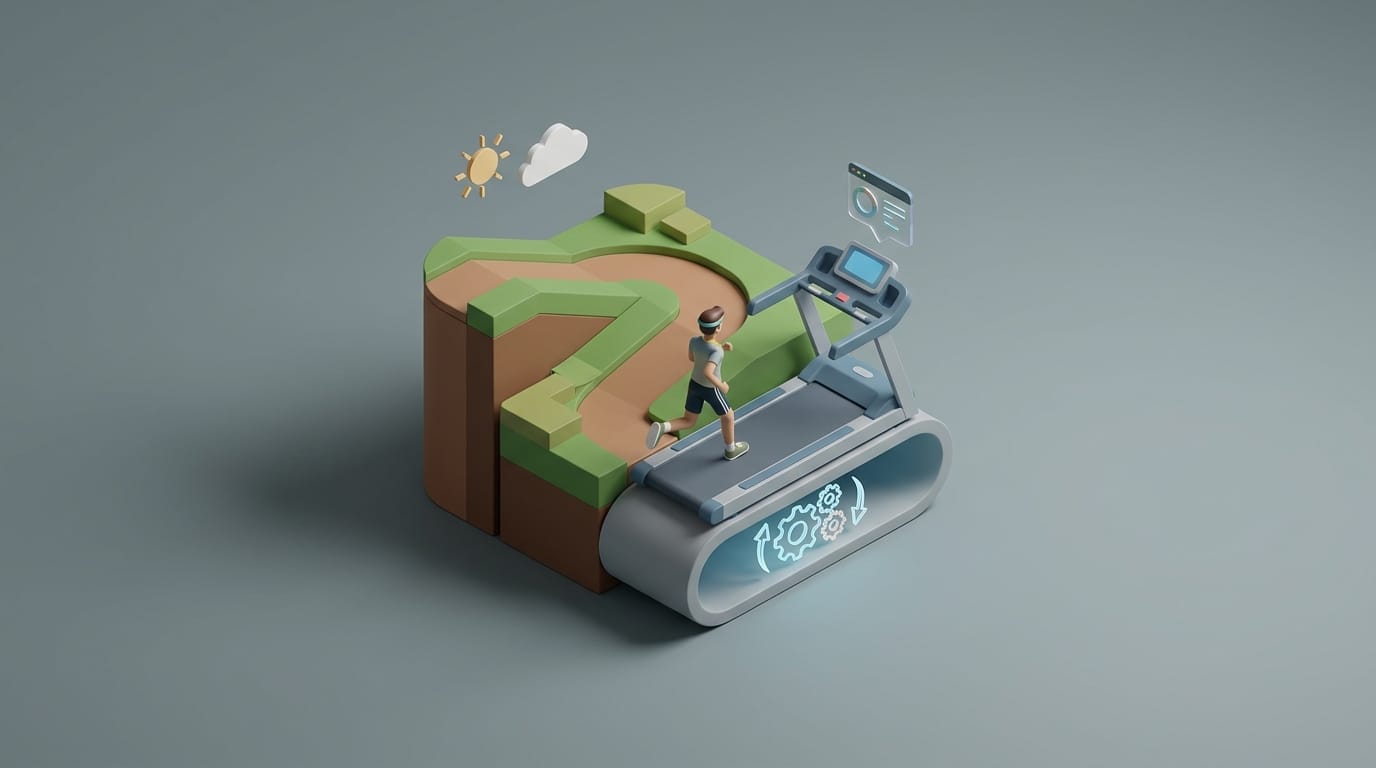
When seasoned marathoners step onto a treadmill, they often find that a pace which feels effortless on the road becomes a struggle against the belt. This discrepancy occurs because treadmill running for outdoor runners involves subtle but significant shifts in movement, cooling, and how the brain perceives effort. While many athletes dismiss the machine as an easier alternative, the reality is that it introduces physical stresses that the open road does not. Understanding why the indoor experience feels more taxing requires looking past the screen and into the physics of the system. For an outdoor runner, the world is a variable terrain that requires active movement and provides natural cooling. On a treadmill, the floor moves while the air stays still, and the body must adapt to a mechanical rhythm that often conflicts with its natural state.
The most basic shift in treadmill running is the change in how your feet interact with the ground. When you run outdoors, you must push off a solid surface to move your body forward. On a treadmill, your primary goal is to stay in the center as the motor pulls the ground beneath you. This change alters how you use your muscles, specifically the hamstrings and glutes, which do not have to provide as much force to move you through space. This reduction in power from the back of the leg often means the quadriceps do more of the work. Because the belt pulls the leg back, many runners experience a passive leg turnover that disrupts their natural rhythm and forces a stride length that might not match their fatigue levels.
Furthermore, the machine forces a rigid, unchanging pace that offers no room for error. On the road, a runner might adjust their speed by tiny amounts every few meters based on small hills or tired muscles. The treadmill removes this feedback loop and locks you into a steady cadence that can lead to early exhaustion. This mechanical rigidity is one reason why warming up properly for indoor workouts is so critical; your nervous system must be ready to handle a fixed rhythm that does not allow for the natural drift of an outdoor stride.
The Physiological Cost of Indoor Environments
The primary reason for higher heart rates indoors is not usually the work of the muscles, but the failure of the body to cool itself. When you run outside, even on a calm day, you create your own breeze. This moving air pulls heat from your skin as you travel through space. Indoors, the air is stagnant, and without a strong fan, your body quickly builds a heat envelope that causes your core temperature to rise. Heart rates can be significantly higher on a treadmill at the same pace compared to outdoor running, according to studies on how heat affects the body. This happens because the heart must pump more blood to the skin to try to cool you down, which leaves less oxygen for the muscles. This feels like a major increase in effort, even though the belt speed stays the same.
There is also a sensory mismatch that happens when your eyes see a static room but your inner ear feels intense movement. This lack of visual flow removes the natural distraction that makes outdoor miles feel shorter. Without changing scenery or landmarks, the brain focuses more on internal signals of fatigue, which makes a standard mile feel much harder. This mental weight adds to the physical strain, making the treadmill a test of both the lungs and the mind.
The Hidden Danger of Mechanical Sterility
While the treadmill surface is softer than asphalt, it is also perfectly flat. This leads to a lack of variety in how you move. When running on a road or trail, every footstep is slightly different. You might land on a small slope, step over a crack, or turn a gentle corner. These small changes move the physical load across different parts of your muscles and tendons, which prevents any single spot from taking too much pressure. On a treadmill, the belt is flat and the movement stays the same for thousands of steps. This creates a high concentration of stress on very specific areas.
If your foot strikes the belt the exact same way every time, the same tiny area of your Achilles tendon or shin bone absorbs the full load of the run. This repetition is a major cause of injuries for people who only use treadmills. To fight this, experienced runners should rotate their shoes. By switching between different pairs of shoes with different cushion levels, you force your foot to hit the belt at slightly different angles. This shifts the load to different tissues and mimics the natural variety of the road. This strategy is an essential part of balancing training and recovery to ensure that indoor training does not lead to injury.
Technical Adjustments for Treadmill Running for Outdoor Runners
To make indoor training feel more like the road, many people use the one percent incline rule. This suggests that setting the machine to a slight grade makes up for the lack of wind resistance. However, this rule depends on how fast you are going. At slower speeds, the air does not push against you much, and a higher incline might make the run harder than it needs to be. As you speed up to faster paces, wind resistance becomes a bigger factor, and the small incline becomes a more accurate way to match your outdoor effort. Instead of leaving the machine on one setting, you should try changing the incline by small amounts every few minutes to simulate a real road. These small shifts prevent you from getting locked into a single movement and keep your stabilizing muscles working.
Calibration is another factor that most people overlook. Many commercial treadmills are not accurate and can be off by a large margin. If your heart rate is very high at what should be an easy pace, the machine might be moving faster than the screen says it is. Whenever possible, rely on how you feel or your heart rate zones rather than the number on the console. By listening to your body instead of the machine, you can ensure you are training at the right intensity for your goals.
Developing Mental Resilience for the Mill
Managing the mental fatigue of the treadmill requires a shift in how you track your progress. Outdoor runners are used to counting miles, but on a machine, those miles can feel very slow. Shifting your focus from distance to time can take away some of the pressure. A hour-long run provides the same aerobic benefit regardless of whether the screen says you covered six miles or seven. You can also use data to make the session more interesting. Using heart rate as your main guide allows you to treat the run as a checkup for your body rather than a race. If your heart rate stays in the right zone, the workout is a success, even if the pace feels slower than your best times on the road.
This mindset helps maintain the science of athletic recovery by preventing you from overtraining just to hit a specific number. Finally, remember that moving back to the road requires time to adjust. Running only on a treadmill can leave the muscles that stabilize your hips and ankles weak. When you go back outside after a long time indoors, keep your first few runs short to wake up the muscles that the treadmill belt bypassed. The treadmill is not a perfect substitute for the road; it is a different tool with its own rules. By using fans for airflow, rotating your shoes for variety, and monitoring your heart rate, you can turn the treadmill into a useful part of your routine. Treadmill running for outdoor runners only feels harder because you are working against the constraints of the machine, but once you adjust your approach, the frustration begins to fade. Does your current indoor setup allow for the variety needed to protect your joints, or are you hitting the same spots mile after mile? A simple fan or a different pair of shoes might be the best fix for your training this season.