
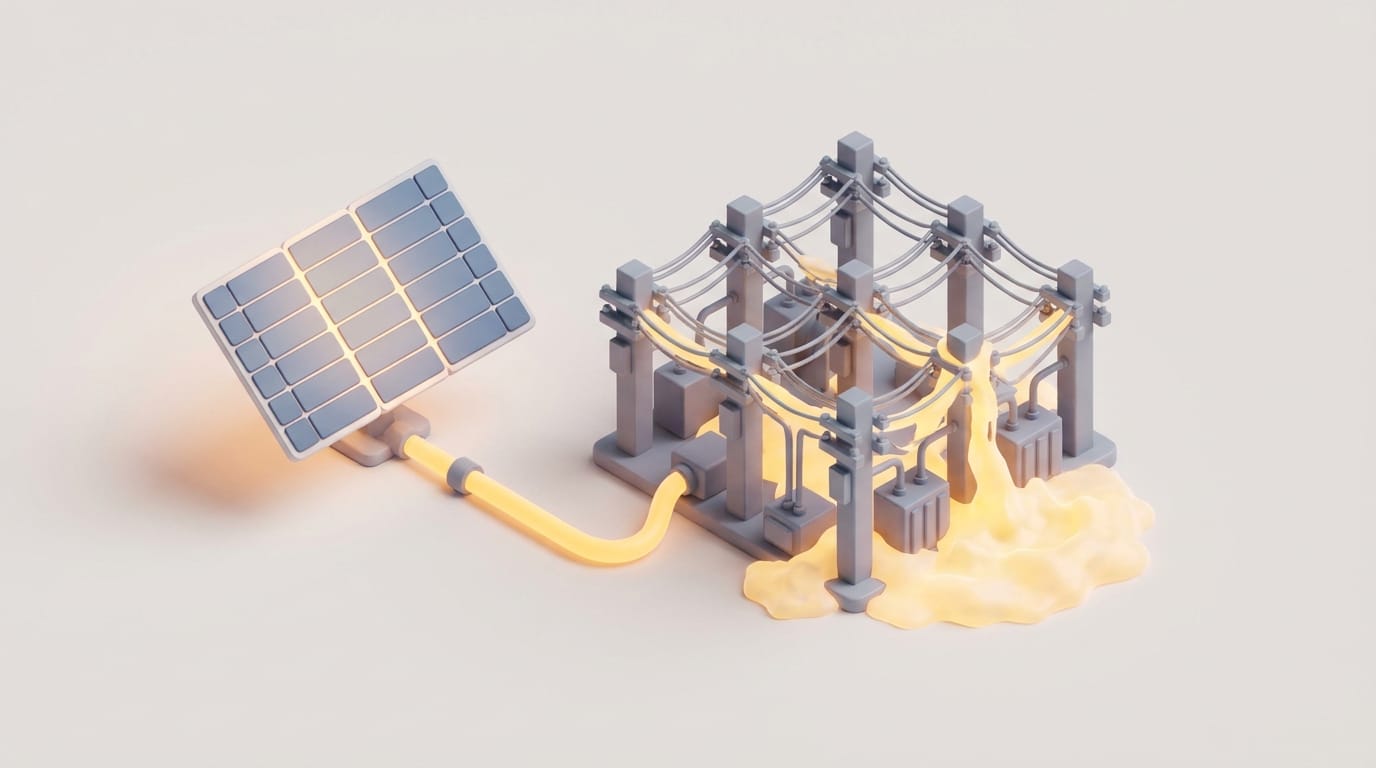
Energy transitions traditionally focused on the scarcity of renewable resources, but the rapid growth of photovoltaics has introduced the solar surplus paradox, a volatile new reality where an abundance of power can be just as destabilizing to the grid as a shortage. This happens when midday solar generation exceeds both immediate demand and the network’s ability to store or move it. This surplus threatens the physical and economic integrity of the entire energy system.
Grid operators now manage the sudden weight of this energy. When the sun hits its peak, the flood of electrons can saturate transmission lines and force prices into negative territory, yet this abundance masks a growing structural fragility. As we retire traditional power plants to make room for renewables, we lose the invisible physical properties that have kept the lights on for a century. Understanding this paradox requires looking past the simple math of megawatt-hours and into the physics of how a power grid maintains its balance. This represents a shift from a system governed by the heavy momentum of spinning steel to one governed by the rapid pulse of silicon and software. In this environment, stability is no longer a natural result of generation; it is a service that engineers must build from the ground up.
The Structural Roots of the Solar Surplus Paradox
The issue stems from timing and geography. Photovoltaic (PV) systems generate the bulk of their power during a narrow window in the middle of the day, often peaking when commercial and residential demand has not yet reached its evening surge. This results in a widening gap where generation potential far outstrips the load, which is the actual work being done by appliances, factories, and cooling systems on the grid.
The Widening Gap Between Peak Generation and Load
Regions with high solar penetration face critical levels of mismatch. During the spring months, when temperatures are mild and air conditioning demand is low, solar arrays can easily produce more energy than the system can safely absorb. The California Independent System Operator (CAISO) recently curtailed 3.4 million megawatt-hours of utility-scale solar and wind, representing a 29% increase in wasted energy compared to previous periods, according to data from the U.S. Energy Information Administration. This oversupply forces operators to find a way to move the energy elsewhere or simply turn the panels off.
Why Modern Grids Resort to Forced Curtailment
Curtailment acts as the grid’s emergency brake by intentionally reducing output from a renewable source. When transmission lines reach their thermal limits, adding more power can lead to equipment damage or fires. Because current infrastructure was designed for a one-way flow of power from centralized plants to the edges, it often lacks the capacity to handle localized surges from massive solar farms. Furthermore, the solar surplus paradox manifests in the market through negative pricing. When there is too much power, producers pay the grid to take their electricity to avoid physical damage from oversupply, yet these market signals do little to solve the underlying technical volatility.
The Mechanical Inertia Crisis in Non-Rotating Energy Systems
Economic waste is only part of the problem. A deeper physical threat exists: the loss of mechanical inertia. Traditional power plants, whether coal, gas, or nuclear, use massive, spinning turbines and generators to produce electricity. These turbines weigh hundreds of tons and spin at high speeds, providing enormous physical momentum. This momentum acts as a shock absorber for the grid. If a large load suddenly turns on or a plant fails, the physical weight of these spinning machines keeps the system frequency stable for a few critical seconds while other assets ramp up.
The Solar Surplus Paradox and the Loss of Physical Momentum
Solar panels and wind turbines use inverters and do not have this physical rotating mass. They are solid-state devices that convert energy through power electronics rather than electromagnetism driven by momentum. As solar displaces traditional thermal plants, the total inertia of the grid drops. This makes the grid physically fragile. Without that mechanical buffer, even a minor disruption can cause the system frequency to drop or spike with violent speed. Even when energy is at its most abundant, the grid is at its most vulnerable.
The Physics of Grid Resilience and Frequency Regulation
Engineers measure this vulnerability through the Rate of Change of Frequency (RoCoF). In a high-inertia system, frequency might drop slowly, giving operators seconds to react. In a low-inertia, solar-heavy system, the change can be nearly instantaneous. Research from Fraunhofer and other leading institutes suggests that as inertia drops, RoCoF values can jump significantly during a disturbance, pushing the system toward the edge of its safety limits within 500 milliseconds. This rapid transition is a primary reason how the energy trilemma drives structural power volatility as we move away from traditional spinning assets.
Operational Hazards of the Duck Curve Phenomenon
The Duck Curve illustrates the paradox. As solar floods the grid during the day, the net load drops into a deep belly. However, as the sun sets, that solar power disappears exactly when residential demand peaks. This creates a neck, which is a steep ramp where the grid must find massive amounts of new power almost instantly to replace the solar that has rolled off the system.
Steep Ramping Requirements for Non-Solar Assets
This ramping requirement places immense stress on the remaining conventional plants. Natural gas plants must fire up and reach full capacity in minutes. This daily cycling is far more demanding than the steady operations these plants were designed for. It increases maintenance costs and can increase the carbon footprint of the grid. Because these plants often run at inefficient partial loads just to be ready for the evening surge, their emissions per megawatt-hour are higher than they would be if they were running steadily.
Financial Implications for Utilities
Utilities must balance these intermittent assets with fixed-cost infrastructure, which creates a financial tightrope. They maintain a full fleet of backup plants that only run for a few hours a day, while the solar surplus paradox ensures that the power they sell during the day is worth almost nothing. This mismatch between physical needs and market value is a primary driver of rising utility rates, even as the cost of solar panels continues to drop.
Technological Mitigations for Renewable Overcapacity
Solving the surplus problem requires a shift from short-term lithium-ion batteries to seasonal and structural solutions. We need to soak up the midday surplus and move it across both time and space. While long-duration energy storage technologies like iron-air batteries and pumped hydro are being deployed, they are only part of the solution.
Grid-Forming Inverters and Synthetic Inertia
To address the inertia crisis, the industry is turning to grid-forming inverters. Unlike standard grid-following inverters, which simply pump power into the grid, grid-forming inverters can simulate the behavior of a spinning turbine. By using digital controls and a small amount of stored energy, they provide synthetic inertia. This allows them to instantly inject power to stabilize frequency before a drop becomes critical. This software-defined resilience allows a solar-saturated grid to maintain the physical stability traditionally provided by coal and gas.
Demand-Side Response and Green Hydrogen
Mitigating the surplus also involves changing how we consume power. Smart-grid technology can trigger electric vehicle charging and industrial processes to activate specifically when solar output is at its peak. Furthermore, excess solar is increasingly used for electrolysis to produce green hydrogen. This hydrogen can be stored for months and burned in modified gas turbines during the winter, effectively turning the summer surplus into winter heat. Integrating strategies for automotive industry electrification will be essential for creating a demand sink large enough to handle utility-scale surpluses.
Regulatory and Market Re-engineering for Future Stability
The technical solutions exist, but market structures designed for the previous century often hinder them. Moving beyond Net Metering, where customers are paid the same for solar regardless of when they generate it, is a necessary step toward grid stability. Regulators are increasingly shifting toward Time-of-Use pricing, which encourages consumers to use electricity at noon when it is abundant and discourages use during the evening ramp.
Finally, we must build high-capacity transmission systems, specifically High-Voltage Direct Current (HVDC) lines. These lines allow us to transport a solar surplus from a sunny desert to a cloudy industrial center thousands of miles away with minimal loss. By interconnecting regional grids, we can smooth out localized volatility and ensure that the solar surplus paradox is resolved through trade rather than curtailment. Redefining reliability metrics to treat inertia as a specific service will ensure that investors who provide stabilization technologies are fairly compensated for the work they do to keep the system whole.
The energy transition is not merely a swap of fuel sources, but a fundamental redesign of the systems that sustain modern life. As we move away from the heavy machines of the past, we must build a grid that is as intelligent as it is abundant. The success of a clean energy future depends not just on how many panels we install, but on how effectively we manage the immense power they provide. We must build a digital nervous system fast enough to replace the physical momentum we are leaving behind.