
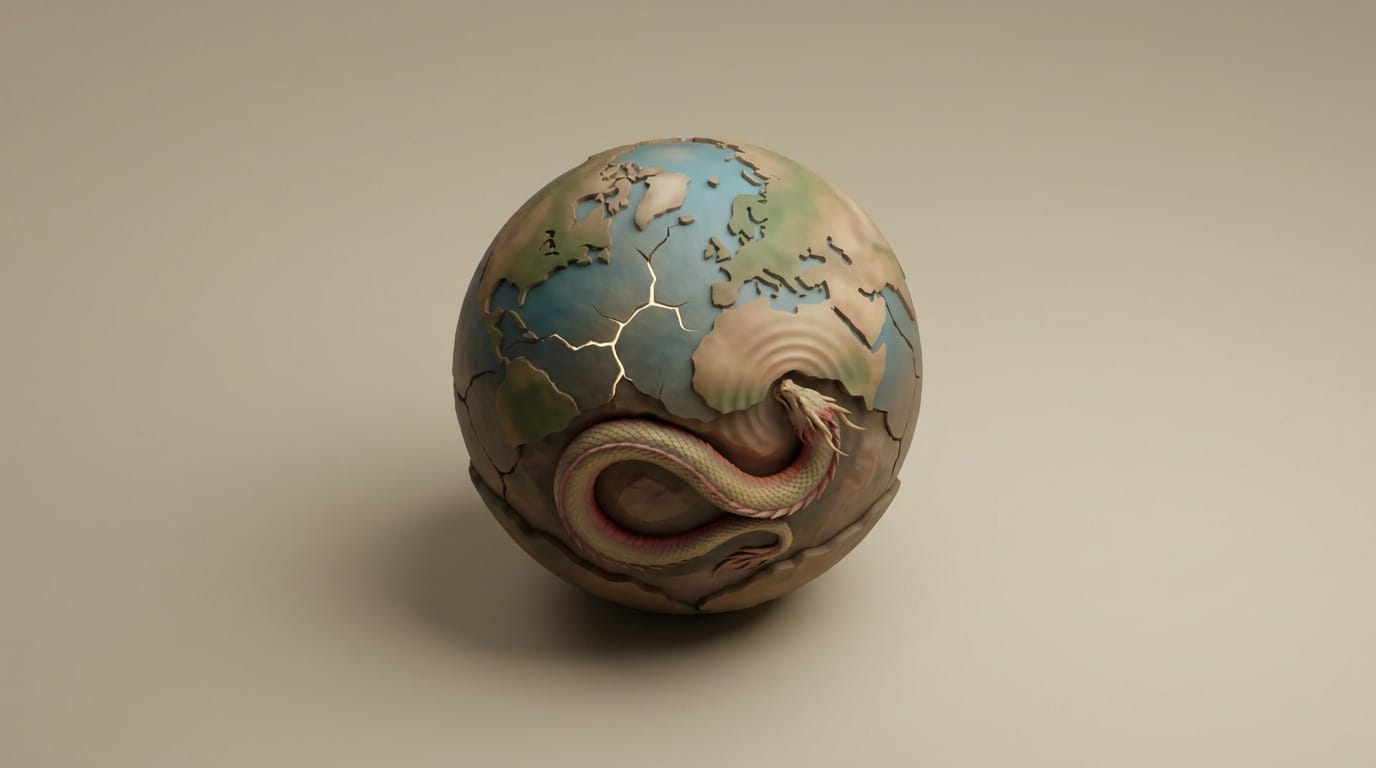
Long before people understood how plates move, they used the language of monsters to map the terrifying and unpredictable shifts of the earth. This ancient tectonic mythology was more than just a collection of tall tales. It served as an early system for recording data for societies living on the world’s most active fault lines. While modern scientists use sensors to track tremors, ancient cultures used stories to describe the physical patterns they saw. By casting the earth as a restless beast or a distracted god, these groups created a way to explain how often quakes happened, where they hit, and what signs appeared before they started.
Understanding these myths is not a way to dismiss old beliefs, but a way to translate early factual data. From the retreat of coastal waters in the Mediterranean to the mud-heavy shakes of Japan, the monsters of the past provide a clear map of how humans first tried to decode the inner workings of the planet.
The Logic Behind Tectonic Mythology
The human brain naturally looks for cause and effect, especially when facing the chaos of a natural disaster. When the ground—the ultimate symbol of stability—suddenly turns to liquid or cracks open, the mind demands an explanation. Ancient societies filled this gap by giving geological events the traits of local animals. They created figures that acted in ways that matched the seismic patterns of their specific region.
Local environments usually dictated which animals represented earthquakes. In Mongolia, people believed a giant hog carried the earth. In India, they spoke of a massive mole or elephant, while parts of South America blamed a whale. These creatures were not chosen by chance; they were animals known for moving underground or having immense weight. Moving from pure chaos to a story allowed communities to shift from terror to a state of readiness where the event felt predictable, even if they could not control it.
These stories often mirror how often local quakes occur. In places where tremors are frequent but small, myths describe a creature that is simply shifting its weight or swatting a fly. In areas where massive quakes happen, the myths become much darker, describing a battle that could end the world. These patterns suggest that mythological idioms were the first tools humans used to visualize complex data.
Poseidon and the Marine Logic of Greek Seismology
In ancient Greece, people knew Poseidon as the “Earth-Shaker” long before they viewed him only as the god of the sea. This double role shows a complex understanding of how land tremors and tsunamis relate to one another. Reports from the National Academies of Sciences suggest that Greek myths likely linked earthquakes to Poseidon because shaking in the Mediterranean is often followed by massive movements of water.
The Earth-Shaker as a Tsunami Warning
The Greeks noticed that before the sea rushes inland during a tsunami, the shoreline often pulls back. By making the sea god the creator of earthquakes, they turned a myth into a survival tip: if the earth shakes, the sea will soon follow. This link made Poseidon a source of early data on events where the movement of the seafloor triggers both the quake and the wave.
The Link Between Coastal Shifts and Seismic Movement
Aristotle later tried to turn this mythology into a natural theory by suggesting that earthquakes were caused by winds trapped in underground caves. However, the cultural memory of Poseidon’s trident striking the earth stayed more effective as a safety warning. It tied the land and water together into a single theory of how the sea and earth interact, a concept that modern plate tectonics eventually confirmed.
Namazu and the Shifting Mud of Japanese Lore
In Japan, the symbol of the earthquake is Namazu, a giant catfish living in the mud beneath the islands. The god Kashima keeps Namazu still by pinning the fish’s head down with a heavy stone called the kaname-ishi. When the god loses focus, the catfish thrashes its tail, causing the islands above to shake.
The Giant Catfish and the Weight of the Foundation Stone
Choosing a catfish shows a deep insight into Japanese geology. Catfish live in silt and mud at the bottom of waterways. During large earthquakes, a process called soil liquefaction happens. This is when wet sediment loses its strength and acts like a liquid. By putting a giant catfish in the underground mud, the myth accurately reflected the physical change of the Japanese soil during a tremor.
Social Change and the Earthquake as a Force of Justice
During the Edo period, the Namazu myth took on a political meaning through woodblock prints. These images often showed the earthquake as a force that punished the wealthy and moved their gold to the poor who were hired to rebuild. This shows an early understanding of how social structures are stressed and changed by natural disasters, just like the physical terrain.
The World Turtle and the Stability of the Americas
Indigenous cultures in North America, such as the Haudenosaunee and Lenape, offer a different way to look at the earth: the World Turtle. In this view, the earth sits on the back of a great turtle. When the turtle moves its flippers or shifts to stay balanced, the people on its shell feel the ground shake.
Indigenous Views on Earth-Bearing Creatures
Unlike the punishment myths found in some other traditions, the World Turtle represents a system of care. The earthquake is not a sign of anger, but a sign of a living system adjusting to stay in balance. This perspective matches many indigenous knowledge systems that focus on ecological balance rather than human sin.
Movement as a Sign of Ecological Duty
In these traditions, keeping the world stable is a shared duty. The turtle supports the earth, but the people living there must act in a way that respects the creature’s burden. This early view mirrors modern ideas about the delicate balance needed to keep a global system stable. It changes how we see an earthquake, moving it from a random act of destruction to a part of the planet’s internal maintenance.
Translating Tectonic Mythology into Modern Data
One of the best examples of mythology acting as hard science is the legend of the Thunderbird and Whale from the Pacific Northwest. For many generations, coastal tribes told stories of a massive struggle between a supernatural bird and a whale. This battle caused the ground to shake so hard that the ocean rose up to swallow whole villages.
Scientists once saw these stories as metaphors. However, researchers at the University of Washington found that these oral histories match geological evidence of a massive earthquake that happened on January 26, 1700. By comparing indigenous stories with “ghost forests”—groups of trees killed by saltwater—scientists pinned down the exact timing and size of a massive prehistoric event.
This field, often called geomythology, proves that historical stories can fill gaps in our scientific records. These myths act as early data, keeping the human experience of events alive long before the invention of the seismograph. When the monsters are removed, what remains is a very accurate log of how the earth behaves when it is most active.
The Value of Tectonic Mythology Today
Understanding the systems we live in requires looking at both the physical world and the stories we tell about it. Tectonic mythology gave early societies a way to survive on a moving planet by giving them a vocabulary for the unthinkable. Today, as we build bigger cities on these same fault lines, these old stories remind us that the earth’s movements are not random. They are the result of a massive, restless system that we are still learning to fully understand.
The fact that these myths have lasted for thousands of years suggests that while our tools for measuring have changed, our need to find meaning in the earth’s movement remains the same. By studying these ancient monsters, we are not just looking at folklore. we are looking at the first draft of planetary science.
How might our current stories about the climate be viewed as mythology by people a thousand years from now? Our modern technical language may not preserve the human experience of disaster as effectively as the story of the Thunderbird and the Whale. Thinking of mythology as a data system changes how we value the wisdom of those who lived on this restless crust long before us.