
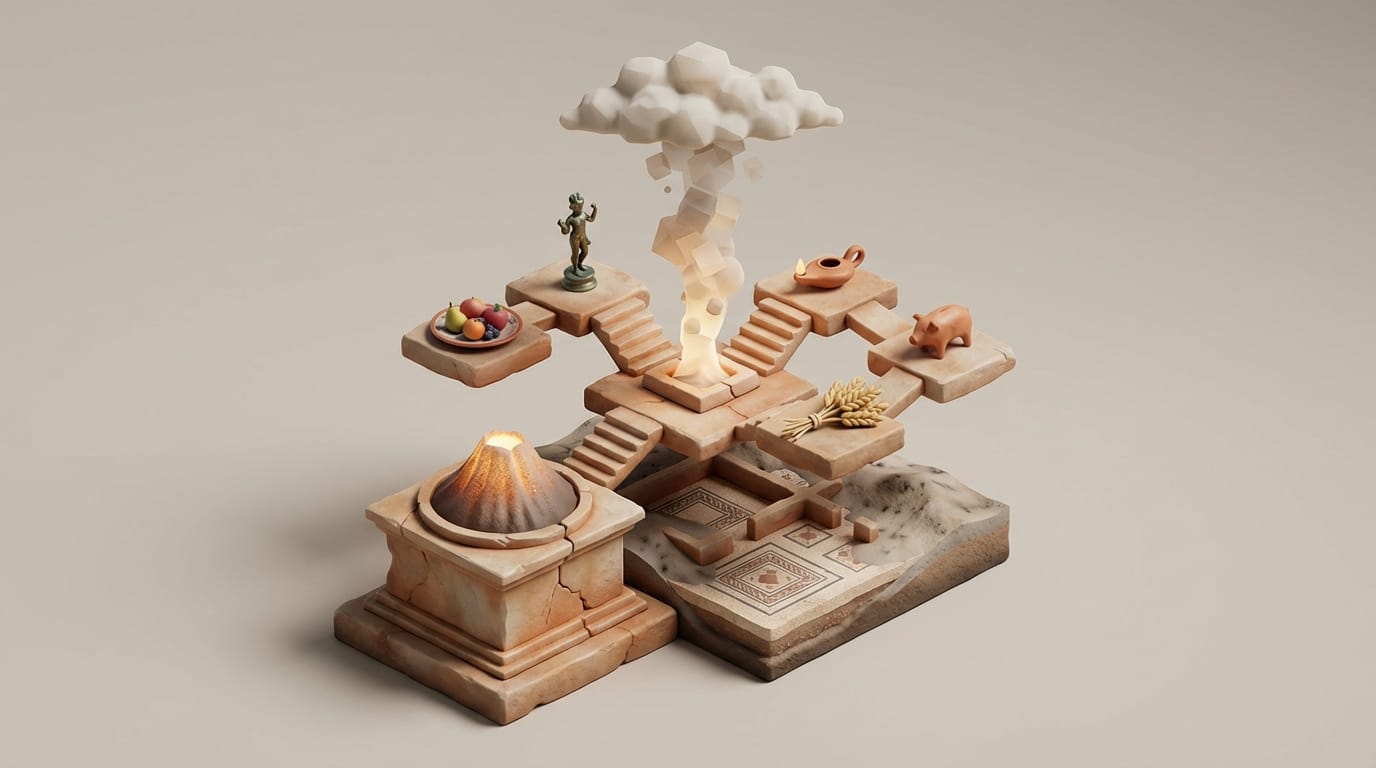
Misinterpreting rituals as simple local superstition obscures the intercontinental supply chains that fueled household prayer. Recent archaeological analysis of Pompeii ritual offerings reveals that these spiritual acts were sustained by a complex, globalized trade network. By examining chemical signatures in charred remains, we see that private Roman devotions were closely linked to far-off regions in Africa and India. Every household functioned as a node in a vast logistics network, where burning resin bridged the gap between a local family and the furthest reaches of the known world.
The Practice of Daily Devotion in Pompeii
In the Roman religious system, the household served as the primary site of spiritual maintenance. While public temples hosted state ceremonies, Pompeii ritual offerings found in private homes focused on the Lares and Penates, which were the protective spirits of the family and its food supply. These rituals took place at a shrine called a lararium. These shrines ranged from simple wall niches in kitchens to painted miniature temples in the formal halls of wealthy villas.
Archaeologists have identified over 500 of these shrines in the city, indicating that private worship was a constant, daily presence. These locations were functional spaces where the family interacted with the divine. The location of an offering often changed its social meaning. A shrine in the kitchen might be tended by workers to ensure the safety of the food, while a shrine in a formal reception room allowed the head of the house to show his wealth to guests. This practice turned the private home into a destination for goods moving across thousands of miles of difficult territory.
The offerings left at these shrines often followed a specific sequence. Common deposits included fruits like figs and grapes, nuts, and cakes made of grain and honey to represent the prosperity of the home. However, the most critical element was the smoke offering. By burning aromatic substances, the worshiper created a physical connection to the gods through scent. This act often began with a preliminary offering intended to gain the attention of the gods. Recent research has confirmed that this involved burning wine and incense together, a practice previously known only through ancient literature. The rising smoke formed a sensory bridge, signaling that the ritual channel was open.
The Globalized Supply Chain for Sacred Goods
While local plants like laurel and oak provided fuel, the sacred element required imported resins. Frankincense and myrrh had to be transported from the southern Arabian Peninsula and the Horn of Africa. This requirement turned a simple morning prayer into a demand for international logistics. The trade routes for these aromatics were among the most lucrative in the world, subject to heavy taxes and the protection of various desert groups.
Finding these resins in modest homes suggests that the global supply chain impact on quality and availability was felt by many citizens. For a resident to burn frankincense, a caravan had to cross the Arabian desert to reach ports in Egypt or the Levant before the goods were shipped across the sea. This system functioned with surprising efficiency, ensuring that a steady supply of African aromatics reached the local market.
The Role of Indian Pepper in Pompeii Ritual Offerings
Beyond resins, Roman rituals frequently integrated spices native to South Asia. Indian pepper was part of the same trade network that supplied the gods. Evidence of this reach is found in artifacts like ivory statues from the East discovered in local houses. These likely arrived on the same ships carrying pepper and elemi resin. Elemi resin, derived from tropical trees, has been found in Pompeii ritual offerings alongside more traditional frankincense. Because these trees grow in the tropical regions of Africa and Asia, their presence indicates that the spiritual market used additions from the furthest corners of the world.
This demand for the exotic drove trade to its limits, with over 100 ships sailing annually from Egypt to India during the peak of the empire, according to records of the ancient incense trade. When these trade routes faltered, it did more than affect the dining room. It interrupted the daily spiritual protection of the family, echoing the reasons why modern logistics systems fail and create shortages today. When the flow of goods stopped, the connection to the divine felt fragile.
Scientific Methods Used to Study Rituals
Distinguishing between ritual offerings and kitchen waste is a difficult task for scientists. To solve this, researchers use the study of phytoliths, which are microscopic silica structures that form inside plant tissues. These structures survive the intense heat of volcanic eruptions and the fires of the ritual. This allows experts to identify specific species of grasses, shrubs, and trees offered to the gods. By examining soil layers within a burner, archaeologists can reconstruct the exact sequence of a ritual. A layer of oak charcoal might sit at the bottom as fuel, followed by laurel leaves for scent, and topped with the charred remnants of a fig.
The most significant discoveries have come from chemical residue analysis. This technique allows scientists to identify the specific fingerprints of rare oils and resins that soaked into the clay of incense burners. It was through this method that researchers identified elemi resin in a burner from a local villa, as detailed in a study published in the journal Antiquity. This analysis provides a level of precision that visual inspection cannot match, revealing the invisible molecular traces of a global market that existed two millennia ago.
Social Status and the Labor of Faith
While the basic structure of the ritual was common across social classes, the rarity of the offering indicated status. In elite villas, the use of pure frankincense from South Arabia signaled that the owner had the money to access the highest tier of the global market. In contrast, lower-income households might have used regional substitutes or resins mixed with local sawdust. The ability to use expensive imported goods was a form of display, where destroying these items by fire proved the economic power of the house.
The system of Pompeii ritual offerings also relied on a hidden layer of labor. In a wealthy home, the maintenance of the shrines was often the responsibility of enslaved people. This labor included cleaning the shrine, keeping the fire lit, and preparing the offerings for the head of the house to present. This created a social paradox where the most sacred protection of the family was maintained by people the family owned as property.
This labor was essential because many rituals were time-sensitive. Just as the evolution of calendars redefined the world by organizing human activity, the Roman religious calendar required specific offerings on certain days of every month. The pressure of meeting these deadlines meant that the sacred was as much a matter of domestic management as it was of faith.
Faith and Economic Resilience
Ritual frequency often functioned as a response to instability. Following a massive earthquake that damaged much of the city, there was a surge in the rebuilding of shrines. This suggests that the inhabitants used their ritual systems as a psychological shock absorber. When the physical world became unpredictable, the investment in globalized ritual offerings provided a sense of order. Connecting the home to the distant world helped residents feel secure.
Even as new religions from Egypt and the East gained popularity, traditional offerings remained the bedrock of daily life. This persistence shows the strength of the domestic cult. It was a system that could absorb new foreign ingredients and new gods without losing its core function. The growth of trade routes did not weaken local faith. Instead, it provided a more expansive variety of scent and substance with which to practice it.
The ritual offerings of the city were never just local traditions. They were the final delivery point for a sophisticated, intercontinental system of trade and devotion. By looking at the microscopic remains of resin and wine, we see a world where a modest home in a provincial town was an active participant in a trade network spanning from the Atlantic to the Indian Ocean. This system reminds us that the sacred has always driven human infrastructure. It forced people to build roads and ships to bring the distant world into their most private spaces. As we look at these ancient ashes, we see how global systems satisfy the deeply held human needs for security and connection.