
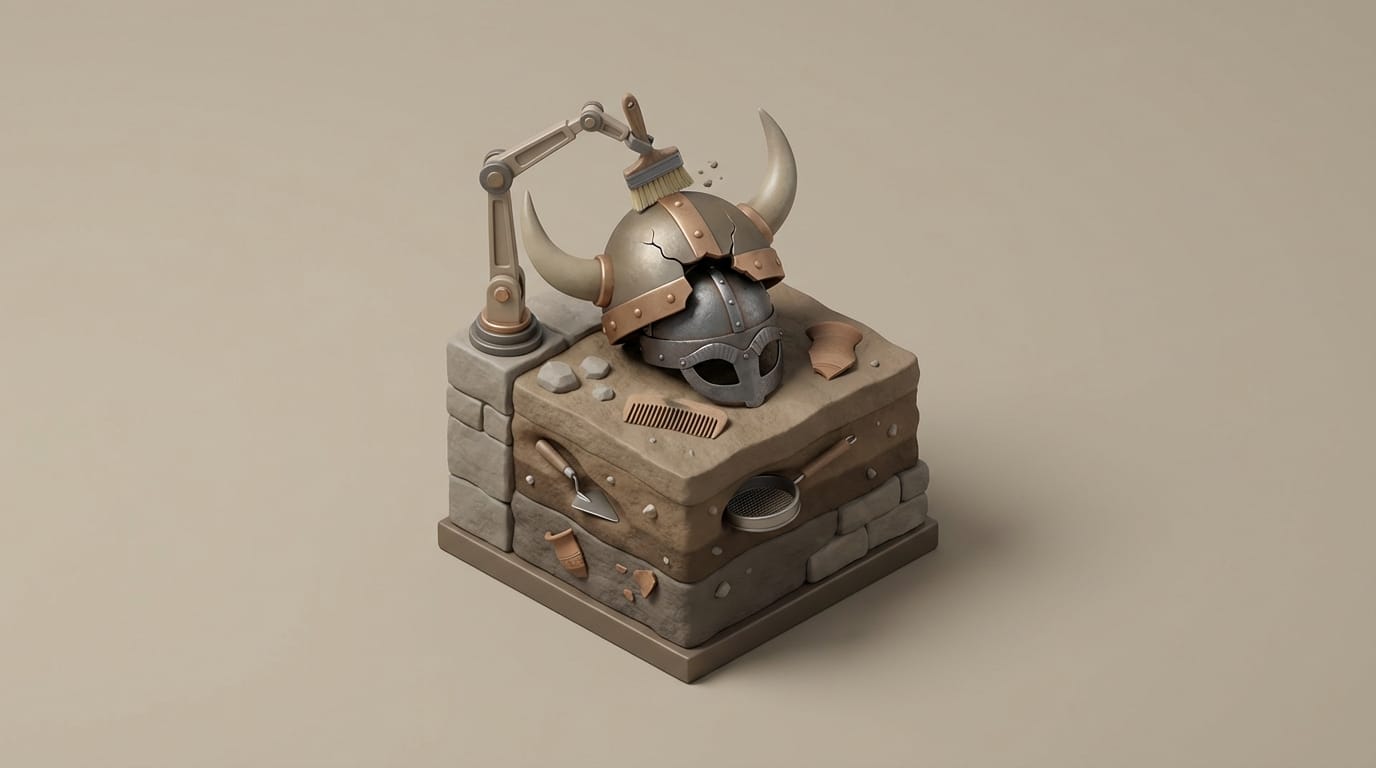
While pop culture portrays Vikings as horned marauders, archaeology tells a different story. No excavation has ever unearthed a horned helmet belonging to a Norse warrior. This persistent viking horned helmet myth stems from a misunderstanding of history that confuses ritual objects with battle gear. To understand why this image dominates our screens, we must look at medieval warfare and 19th-century theater designers who rewrote history for the stage.
When we examine historical records, the gap between fiction and reality is clear. For a Viking, a helmet was an expensive tool designed for one purpose: survival in a shield wall. Adding horns would have been costly and dangerous. By looking at the engineering of Norse headgear, we can see how artists rebranded an entire era centuries later.
The Roots of the Viking Horned Helmet Myth
Archaeologists notice that Viking helmets are surprisingly rare. Even after digging up thousands of Norse graves across Europe, researchers found only a few metal helmets. This suggests that average warriors used sturdy leather caps while iron helmets remained luxury items for the elite. When blacksmiths used iron, they never added decorative horns.
The Gjermundbu Helmet Discovery
The Gjermundbu helmet serves as the best proof against the horned look. Found in 1943 on a farm in Norway, this 10th-century object remains the only complete Viking Age helmet ever discovered. University of Oslo researchers note that staff rebuilt the helmet using nine iron fragments. It represents the peak of Norse protection technology.
The helmet uses a functional design with a rounded dome made of four iron plates. It also features a unique “spectacle” guard to protect the eyes and nose. The surface has no holes or brackets for horns because it was built to deflect blows from axes and swords. In the tight space of a raid, a smooth surface kept the wearer safe.
Common Materials in Viking Protection
Because iron was hard to produce, many warriors relied on hardened leather. Leather decays quickly, but National Museum of Denmark records show warriors in simple caps. These often had an iron nasal guard or internal bands to keep the shape without adding too much weight. This practical approach helped warriors stay mobile during long voyages.
A Mistake in Timing
The viking horned helmet myth comes from a case of timing confusion. Researchers have found horned helmets in Scandinavia, but they belong to a culture that disappeared a thousand years before the first Viking ships sailed. This error resembles how ancient solar myths confused later cultures who lacked the tools to measure the world around them.
The Viksø Helmets and the Bronze Age
In 1942, workers in a Danish bog found two bronze helmets with long, curving horns and stylized eyes. Tests on the birch tar found on the horns confirmed the objects date to about 800 BC. This places them in the Nordic Bronze Age, long before the Viking Age began. These were ritual objects used in religious ceremonies and were likely never intended for the battlefield.
The society that made the Viksø helmets differed greatly from the Iron Age Norse. They lived in a world of complex bronze casting and sun worship. By the 8th century, these helmets were already ancient relics. The myth grew because 19th-century scholars wanted a fierce look for the Norse and pulled these older objects out of context.
Why Horns Fail in Combat
From an engineering perspective, a horned helmet is a failure. In a fight, a helmet must absorb impact and redirect force. A smooth, rounded surface ensures that a blade slides off rather than cutting through the metal. Horns do the opposite by acting as hooks.
The Physics of Redirection
A sword hitting a rounded helmet will slide away and lose power. If a blade hits a horn, it catches and transfers the full force to the wearer’s neck. Instead of protecting the warrior, the horns help the opponent’s weapon find a grip. This makes the viking horned helmet myth not just historically wrong, but physically impossible for a warrior who wants to survive.
Leverage and Injury
Shield walls are crowded spaces where grappling is common. A horn provides a handle for an opponent to grab. By pulling a long horn, an enemy could snap the wearer’s neck or expose their throat. In shipboard combat, where balance is key, such a high center of gravity would be a major weakness. Real warriors avoided these risks to stay alive.
How the Theater Created the Fiction
If history and physics reject the horns, we must look to 19th-century art for their origin. During this time, nations searched for their heritage, often creating legends to fill the gaps. Spotting emotional triggers in media helps us understand why this image became so popular.
Richard Wagner and Opera Costumes
The horned Viking appeared in 1876 for the premiere of Richard Wagner’s opera cycle. Costume designer Carl Emil Doepler wanted a wild look for the characters. He used various ancient sources and decided horns would show a pagan spirit. The opera was a massive success, and the image stuck in the public mind. Once these characters took the stage, artists and filmmakers adopted the design as a standard uniform.
Because people were defining the Viking Age as a field of study at the same time these operas were popular, they mistook theater props for research. This created a loop where pop culture informed history more than the artifacts did. Over time, the costume became the accepted truth.
The Practical Gear of Real Vikings
Real Viking warriors were practical. Their gear was a system of parts built for mobility and sea travel. Status came from the quality of a sword or the detail in a piece of jewelry. This focus on useful technology is a common pattern, much like the carbon filaments in early bulbs that paved the way for modern science.
Standard Combat Equipment
- The Nasal Helmet: This was a simple iron dome with a metal strip over the nose.
- The Shield: Warriors used large wooden circles with an iron center to protect the hand.
- The Mail Shirt: Also called a byrnie, this interlocking ring garment stopped slashing wounds.
- The Axe and Spear: These were the primary tools of the Norse because they offered reach.
The viking horned helmet myth shows the power of storytelling over data. By confusing the bronze of 1000 BC with the iron of 900 AD, we lose the truth of how these people lived. Real Norse history shows a culture of precision and adaptation. Once we remove the theater costumes, we find people who valued function over fashion.