
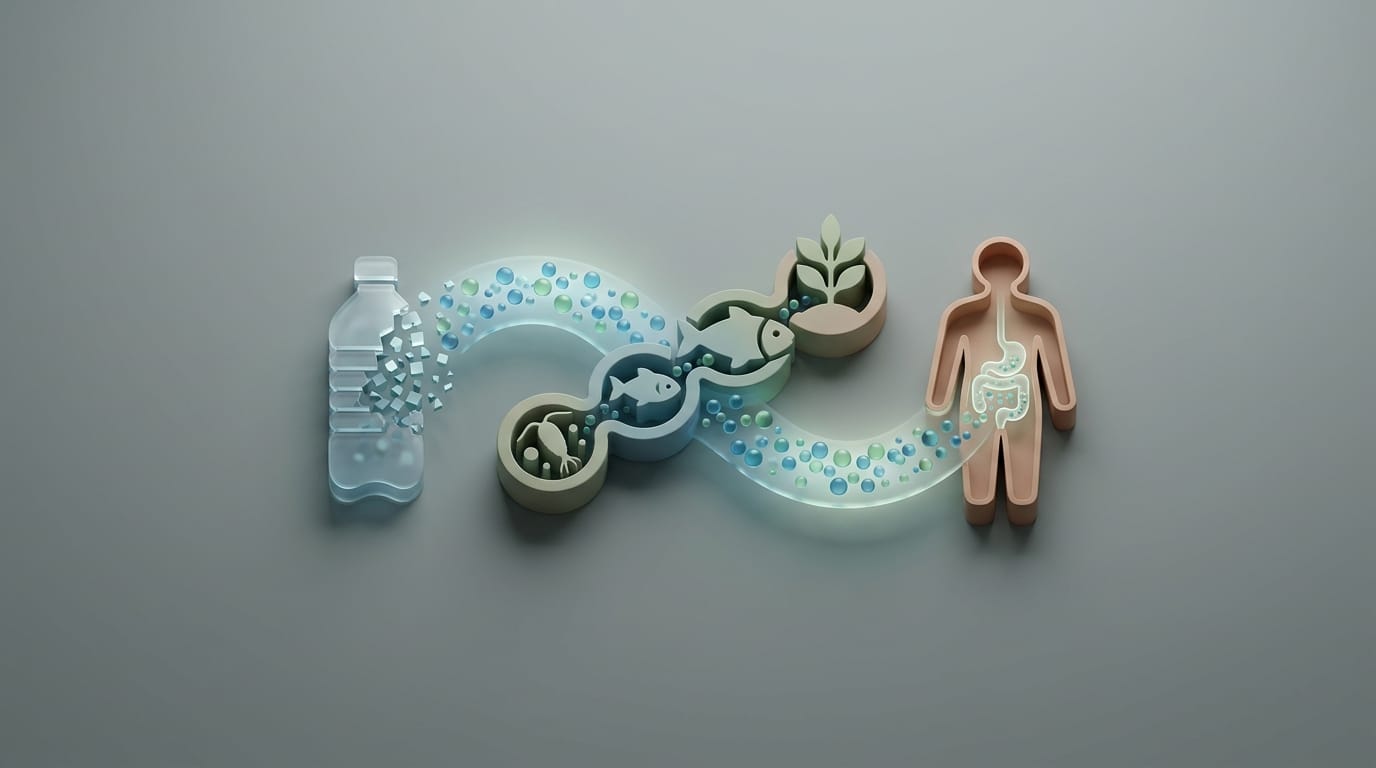
While most people recognize microplastics as an environmental nuisance, their most dangerous trait is the “Trojan Horse” effect. These particles gather heavy metals and pathogens, delivering them directly into human tissues. Understanding the presence of microplastics in the food chain involves more than tracking waste; it requires analyzing how they transport concentrated toxins. When we consume these particles, we take in complex vehicles for pollutants rather than just inert plastic. This shift in toxicology reveals that microplastics act as solid rafts, shielding and moving harmful substances through biological environments that would otherwise neutralize them.
This mechanism allows high-potency toxins to bypass natural metabolic defenses, reaching sensitive organs that are usually protected by filtration systems. To understand the threat, we must first examine how these materials enter the world. Synthetic polymers do not rot. Instead, they break into smaller pieces through exposure to light and physical stress. This process creates a wide range of debris, from visible fragments to invisible nanoplastics that can enter individual cells.
The Hidden Lifecycle of Synthetic Polymer Waste
Primary microplastics start as manufactured items, such as industrial pellets or microbeads in soaps. However, most particles come from unintentional sources like clothes and car tires. Every time someone washes a polyester shirt, it releases thousands of fibers. Friction from vehicle tires on asphalt also produces massive amounts of rubber dust that enters the air and local waterways. These fragments represent a permanent change in how we view waste, as they never truly leave the environment.
Secondary microplastics result when larger items like bottles and fishing nets fail structurally. Sunlight triggers oxidation that makes the plastic brittle, while waves or soil movement pulverize the pieces. As these particles shrink below five millimeters, they reach a size where they interact directly with living cells. Nanoplastics are especially concerning because they are small enough to pass through tissue boundaries, turning a piece of trash into a mobile biological actor.
Trophic Transfer and Microplastics in the Food Chain
The movement of microplastics in the food chain begins at the base of the ecological pyramid. Plankton and soil microbes often mistake small polymer fragments for food because of their size and the biological films that grow on their surfaces. This ingestion is the gateway for synthetic materials to enter the living world. Once the smallest organisms consume these particles, the plastic begins its journey through the entire web of life.
In the ocean, filter feeders like mussels and oysters take in microplastics directly from the water. These animals serve as a link in the transfer process because larger predators eat them and accumulate the plastic load of every prey item. This creates a gradient where top predators, including humans, end up with higher exposures than those at the bottom. The plastic does not just sit in the stomach; it moves into the tissues that humans eventually eat.
Land-based food webs face similar threats through farming. Microplastics are now common in soil, often arriving through contaminated water or sewage used as fertilizer. We can see how this affects the system by observing how living soil composting builds a biological engine, which can unfortunately store these polymers if the inputs are not clean. Once in the dirt, microplastics can enter the roots of crops and move into the edible parts of vegetables and grains.
The Accumulation Gradient
As we move up the chain, the concentration of the smallest particles tends to increase in predator tissues. While larger pieces might pass through the body, nanoplastics can move from the gut into the blood and muscles. This means that even if a person avoids eating the organs of a fish, they may still take in particles that have migrated into the meat. Current data suggests that irrigation systems are now major pathways for this accumulation, ensuring that microplastics stay in our food supply for the foreseeable future.
The Trojan Horse Effect of Microplastic Adsorption
The greatest threat from microplastics is not the plastic itself, but its ability to carry other toxins. Because these particles do not mix with water and have high surface areas, they attract organic pollutants and heavy metals. They act as chemical sponges, pulling lead, cadmium, and mercury from the surrounding environment at high levels. Research in the Journal of Toxics shows that the combination of microplastics and heavy metals is more toxic than the metals on their own.
The age of the plastic makes this worse. As a particle spends time in the wild, its surface becomes pitted and rough, creating more spots for toxic molecules to attach. This makes older, degraded microplastics more dangerous than new ones because they have had more time to gather a toxic load. When an animal eats these particles, its internal chemistry can cause the toxins to release, delivering a high dose of poison directly to its organs.
Microplastics also serve as homes for germs, creating a community known as the plastisphere. These surfaces host biofilms that include human pathogens and bacteria that resist antibiotics. The plastic provides a stable place for these microbes to grow and travel long distances. When ingested, the plastic protects these germs from stomach acid, allowing them to act as a shuttle for antibiotic resistance genes into the human gut.
Human Entry Points and Systemic Distribution
Humans take in microplastics through three main paths: eating, breathing, and skin contact. Ingestion is the most common route for microplastics in the food chain, with seafood and drinking water as the main sources. However, we are finding that the air in cities may carry as much plastic as the food we eat. This creates a constant cycle of exposure that is difficult to avoid in modern life.
Drinking water is a primary source of daily intake. Studies find higher levels of particles in bottled water than in tap water because of the bottle materials and the friction of opening the cap. When looking at household safety, choosing a water filter rated for tiny particles can lower this risk. Food preparation also adds to the load, as cutting food on plastic boards or heating plastic containers can release millions of sub-microscopic particles into a meal.
The air inside homes is filled with synthetic fibers from carpets and clothing. Unlike larger dust, the smallest microplastics can be inhaled deep into the lungs. This path is often missed because hidden forms of air pollution escape standard detection by common sensors. Once in the lungs, these particles can cause inflammation or move directly into the blood, bypassing the digestive system entirely.
Biological Persistence and Internal Barriers
The human body has many ways to filter out foreign objects, but the tiny size of nanoplastics allows them to bypass these barriers. Once a particle enters the blood, its destination depends on its size and the layer of proteins it picks up. Some particles are now being found in areas once thought to be unreachable, such as the brain and the placenta. This suggests that plastic exposure can even begin before a person is born.
The blood-brain barrier is a network of cells that protects the nervous system from toxins. While it was once thought to be impenetrable to solids, a recent study found that brain samples contained significantly more plastic than other metabolic organs. Particles in the range of 100 to 200 nanometers appear most capable of crossing these filters. This ability to enter sensitive areas is a major concern because a developing fetus or a brain lacks the tools to manage synthetic foreign bodies.
When the immune system finds a plastic particle, it treats it as a permanent threat. Because the body cannot break down synthetic polymers, the immune response never turns off. Cleaner cells called macrophages may try to swallow the particle but fail to digest it, leading to a cycle of inflammation. Looking at how peripheral ganglia function as biological edge nodes helps us understand how these local distress signals move through the body. Over time, this chronic stress can damage cells and may lead to long-term health issues.
Chemical Persistence and Future Health
The final layer of the problem is the chemical leaching that happens once plastic is stuck in human tissue. Plastics are mixtures of resins and additives like flame retardants and stabilizers. Many of these, such as BPA and phthalates, disrupt hormones. As microplastics stay in the body, they slowly release these chemicals into the surrounding area. This creates a constant background level of disruption that affects reproductive health and metabolism.
Because the body cannot easily get rid of these particles, the chemical load is a lifelong issue. Even if we stopped plastic pollution today, the particles already in our tissues would continue to release chemicals for years. The presence of microplastics in the food chain has changed the baseline chemistry of the human body. We are moving from a world of outside pollution to one of internal contamination, where the polymers we created have become a part of our biology.
Current research is now focused on the specific ways these particles cause harm. Scientists are studying how different plastics interact with human proteins and how they impact our longevity. The goal is to develop strategies to mitigate the impact of the materials we have already integrated into our systems. The infiltration of microplastics in the food chain marks a permanent shift in our relationship with the industrial world. Because these materials last longer than a human life, our current production choices will define the health of every future generation.