
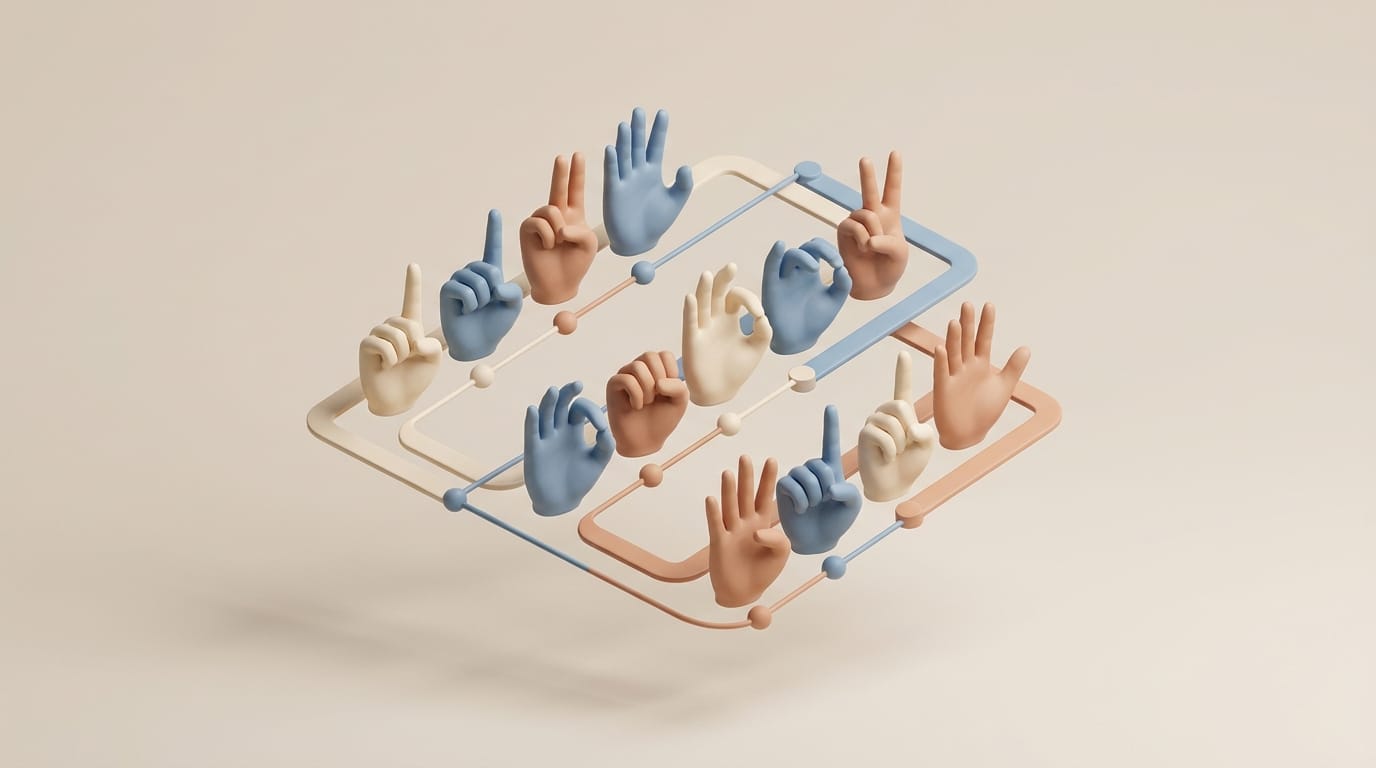
When students first learn ASL number system rules, they often view the subject as a series of disconnected handshapes. They try to memorize gestures through repetition, but this strategy fails because American Sign Language is a dynamic system governed by the physics of sight. If you understand why a rule exists, you no longer have to struggle to remember it. The logic of these numbers rests on a distinction between a signer’s personal space and their communicative space. Most guides describe palm orientation as a rule, but signers use it as a marker of intent. By shifting the hand position, a signer signals whether they are counting for themselves or reporting information to an audience. This clarity explains how structure and function design governs complex systems, including manual languages.
Misinterpreting these shifts as arbitrary leads to mechanical signing. This lacks the fluid rhythm of a native speaker. To move beyond simple memorization, you must look at how the hand functions as a tool for mapping data. Whether you are counting objects, giving a phone number, or discussing time, the physical orientation of your hand serves as the visual syntax that guides the listener. This approach turns a list of shapes into a predictable language tool.
Moving Beyond Rote Memorization of Sign Shapes
Rote memorization obscures the fact that ASL numbers are a sophisticated grammatical system. In many spoken languages, numbers are simply words, but in ASL, they are complex symbols that change shape based on context. A two is not just a handshape; it is a vector that signers can build into pronouns, time markers, and spatial locations. Students often struggle because they treat signs as static images rather than movements. When a signer integrates a number into a sentence, the orientation and movement must align with the surrounding signs to maintain conversational flow.
Without a logical framework, a student must memorize thousands of unique combinations. With a framework, they simply apply a set of visual principles to any situation. This makes learning much faster because the rules follow the natural movement of the body. When you understand the purpose behind the movement, your brain categorizes the information more effectively than it would through repetitive drills alone. This transition from memorizing shapes to understanding movement is the first step toward fluency.
How Palm Orientation Rules Signal Intention
The most common hurdle for beginners involves the shift in palm orientation between 1 through 5 and 6 through 9. In the ASL number system rules, numbers one through five use a palm that faces toward the signer. Numbers six through nine face outward toward the listener. This is not a random design choice. It functions as a visual marker that distinguishes between self-counting and communicative labeling. This small shift tells the viewer exactly what kind of information they are receiving before the hand even forms the specific digit.
The inward-facing logic of numbers one through five
When you sign the numbers 1 through 5 with the palm facing inward, you use a handshape that feels neutral and comfortable. Research on ASL number production by Dr. Bill Vicars shows that this inward orientation produces the least amount of muscular tension in the wrist. Visually, this inward face signifies quantity as a personal observation. It is as if the signer is counting for themselves and tracking a total within their own private visual field before presenting it to others. It keeps the focus on the amount rather than the act of sharing it.
The outward-facing logic of communicative labeling
At the number six, the palm rotates to face outward. This shift acts as a communicative marker. It signals a transition from counting for the self to reporting to a listener. Because the handshapes for 6 through 9 involve the thumb touching different fingers, facing them outward makes the specific digit much easier for the observer to identify. This outward orientation works for communicative labeling, such as reporting scores, giving dates, or providing addresses. In these cases, the primary goal is clear transmission of data to the listener, so the hand opens up to the room.
The Structural Difference Between Counting and Labeling
Understanding the logic of the audience helps explain why orientation changes even for the numbers 1 through 5 when you use them as labels. In cardinal counting, such as when you count three books, the palm stays in. However, when those same numbers appear in a series, such as a phone number, an ID card, or a jersey number, the palm flips outward. You are no longer counting a total. You are providing a name or a label for the audience to record. This shift ensures the viewer knows if you are talking about how many items you have or which specific item you mean.
This syntax ensures that the viewer can distinguish between a quantity and an identifier. This is similar to the way predictive text technology anticipates intent through context. ASL signers use palm orientation to set the mode of the information before the specific digit is even processed. Maintaining a consistent visual plane is essential for clarity. In high-speed communication, small orientation errors can change the meaning of an entire sentence. By keeping the palm position consistent, the signer provides a steady background for the numbers to stand out against.
- Cardinal Numbers: Use a palm-in position for 1 through 5 when counting a total number of items.
- Ordinal and Nominal Numbers: Use a palm-out position to identify a specific item, a position in a race, or a digit in a series.
- Rule of Nine: Signers can blend the numbers 1 through 9 into other signs to indicate specific days, weeks, or months in a single motion.
Navigating Compound Numbers and ASL Number System Rules
As numbers grow more complex, the ASL number system rules rely on movement and specific handshapes to signify place value. The twenties provide a great example of this logic. Rather than signing a two followed by another digit, numbers 21 through 29 (excluding 22) use a specific L handshape. This L-shape functions as a visual shorthand for the digit two in the tens place. This allows for faster and more rhythmic articulation because the signer does not have to reset their hand between digits.
For hundreds, the hand transitions into a C shape. This visual similarity is easy to recognize because the hand mimics the Roman numeral C for a hundred. It provides a visual scale that matches the magnitude of the number. When signing double digits like 66, 77, or 88, signers use a rhythmic rocking or slapping motion. By bouncing the hand slightly to the side, the signer visually duplicates the digit without having to reset the handshape. This maintains the pulse of the conversation and makes the repetition clear to the viewer without slowing down the speech.
Integrating Numbers into Broader ASL Grammar
In ASL, numbers are not always stand-alone signs. One of the most efficient systems in the language is numerical blending. For example, when signing two weeks or three months, the number handshape combines with the movement of the time sign itself. This reduces the number of signs required and increases the density of the information. Instead of two separate gestures, you produce one fluid movement that carries both the time unit and the amount.
This integration extends to pronouns as well. Instead of signing “WE” and then “THREE,” a signer uses a 3 handshape and moves it in a circular motion to mean “the three of us.” This efficiency is a core tenet of manual languages. Just as animal sensory perception shapes communication through specialized signals, ASL uses these blended signs to transmit complex data in a single motion. This includes the subject, the quantity, and the time, all happening at once.
“When done in isolation, numbers 1 through 5 are generally done palm back. However, if those numbers are part of a series, such as a phone number, they are instead done palm forward.”
Why Understanding the Visual Field Prevents Errors
Most common signing errors stem from a lack of spatial sense. When a student memorizes two as a static V shape, they often sign it with the palm forward in situations where it should face inward. This leads to confusion with the letter V or the sign for SEE. If the student understands that an inward palm signifies a count, they can self-correct. They simply identify that they are counting and not labeling. This logic prevents the student from making mistakes that confuse the listener.
Developing this visual logic transforms the ASL number system rules from a chore into an intuitive map. When you know that palm-out signs are for the audience, you naturally rotate your hand when giving your birth year or a price at a store. This spatial awareness allows you to transition from mechanical signing to natural communication. The hand is no longer just making shapes. It is navigating a visual field designed for maximum clarity and minimum physical effort. This makes the language feel more like a tool for expression and less like a list of rules to follow.
The core insight of the ASL number system rules is that every orientation and movement serves a specific purpose. By viewing the palm as a toggle between the self and the audience, the system becomes predictable. This shift in perspective is the difference between a student who repeats gestures and a signer who understands how the language is built. As you continue to practice, ask yourself who the information is for. The answer will almost always tell you how to orient your hand and how to move through the numbers with confidence.