
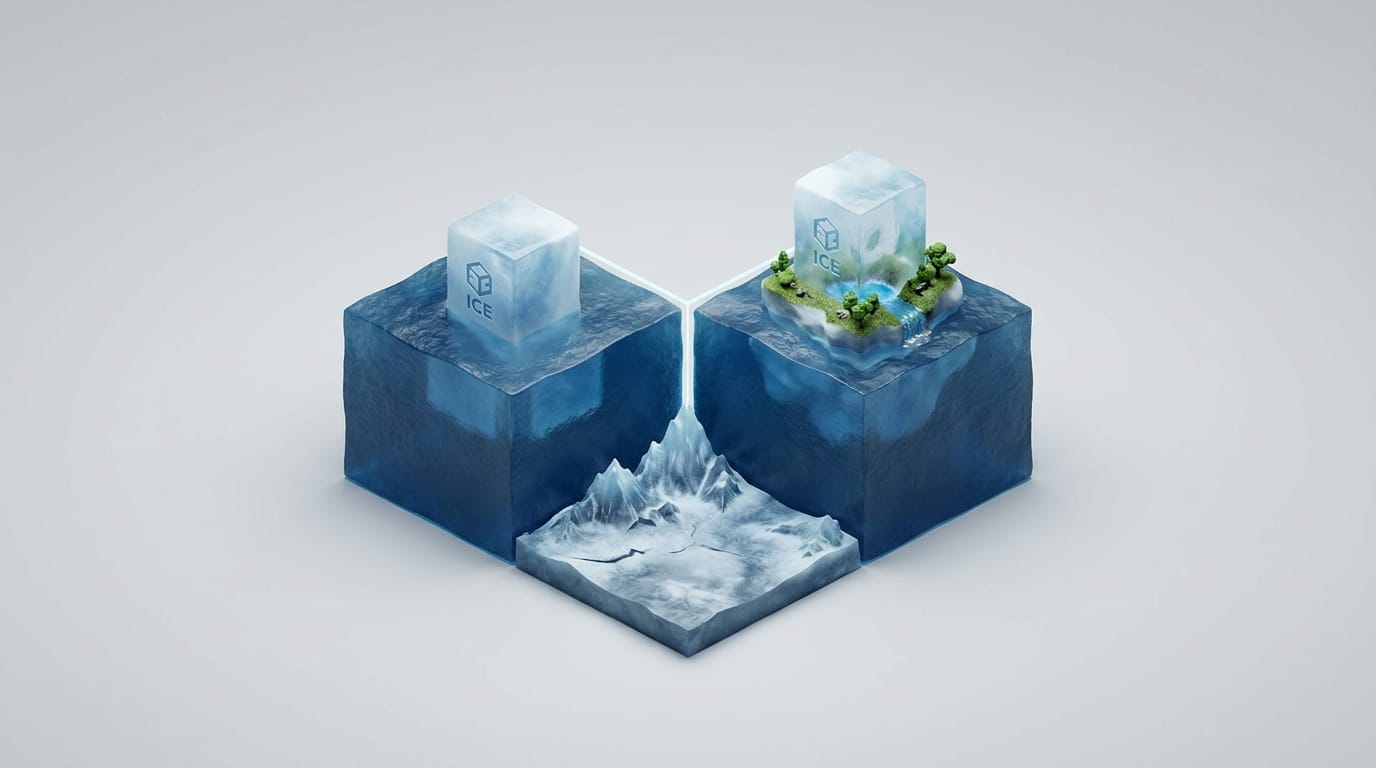
If water behaved like almost every other liquid on Earth, our oceans would freeze from the bottom up, turning the planet into a permanent graveyard of ice that no summer sun could thaw. This peculiar behavior, known as the water density anomaly, is the main reason Earth remains a habitable blue marble rather than a dead white husk. While we often view floating ice as a simple convenience for polar bears, it serves as the mechanical failsafe that prevents our planet from entering a terminal state of glaciation.
For most substances, the solid state is the most compact. As molecules lose energy and cool, they huddle together and sink. Water follows this rule only until it reaches 4°C, where it begins a surprising expansion. This reversal of standard physics dictates the thermal structure of our world, from the way deep-sea currents move to the survival of the planetary thermostat. Understanding this system requires looking past the surface of the ice and into the geometry of the water molecule itself.
The Molecular Mechanics of Expanding Water
To understand why ice floats, we must look at the structural design of the H2O molecule. Water is polar, meaning it has a distinct positive end and a negative end. This polarity allows for hydrogen bonding, a type of molecular stickiness where the hydrogen atoms of one molecule attract the oxygen atoms of another. In liquid form, these bonds are chaotic and brief; they break and reform billions of times per second as molecules slide past one another in a dense, crowded state.
The Role of Hydrogen Bonding
As water cools, molecules move more slowly, which lets hydrogen bonds exert more influence over their position. In a typical liquid, cooling leads to tighter packing and higher density. However, when water reaches the freezing point, the hydrogen bonds become strong enough to overcome the energy that keeps the molecules crowded together. Instead of collapsing into a tight pile, the bonds force the molecules into a specific, rigid position that keeps them stable.
The Formation of the Hexagonal Lattice
This rigid position results in a hexagonal crystal lattice. In this crystalline state, each water molecule bonds to four neighbors in a fixed pattern, creating a structure that contains more empty space than the liquid phase. Because the same number of molecules now occupies a larger volume, the density of the solid state drops by about 9 percent. The internal geometry literally puffs up the ice, which molecular research shows is the primary reason for its buoyancy.
The water density anomaly and the Four Degree Threshold
The most critical point in this system is not the freezing point itself, but the 4°C mark where the water reaches its maximum density. This temperature serves as a structural pivot point for the entire global ocean. Above 4°C, water behaves like a normal liquid, expanding as it warms and contracting as it cools. But as it drops below 4°C, the molecules begin to push apart even before they actually lock into ice.
Maximum Density and the Descent of Cold Water
When the surface of a lake or ocean cools toward 4°C, that water becomes heavy and sinks to the bottom. Scientists call this process convection, and it forces warmer water to the surface where it can release its heat into the atmosphere. This turnover is a vital part of the planet’s heat distribution system. If water continued to get denser all the way to 0°C, the coldest water would always stay at the bottom, and the entire body of water would eventually reach a uniform freezing temperature.
The Thermal Layering of Liquid Bodies
Because water is densest at 4°C, the deepest parts of most large bodies of water stay at a steady, liquid temperature regardless of air conditions. Once surface water cools past 4°C toward the freezing point, it becomes lighter and stays on top. This creates a stable thermal layering where the coldest water is trapped at the surface. This allows the surface to freeze into a solid crust while leaving a massive reservoir of liquid 4°C water protected beneath it. This layering is a prerequisite for the complex physics that govern ocean tides and large-scale circulation.
The Catastrophe of a Sinking Solid State
If we modified the water density anomaly so that ice behaved like solid iron or lead, the consequences would be permanent. In this alternate reality, the first crystals of ice forming on a winter ocean would sink to the seabed. They would accumulate there, far away from the warming rays of the sun. Because water is an excellent insulator, the heat from the surface would never reach these deep-sea ice deposits.
Over thousands of years, the world’s oceans would fill with ice from the bottom up. Each winter, more ice would form at the surface and sink to join the permanent glacial layers on the seafloor. Unlike our current world, where ice melts every spring, this deep-sea ice would never thaw. The sun can only penetrate the top few hundred meters of the ocean, and the deep basins, which hold most of Earth’s water, remain in near-freezing temperatures.
Eventually, these growing mounds of ice would become a massive heat sink. As the liquid volume of the ocean decreased, the remaining water would lose its ability to store and transport heat. The ocean floor would no longer cycle nutrients; it would be a solid block of ice thousands of meters thick. This would destroy the Earth’s ability to recover from cooling periods, a concept that mirrors the delicate balance found in studies of natural climate cycles.
The Destruction of the Planetary Thermostat
The danger of sinking ice is not just the loss of liquid water, but the destruction of the planetary thermostat. The Earth maintains its temperature through a balance of energy absorbed from the sun and energy reflected back into space. Liquid water is dark and absorbs most of the solar radiation that hits it. Ice, however, is bright and reflects much of that energy back into space.
If ice sank, the surface of the ocean would remain liquid for a longer period, but the overall temperature of the planet would drop as the deep oceans froze. Eventually, the surface would freeze over entirely. At this point, the reflection effect would take over. Because the white surface reflects so much sunlight, the planet would no longer absorb enough heat to melt the ice. This runaway cooling loop is known as Snowball Earth, a state where the entire planet is encased in a thick shell of ice, according to climate simulations from NASA.
Global heat distribution relies on the movement of water from the equator to the poles. In a world with sinking ice, these currents would hit undersea glaciers and stop. The great conveyor belt of the ocean would stall. Without warm water moving toward the poles, the high latitudes would freeze solid, further increasing the planet’s reflection and accelerating the descent into a permanent ice age. This breakdown is closely linked to how axial tilt and seasons shape global climate dynamics.
Underwater Shelters and Biological Survival
Beyond the planetary scale, the water density anomaly acts as a shield for life. When a pond or lake freezes today, the layer of ice on the surface acts as a thermal blanket. Because ice is a poor conductor of heat, it traps the residual warmth of the 4°C liquid water below it. It also prevents the wind from further cooling the water through evaporation.
This insulating layer ensures that even in the harshest winters, a sanctuary of liquid water remains at the bottom of every deep lake and ocean basin. Geothermal heat from the Earth’s crust slowly leaks into this bottom layer, keeping it liquid and providing a stable environment. If ice sank, this sanctuary would be the first place to freeze, crushing any organisms living on the seafloor and eliminating the primary habitat for many of Earth’s most ancient species.
The ocean floor is the foundation of many marine food webs. By keeping the deep ocean liquid, this property allows for the continued cycling of nutrients and the survival of organisms that may have been the ancestors of all life on Earth. This tiny shift in molecular geometry, the simple fact that four degrees is heavier than zero, is the mechanical barrier that keeps the planetary thermostat functioning and the deep oceans liquid. It reminds us that the most massive systems we live inside often depend on the most minute patterns of physics to remain stable. If we ever discovered a world where ice sank, we would likely find a planet that was geologically and biologically dead.