While many believe microwaves cook food from the inside out, the process relies on a molecular friction known as dielectric heating. This mechanism occurs when electromagnetic radiation interacts with polar molecules found in most organic matter. By understanding how these fields shift and how molecules respond, we can clarify why certain foods heat unevenly or stay frozen at their core. Most modern appliances operate within a strictly regulated band of the electromagnetic spectrum. Instead of waiting for heat to move from a heating element to the surface of a dish, microwaves bypass the air entirely. They deliver energy directly to the molecular structure of the food, causing a physical reaction that generates heat through high-frequency movement.
Molecular Agitation and the Physics of Microwaves
The electromagnetic spectrum classifies waves by their frequency and wavelength, ranging from long radio waves to high-energy gamma rays. Microwaves sit between radio waves and infrared radiation. In a kitchen, a magnetron vacuum tube converts electricity into short-wavelength radiation, as explained in Britannica’s overview of microwave technology. This radiation fills the oven chamber and interacts with the food placed inside.
Understanding Electromagnetic Field Oscillation
A microwave creates a rapidly changing electric field that reverses its polarity billions of times every second. This oscillation drives the heating process by forcing receptive materials to constantly realign their internal charge to match the field. When the field flips, the molecules within the food must flip as well. This constant motion creates the energy needed to raise the temperature of the meal without using an external flame or hot surface.
How Dipolar Molecules React to Radiation
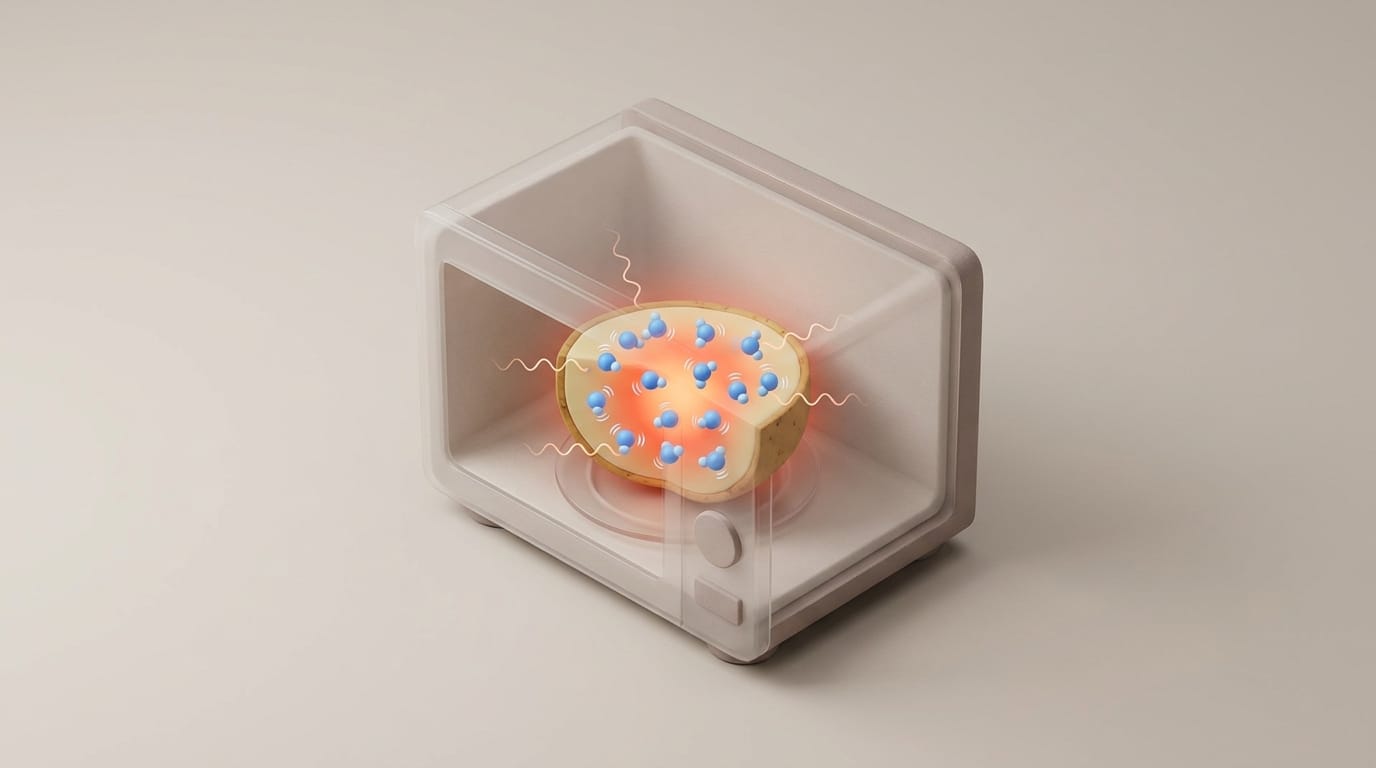
For dielectric heating to work, a substance must contain polar molecules, also called dipoles. These molecules have a partial positive charge on one end and a partial negative charge on the other, acting like tiny compass needles. Water is the most common dipole in food, though fats and sugars also have degrees of polarity that make them move when exposed to electromagnetic waves. When the electric field reverses, these dipolar molecules rotate to stay aligned with the new polarity. Because the field changes direction so quickly, the molecules stay in a state of continuous, high-speed agitation. This molecular dance converts invisible radiation into the heat we use to cook.
The Process of Dipolar Rotation and Heat Generation
The water molecule sits at the center of this system. Its asymmetrical shape, consisting of two hydrogen atoms bonded to one oxygen atom, creates a permanent electric charge. This makes water react strongly to the shifting electric fields inside the oven. This reaction shares similarities with how batteries store and release energy via electrochemistry, where the movement of charges facilitates a change in state.
Why Water Molecules Are the Primary Target
Since water makes up most fresh foods, it acts as the main tool for absorbing energy. While fats and sugars are polar, they move less freely than liquid water. In complex foods, water molecules act as tiny heaters that respond almost instantly to the magnetron. They vibrate and rotate at the same frequency as the incoming waves, creating a ripple effect of energy throughout the dish. This allows the appliance to start the heating process the moment the power turns on.
Converting Kinetic Energy into Thermal Energy
As billions of water molecules rotate, they collide with neighboring molecules. This interaction creates intense molecular friction, which converts the kinetic energy of the rotating dipoles into thermal energy. This heat then spreads through the food by conduction and convection. Materials without dipoles, like dry glass, ceramics, or some plastics, remain transparent to microwaves. The waves pass through them without causing rotation, which is why a glass bowl stays cool while the soup inside boils. The heat you feel in the container usually moves from the food to the glass, rather than coming from the waves themselves.
Why Microwaves Use the 2.45 GHz Frequency Range
A common myth suggests that 2.45 GHz is the resonant frequency of water. In truth, water absorbs energy most efficiently at much higher frequencies, near 20 GHz. However, using dielectric heating at that peak would cause engineering problems. If ovens operated at 20 GHz, the energy would be absorbed entirely by the very first layer of molecules. This would scorch the outside of a steak while leaving the center raw or frozen. By choosing 2.45 GHz, designers picked a frequency that offers better penetration, according to reports from Scientific American.
Balancing Surface Absorption with Deep Penetration
At the standard frequency, microwaves can reach a depth of nearly two centimeters in liquid water. This allows the waves to bypass the surface and deposit energy into the bulk of the food. This trade-off is necessary for heating thick items like potatoes or bowls of stew. Without this penetration, the machine would only be useful for thin slices of food. The current standard balances the speed of heating with the need for a cooked center.
The Tradeoff Between Peak Efficiency and Even Heating
The choice of 2.45 GHz also follows global rules for telecommunications. This frequency sits in the Industrial, Scientific, and Medical band, which is reserved for non-communication uses. This prevents your kitchen appliance from interfering with radar or satellite systems. This coordination of radio frequencies is similar to the management of pulses discussed in the study of why MRI machines are so loud during medical scans. The mix of physics and regulation defines the technology we use every day.
Debunking the Myth of Cooking From the Inside Out
The idea that microwaves cook from the inside out is a myth that grew from seeing how hot the centers of some foods become. In reality, microwaves follow standard physics by entering from the outside and losing energy as they move inward. The heat in the center of a large dish usually comes from thermal conduction rather than direct waves. Penetration depth is the distance where the wave power drops to about 37% of its initial value. In dense foods, this depth is limited to a few centimeters.
Why Thick Foods Often Have Cold Centers
For a large roast or a thick loaf of bread, microwaves never reach the center. Instead, they heat the outer layers, and that heat moves inward just as it does in a traditional oven. If you have ever eaten a burrito that was hot on the ends but frozen in the middle, you have seen the limits of this process. Because the outer layers absorb the waves, little energy remains for the core. This is why manufacturers suggest letting food stand for a few minutes. This time allows the temperature to even out as heat moves from the energized exterior to the cold interior.
Material Constraints and Dielectric Properties
Not all foods react to dielectric heating the same way. The physical state and chemical makeup of the food change how it absorbs waves. Salt and the state of water are the two most important factors. Salt is an electrolyte that breaks into ions in water. These ions react aggressively to electric fields, which increases heat on the surface but decreases penetration depth. High salt levels can make the surface of a dish heat instantly, creating a shield that stops waves from reaching the middle, as noted in research on ionic influence in microwave chemistry.
Ice presents a different challenge because its molecules are locked in a crystal lattice. They cannot rotate freely, which is why frozen food takes so long to thaw until a small pocket of liquid water forms. Fats have lower polarity than water but also have a lower specific heat. This means they need less energy to rise in temperature, often heating faster than the surrounding proteins. The shape of the food and its container also matter. Waves often gather at edges and corners, causing them to overcook. Using circular containers helps prevent this because they lack the sharp corners that lead to edge-burning. By managing these properties, such as adding a splash of water to dry food or arranging thicker portions toward the edge of the plate, you can get much more consistent results from your machine.
Microwave cooking is a balance between physics and chemistry. It is a tuned environment that uses the properties of water to achieve fast heating. By recognizing that dielectric heating is a process of molecular friction, we can make better choices in the kitchen. Understanding how waves decay and how heat moves ensures that “standing time” becomes a useful tool rather than a mystery. This fundamental knowledge of molecular agitation remains the core of how we use invisible energy to prepare our meals.