
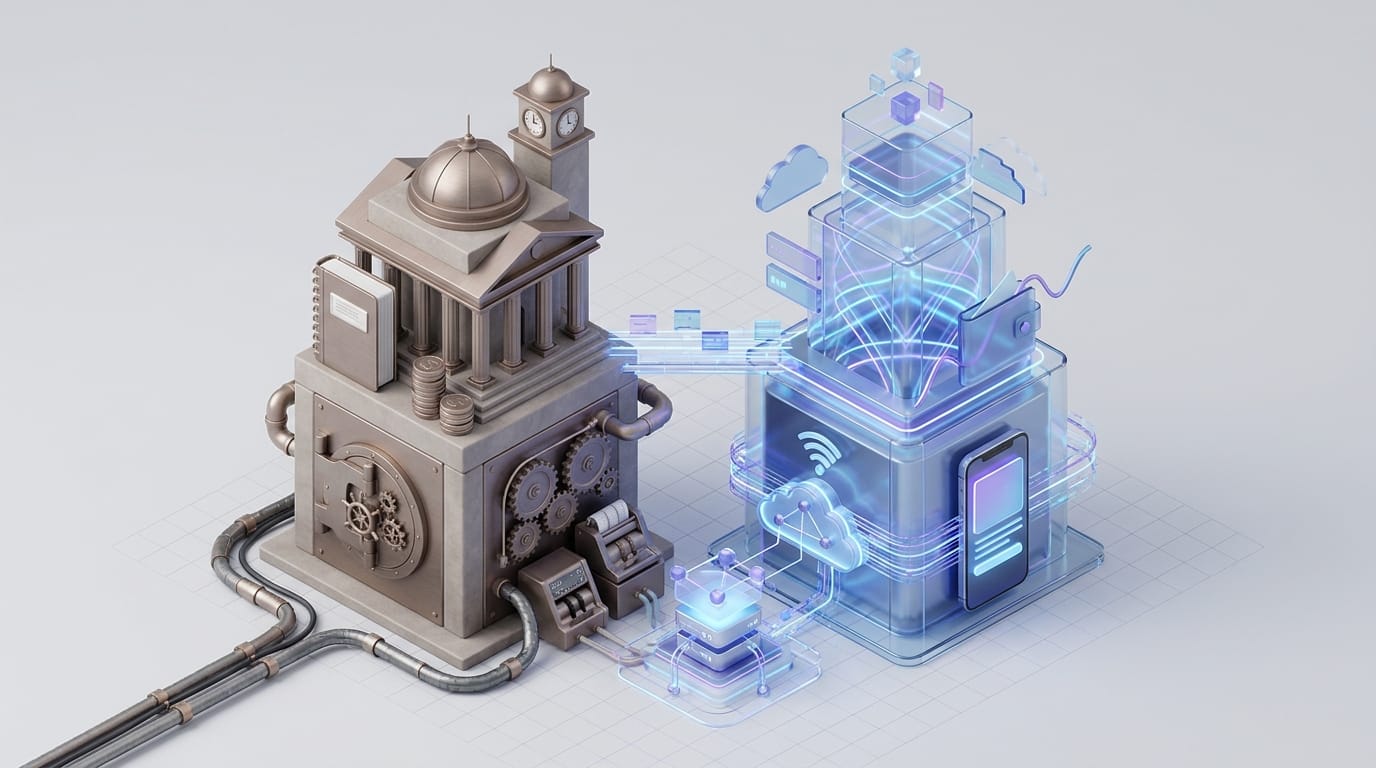
A polished app on your phone looks like a bank, but the vault holding your savings likely sits in a different institution thousands of miles away. Most users interact with a clean interface and assume the company behind the logo manages their deposits. In the modern financial system, however, the brand and the balance sheet are often separate entities. When comparing neobanks vs traditional banks, the critical difference lies in the regulatory and technical plumbing beneath the surface. This structural divide dictates everything from how fast your paycheck clears to what happens if the company goes out of business.
To understand where your capital sits, you must look past the design and examine the infrastructure. Traditional banks are integrated monoliths, while most neobanks function as software layers that outsource core functions to a network of partners. These partnerships hide behind marketing terms like “real-time updates,” but they represent a fundamental shift in how money moves through the economy.
The Digital Illusion of Modern Banking Interfaces
Defining the Neobank Model
A neobank is a financial technology firm that offers services through a digital-only platform. Unlike a local credit union, a neobank rarely owns a physical building or a vault; it prioritizes the user interface and customer acquisition instead. By focusing on mobile design and avoiding the overhead of physical branches, these firms can offer higher interest rates and lower fees. Few neobanks hold a banking charter, which means they cannot legally accept deposits on their own.
The Legacy Structure of Traditional Institutions
Traditional banks are chartered depository institutions with the legal right to accept deposits and lend money. They are the primary nodes in the financial network, maintaining their own ledgers and direct relationships with central banks. While many have launched mobile apps, these are digital extensions of physical systems that have existed for decades. This integration creates a high barrier to entry but provides a level of stability that software-only firms struggle to match. Understanding how the history of money and payments shaped modern trust helps explain why these legacy institutions remain the bedrock of the financial system despite their technical friction.
neobanks vs traditional banks: Understanding the Hidden Charter Gap
How Banking-as-a-Service Platforms Connect the Two
The most significant secret in fintech is that most neobanks are not banks. They operate through a model known as Banking-as-a-Service (BaaS), where a tech company builds the app and a chartered bank provides the regulatory umbrella. Large players like Chime, which serves millions of customers, partner with The Bancorp Bank and Stride Bank to handle the movement of money. The neobank manages the front end, including the app and customer service, while the partner bank manages compliance, anti-money laundering protocols, and the balance sheet.
The Role of Small Partner Banks in Digital Finance
This partnership creates a relationship between technology firms and small, rural traditional banks. Many of the banks powering popular fintech apps are small institutions located in states like Utah, South Dakota, or Georgia. These banks use their charters to earn fees from fintech partners, allowing them to process a high volume of transactions. The neobank handles the expensive task of finding customers, while the legacy partner provides the legal right to exist. This division of labor is why you can open an account in five minutes; the tech firm has optimized the sign-up process while the partner bank fulfills regulatory requirements in the background.
How Technical Debt Shapes Bank Operations
Legacy Systems vs Cloud Infrastructure
The core difference in performance between these two systems stems from their age. Over 60% of U.S. banks still rely on COBOL, a programming language from the 1950s, according to analysis by Pragmatic Coders. These legacy systems are designed for batch processing, where the server queues transactions and processes them in a single run at the end of the day. This is why a transfer at a traditional bank might take 48 hours to clear even if the numbers appear in your app immediately; the underlying mainframe waits for a specific time to settle the books.
Neobanks use cloud-native infrastructure and API-first architectures. They treat every transaction as a real-time data event. When you swipe a card from a neobank, the app can instantly send a push notification, sort the spend, and update your balance in milliseconds. They avoid the technical debt that plagues older firms. However, this agility is often a thin layer; the neobank’s modern API must still eventually communicate with the partner bank’s aging ledger, which remains the final source of truth for your balance.
The Speed of Transaction Processing
The speed gap is narrowing as traditional banks adopt real-time payment systems. Currently, more banks are offering instant payments, but neobanks made this a baseline feature years ago. The infrastructure of a traditional bank is built for safety and auditing at the expense of speed. The infrastructure of a neobank is built for user engagement and data. This difference is why a neobank can tell you exactly which shop you visited, while a traditional bank statement might only show a confusing string of letters and numbers.
Regulatory Safety and the Reality of FDIC Insurance
Pass-Through Insurance Explained
When you see the FDIC logo on a neobank’s website, it usually applies through a partner. Because the neobank is not a bank, it cannot provide insurance directly. Instead, it offers pass-through insurance. The platform deposits your money into an account at the partner bank held in the neobank’s name for your benefit. If the partner bank fails, you are insured up to $250,000. However, if the neobank itself fails, the path to your money becomes more complicated.
Liability Shifts in the Event of a Platform Failure
The 2024 collapse of Synapse, a major middleman in this industry, exposed a flaw in this infrastructure. Thousands of customers could not access their accounts because the records kept by the tech firm did not match the records at the partner bank. In a traditional bank, the ledger and the insurance reside in the same institution. In a neobank model, a failure in the software layer can lose the map to your money, even if the funds sit safely in a vault. Managing this risk requires you to recognize that your primary contact is a software company, not a fiduciary institution.
Why P2P Apps Differ From Bank Accounts
Ledger Systems vs Fractional Reserve Banking
It is common to treat peer-to-peer (P2P) apps like Venmo or Cash App as bank accounts, but their infrastructure is different. These apps often operate on closed-loop ledgers. When you have a balance in a P2P app, it is not necessarily cash in a regulated reserve; it is often an IOU on the company’s internal database. Traditional banks operate under fractional reserve rules, which require them to keep specific capital levels and undergo audits to ensure they can meet withdrawal demands.
Storing large sums in a P2P wallet is riskier than using a neobank or a traditional bank. P2P apps do not always provide pass-through insurance unless you use specific banking features like a debit card. Without these protections, your balance is a liability of the tech firm. If the firm faces a liquidity crisis, your funds could be treated as those of a general creditor rather than a protected depositor. For this reason, these apps are useful for small transfers but less reliable for long-term storage.
Choosing the Right Infrastructure for Your Capital
Yield vs Systemic Stability
Deciding between neobanks vs traditional banks often comes down to a trade-off between growth and security. If your goal is to maximize interest on your savings, neobanks are usually the better choice. Their lower overhead allows them to pass on higher yields. For a primary account where you pay a mortgage or store emergency funds, the physical presence and direct charter of a traditional institution offer a safety net that software cannot yet match. You may find value in deciding between premium vs free checking accounts based on these infrastructure benefits rather than just sign-up bonuses.
The Hybrid Approach to Personal Finance
Many experts in finance use a hybrid model. They use a neobank for daily spending and high-yield savings to take advantage of the superior interface and interest rates. They also maintain an account at a large traditional bank to ensure they have a direct line to the central banking system and a branch for complex tasks like notarizing documents or sending wire transfers for large purchases. This approach treats your finances as a redundant system; if the neobank’s software layer has a problem, your primary capital remains accessible through the legacy institution.
The infrastructure behind your money defines its utility. Traditional banks offer a heavy foundation that moves slowly but resists collapse. Neobanks offer a fast interface that simplifies your life but relies on a complex chain of partnerships. By understanding the differences between neobanks vs traditional banks and the reality of legacy code, you can stop viewing your bank as just an app and see it as a structural system. Your banking setup should reflect the balance of speed and safety your capital requires.