
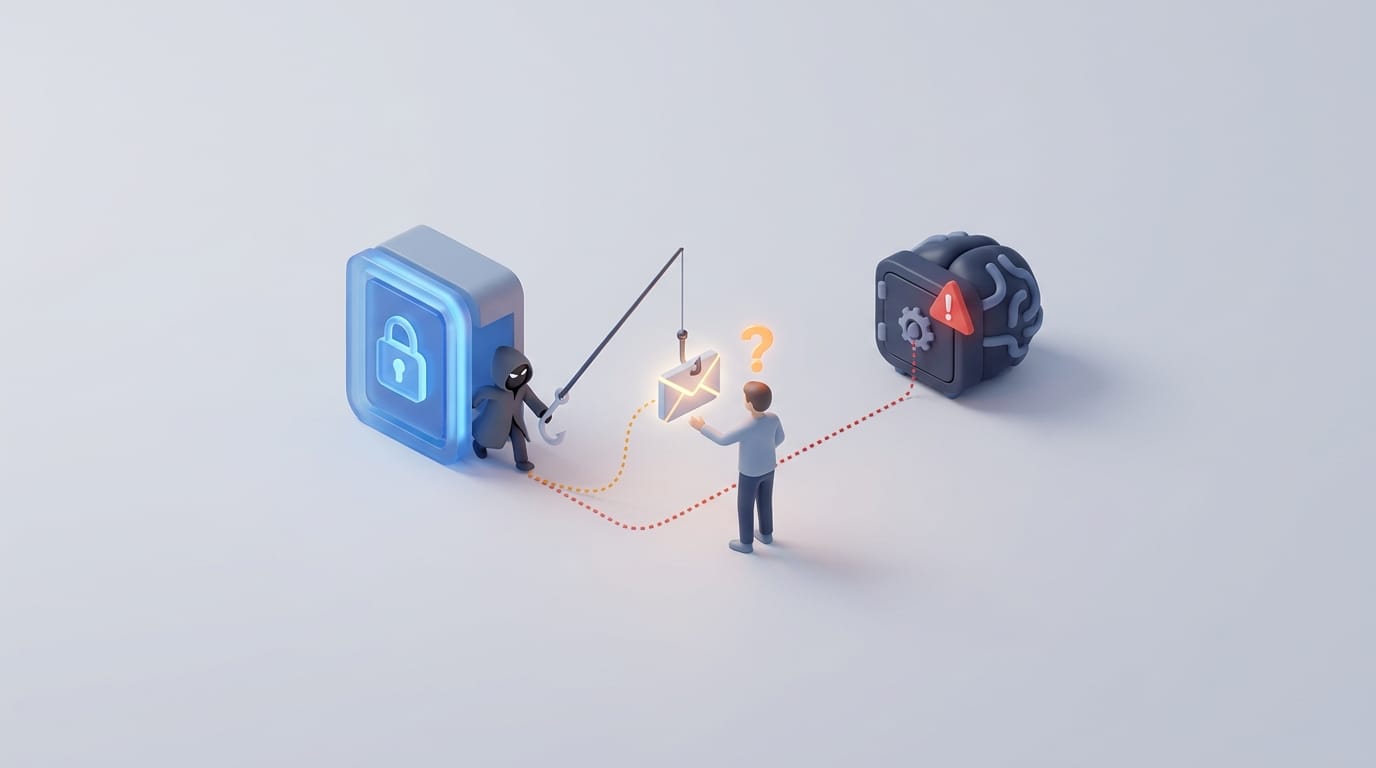
Social Engineering Phishing: The Human Operating System Under Attack
When technical defenses are strong, attackers stop trying to break the lock and simply ask for the key. In the modern security environment, where companies invest millions in firewalls and endpoint detection, the human element remains the most predictable and exploitable vulnerability. This shift in strategy explains why social engineering phishing remains the most effective vector for breaching high-security enterprises, accounting for over a third of all incidents according to recent research from Palo Alto Networks.
Many people misunderstand security as a purely technical problem involving patches and protocols designed to keep malicious code out of a network. The most sophisticated threat actors today do not rely on malware to gain entry; they rely on the victim’s own cooperation. By manipulating trust, urgency, and corporate authority, attackers convince individuals to voluntarily bypass the very security measures designed to protect them. This is not a failure of technology, but an exploitation of the human operating system that underpins every business environment.
Understanding the resilience of this threat requires looking past the basic scam and into the mechanics of how humans process information under pressure. From the biological triggers that cloud judgment to the technical infrastructure that allows attackers to hide once inside, we must examine why traditional defenses are often blind to the subtle art of social manipulation. Only by deconstructing these attacks can organizations build a defense that accounts for both the silicon and the psyche.
The Psychology of Trust and Urgency
The success of any social engineering campaign depends on its ability to bypass the logical, analytical part of the human brain. Attackers do not want a victim to think; they want them to react. To achieve this, they use a biological shortcut often called the amygdala hijack. When a person experiences a sudden sense of fear or extreme urgency, such as an alert stating their bank account is compromised, the amygdala triggers a fight-or-flight response. This physical reaction prioritizes immediate action over critical thinking, making even the most security-conscious employee susceptible to a fraudulent request.
Human beings rely on mental shortcuts, or heuristics, to navigate the hundreds of decisions we make daily. One of the most powerful is the consistency heuristic, where we tend to trust information that fits into our existing expectations. If an employee receives an email from what looks like their HR portal during open enrollment season, they are far less likely to scrutinize the link than they would be at any other time of the year. Attackers spend weeks performing research to ensure their social engineering phishing attempts align with corporate calendars, project deadlines, and internal language.
This psychological tailoring is why broad phishing campaigns are being replaced by highly targeted spear-phishing. By referencing specific project names, internal managers, or recent company-wide announcements, attackers create a fabricated scenario that feels familiar and safe. When the context is right, the brain’s natural skepticism lowers, allowing a malicious link to appear as a standard task in a busy workflow. This is particularly effective in environments where loss aversion psychology is high, as the fear of missing a critical deadline often overrides the instinct to verify a sender’s identity.
Corporate hierarchies are built on the assumption that requests from superiors should be handled with priority and minimal friction. Attackers exploit this institutional trust through Business Email Compromise (BEC), where they impersonate a high-ranking manager. In a fast-paced environment, a direct request from the CEO is rarely questioned. The pressure to appear helpful and efficient creates a cultural vulnerability that no software can patch. This social dynamic is the primary reason why identity is the new perimeter for enterprise security, as the compromise of a single trusted name can provide an attacker with more access than any software exploit could offer.
Technical Anatomy of Modern Social Engineering Phishing
While the hook is psychological, the delivery of a modern phish is a masterpiece of technical mimicry. We have moved far beyond the era of poorly spelled emails; today, attackers use sophisticated toolkits that can replicate a company’s entire login infrastructure in seconds. These Adversary-in-the-Middle (AiTM) attacks represent a fundamental shift in how social engineering phishing operates at the network level.
As corporate email filters have become more adept at flagging suspicious links, attackers have migrated to less-guarded channels. Smishing (SMS phishing) and vishing (voice phishing) are common because people tend to be more trusting of their mobile devices than their work inboxes. A text message appearing to come from the IT help desk, asking a user to click a link to verify their login session, feels more personal and urgent than a standard email. This multi-channel approach ensures that even if one vector is blocked, the attacker has multiple paths to the victim. Furthermore, attackers are increasingly infiltrating internal communication platforms like Slack and Microsoft Teams. By compromising one low-level account, an attacker can send messages to other employees within the same organization. Since these platforms are viewed as secure internal spaces, users are significantly more likely to click on links or share information that they would have questioned in an external email.
Modern phishing pages are no longer static replicas; they are dynamic proxies. Tools like Evilginx allow attackers to set up a reverse proxy between the victim and the legitimate website. When the user navigates to a lookalike domain, the proxy server fetches the real login page in real-time. Every file, script, and branding image is pulled directly from the actual site, making the phishing page visually identical to the real one. Because the page is a live proxy, it can even handle Multi-Factor Authentication (MFA) prompts. When the user enters their credentials and their one-time passcode, the attacker’s server passes those details to the legitimate site. Once the login is successful, the attacker intercepts the resulting session cookie, the digital token that proves the user is logged in. By stealing this token, the attacker can bypass MFA entirely in future sessions, effectively hijacking the user’s identity without ever needing to know their actual password.
How Attackers Hide Post-Breach
The most dangerous phase of a modern attack begins after the initial click. Historically, phishing was a precursor to delivering malware that would encrypt files or steal data. Today, sophisticated attackers have abandoned malware in favor of Living Off the Land (LOTL). Once they have successfully used social engineering phishing to obtain valid credentials or session tokens, they stop acting like hackers and start acting like employees. Once inside a corporate environment, an attacker does not need to install a virus; instead, they use the company’s own tools. They might use Microsoft OneDrive to move data, Slack to phish other departments for higher privileges, or Outlook to set up email forwarding rules that send copies of sensitive documents to an external server.
Because these are legitimate, pre-approved applications, they do not trigger traditional antivirus or Endpoint Detection and Response (EDR) alerts. To a security scanner, the attacker’s activity looks exactly like a productive day for a regular employee. This strategy makes the breach nearly invisible. A recent major breach involving 350 GB of stolen data triggered zero endpoint alerts because the attackers used nothing but legitimate credentials and built-in system tools. By blending into the noise of daily operations, attackers can maintain access to the network for months without being discovered. This silent presence is often more damaging than a loud ransomware attack, as it allows for the long-term theft of intellectual property and strategic corporate intelligence.
The primary weakness of automated security software is its reliance on signatures or known patterns. A scanner can easily identify a malicious file, but it struggles to identify a malicious command sent via a verified administrator’s account. When an attacker lives off the land, they are using the network’s own trust against itself. They aren’t breaking into the system; they are logged into it with a valid key. If an attacker uses an internal SharePoint site to host a malicious file, the email linking to that file will pass every security check because the link points to a trusted corporate domain. This creates a circular logic where the system assumes the content is safe because the source is internal, even though the source has been compromised.
Why Social Engineering Phishing Defeats Automation
Automated defenses are designed to find technical anomalies, but social engineering is a behavioral anomaly. This fundamental mismatch is why organizations with the most expensive security stacks still fall victim to simple phishes. Software is excellent at spotting a compromised file, but it is remarkably poor at spotting a compromised conversation. Many organizations use email sandboxing, where every link and attachment is opened in a safe environment before being delivered to the user. Attackers have evolved to bypass these systems using logic gates. For example, a phishing link might detect the IP address of the person clicking it. If it detects a known security vendor or a virtual machine, it serves a harmless page. If it detects an IP belonging to the target, it serves the malicious portal.
Furthermore, social engineering often uses text-only manipulation that contains no links or attachments at all. A callback phish might simply ask an employee to call a help desk phone number to resolve a billing issue. Since there is no digital payload for the sandbox to inspect, the email is marked as clean. According to a recent phishing trends report from Hoxhunt, these non-technical vectors are growing because they are invisible to traditional automated filters. The payload in these attacks isn’t a file; it’s the conversation that happens once the victim picks up the phone.
Detecting a social engineering attack requires a system to understand context. For an AI-driven security tool to flag a fraudulent request, it must first know what a normal request looks like, the time of day a user usually sends emails, their typical tone, and whether the requested action is standard procedure. While behavior analytics software is improving, it still produces a high rate of false positives that lead to alert fatigue among IT staff. In contrast, a human being is naturally wired for context, yet we are often trained to ignore our instincts in favor of efficiency. Automated defenses fail because they cannot account for the pretexting that happens over multiple interactions. An attacker might spend three days engaging in friendly banter with a target on social media before sending a single malicious link. To an automated scanner, the link is just a link; to the victim, it is a resource from a new professional contact they have come to trust.
Establishing a Resilience Layer
If the vulnerability is human, the solution must be structural and cultural. We cannot patch human psychology, but we can change the systems in which humans operate. Building a truly resilient organization requires moving past the idea of the human firewall and toward a model of operational verification where trust is never assumed. The most effective defense against social engineering phishing is out-of-band verification. This means that any high-risk request, such as a change in banking details for a vendor or a request for sensitive employee data, must be verified through a second, independent communication channel. If an email arrives from the CEO requesting an urgent wire transfer, the protocol should mandate a phone call or a face-to-face confirmation before the transaction is processed.
This structural change removes the burden of spotting the phish from the individual and places it on the process. When verification is a standard operating procedure, the psychological pressure of urgency is neutralized. An attacker can create a fake sense of emergency, but they cannot easily bypass a multi-step verification process that requires a physical voice confirmation. Resilience is also built when questioning a legitimate request is not only allowed but rewarded. Organizations must foster an environment where a junior staff member feels comfortable calling a senior executive to verify a strange email. By treating security as a collective, system-wide responsibility rather than an individual test of intelligence, companies can create a human layer of defense that is as strong as their technical ones. Mastery of how to recognize phishing scams and verify digital requests should be as foundational to corporate training as learning how to use the company’s software.
The ultimate goal of social engineering is to turn a company’s internal trust into its greatest liability. Recent data suggests the average cost of a phishing-related data breach has reached nearly $5 million, reflecting not just the technical cleanup but the damage to institutional trust and brand reputation. As attackers continue to move away from malware and toward the exploitation of human identity, the only way to stay secure is to recognize that our psychological shortcuts are just as important as our software firewalls. The persistence of phishing is not an indictment of our intelligence, but a testament to our social nature. We are wired to help, to respond to authority, and to trust our colleagues. Attackers do not break these traits; they use them as a bridge into our most secure systems. By implementing rigorous verification protocols and fostering a culture of healthy skepticism, we can transform these human instincts from vulnerabilities into a sophisticated layer of defense.