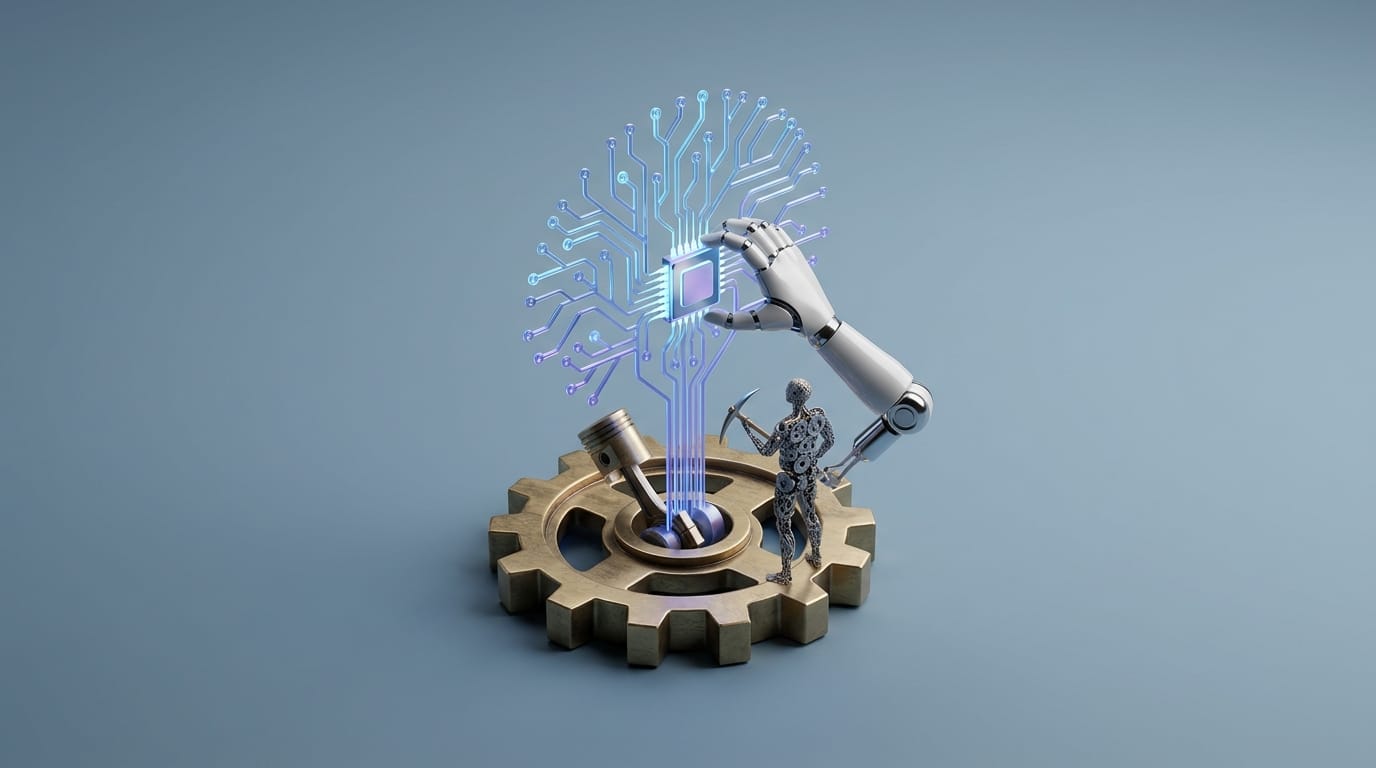
The most dangerous misconception about automation suggests that efficient technology naturally leads to less work for humans. While we often imagine robots and algorithms clearing our schedules, the reality is a persistent automation paradox where the more we automate a task, the more demanding the human contribution becomes. This paradox defines the friction of modern labor markets; technical efficiency frequently increases the volume of work rather than reducing it.
When a system grows more efficient, the cost of its output drops, which usually triggers a surge in demand. This shift does not just replace human effort or thought; it changes the human role from a primary producer to an overseer of high-velocity systems. Understanding why this happens requires looking past the immediate time saved; we must examine the structural ways organizations respond to new capabilities. Instead of resting, workers often find themselves managing a higher volume of more complex tasks that the machines cannot handle alone.
Defining the Automation Paradox in Human History
The automation paradox functions as a systemic phenomenon where advanced systems make the human operator more vital to success. As machines take over routine parts of a job, the remaining pieces (the exceptions, the edge cases, and the high-level strategy) become more complex and carry higher stakes. If a system handles 99% of a process perfectly, the 1% it cannot handle is, by definition, the most difficult and nuanced portion of the work. This tiny fraction of work requires deep judgment and often bears the weight of the entire operation’s success.
The Perpetual Cycle of Displacement and Creation
History shows that technology rarely deletes a job in its entirety; instead, it breaks a job into specific tasks. Some tasks move to machines while others require human help; this leads to a shift in necessary skills. This shift illustrates how AI and automation are reshaping the future of work by moving the labor market toward roles that favor judgment over simple execution. We see this in the shift from the manual drafting of blueprints to the management of complex computer design software. The designer no longer spends time on the mechanics of drawing; instead, they focus on the complexity of the architectural system itself, which creates more mental work even as the physical work disappears.
Why Historical Fears of Total Unemployment Fail
Since the beginning of the industrial age, every major technological leap has met with the fear of technological unemployment. Yet, we consistently find that the augmented intelligence printing press comparison holds true; new tools do not end work, they lower the barrier to creation. When the barrier to creation falls, the volume of creation tends to skyrocket, which maintains or even increases the total demand for human oversight. The system does not run out of work; it simply demands more sophisticated ways to manage the new abundance of output. We are not fighting for the remaining crumbs of labor but are instead struggling to keep up with the scale of what we can now produce.
Economic Lessons from the First Industrial Revolution
The transition from manual labor to machine oversight is not a modern invention; it was the defining feature of the 19th-century factory system. During this era, the introduction of the power loom seemed like the end of the weaver’s trade. While it did displace the independent artisan, it simultaneously triggered a massive expansion in the textile industry. The efficiency of the machine lowered the price of cloth so dramatically that global demand surged; this created a need for thousands of factory workers to manage the new machines. The worker was no longer weaving; they were ensuring the machine did not stop weaving.
The Luddite Response to Textile Mechanization
The Luddite movement is often remembered as an anti-technology crusade, but historians now view it as a labor rights struggle. These workers were not offended by the machines themselves (they were often skilled users of technology). Instead, they fought the ways employers used machines to bypass labor standards and lower wages. This highlights a core component of the automation paradox: the tension rarely involves the tool itself but focuses on the distribution of the value that the tool creates. As machines produce more, the question of who benefits from that extra productivity becomes the primary source of social conflict.
How Power Looms Created More Jobs for Weavers
The economic driver behind this paradox is known as the Jevons Paradox. It states that as the efficiency of a resource increases, the total consumption of that resource often rises because the cost of using it has dropped. In the 1800s, this meant that as looms became more efficient, society consumed exponentially more cloth. By the mid-1830s, the economic advantages of machine use were established, yet it took decades for the labor market to stabilize. This period of adjustment eventually led to social changes, such as the creation of the modern weekend, to balance new industrial productivity with the need for human recovery.
The Hidden Burden of the Expectation Paradox
The most subtle part of the automation paradox is what we might call the Expectation Paradox. When technology makes a task five times faster, the organization rarely gives that time back to the worker. Instead, the baseline expectation for output scales to match the new speed. If an engineer can now generate code five times faster with an assistant, the project timeline does not stay the same with less effort; the project scope expands to include five times more complexity. The “saved” time is not a gift of leisure; it is a permission slip to do more work at a higher level of intensity.
The Myth of the Automated Four-Hour Workday
The dream of the automated four-hour workday stays out of reach because we consume saved time immediately. Recent reports show that a majority of employees feel that AI tools have increased their total workload, according to a report by Seramount on workplace productivity. As the friction of production disappears, the friction of coordination and management takes its place. We are currently experiencing acceleration whiplash, where the speed of technical output outpaces our ability to manage the results. We can produce more than we can organize, leading to a state of constant catch-up.
How Reduced Friction Scales Corporate Expectations
When software makes it easy to produce a report, a manager no longer wants one report per week; they want five reports, updated in real-time, with interactive dashboards. The time saved by automation is instantly swallowed by the increased granularity and frequency of the new demand. In this environment, workers often find themselves working harder to manage the fast automated workflows than they did when they were performing the original tasks manually. The speed of the machine sets the pace for the human, and the machine never gets tired.
How AI Replicates Historical Labor Shifts
In the current era of generative AI, we are seeing a shift from primary creator to system orchestrator. This mirrors the 19th-century shift where a weaver moved from throwing the shuttle themselves to managing a row of twelve power looms. The modern knowledge worker is becoming a curator of generated content, a role that requires a different, often more taxing, cognitive load than original creation. Managing an automated system requires constant vigilance and the ability to spot subtle errors that a machine might overlook.
Moving from Primary Creator to System Orchestrator
As AI handles the execution of a task (the writing of the draft or the compiling of data), the human role moves toward verification and judgment. The value no longer rests in the technical skill of the basic task but in the critical curation of the final output. The human becomes the gatekeeper for quality and accuracy. This role is inherently more stressful; when you are the creator, you know where the flaws are, but when you are the orchestrator, you must hunt for flaws in a system that produces work at a scale you cannot replicate.
The Increasing Value of Human Verification and Judgment
The paradox here is that as the cost of generating information drops to near zero, the cost of verifying that information increases. AI can produce plausible-sounding nonsense at a scale humans cannot match. Consequently, the labor market is placing a premium on workers who can audit and stand behind the output of automated systems. A recent study from MIT and Harvard suggested that while AI displaces routine tasks, it creates an intense demand for judgment-intensive labor that cannot move to an algorithm. We are entering an era where being “right” is much more valuable, and much harder to achieve, than being “fast.”
Strategic Adaptation for a High-Output Future
For business leaders and workers to survive this automation paradox, they must shift their definition of productivity. If we define productivity solely as volume, we fall into the trap of infinite scaling; we produce more content than any human can ever consume. Strategic adaptation requires moving beyond the volume metric and toward a quality and impact metric. We must ask not how much we can produce, but whether the things we are producing actually solve meaningful problems.
Redefining Productivity Beyond Volume
The real goal of automation should not be to produce more of the same, but to solve problems that were previously too complex to attempt. Instead of using AI to write 100 average emails, we should use it to solve a single, complex logistical problem that requires sorting through vast amounts of data. This requires a shift in workflow management, where we use tools to digitalize daily tasks and build a smarter workflow. The goal is to clear the mental space needed for high-level thinking rather than just filling it with more automated noise. Efficiency should be a tool for depth, not just a tool for more.
Building Institutional Knowledge for AI Management
Organizations must invest in the fluency of their workforce. This does not mean teaching everyone to code; it means teaching everyone how to manage automated systems. When a worker receives an AI tool, they are essentially taking charge of a team of tireless but occasionally unreliable assistants. The skill required to manage that team differs from the skill required to do the work alone. Successful companies will be those that recognize that their most valuable asset is not the AI model they use, but the people who know how to govern it, as highlighted by analysis from Man Group on the productivity paradox. Governance, ethics, and critical oversight are the new “hard skills” of the modern era.
The automation paradox reminds us that technology is not a replacement for human agency, but a multiplier of it. As we build more powerful systems, we do not reach a point where humans are no longer needed; we reach a point where human judgment and critical thinking are the only things keeping the system from spinning out of control. The work of the future is not about doing less; it is about choosing more wisely what we do. The question for the next decade is not whether AI will take our jobs, but whether we are prepared for the immense, complex responsibility of managing a world where speed is no longer the bottleneck.