While software control dominates modern research, many legged systems fail because designers ignore the physical mechanical constraints and intelligence of the chassis itself. Understanding legged robot locomotion engineering requires looking beyond the algorithm to the interaction between structural dynamics and environmental forces. When a machine meets unpredictable terrain, the physics of the leg often decides the outcome before the processor can run a single line of code.
Transitioning from wheeled to legged platforms shifts how engineers manage stability and energy. Wheels provide a continuous contact point on flat surfaces, but legs introduce high-impact events that require constant momentum management. This complexity is not just a software challenge. It is a structural one that demands a deep integration of materials science, mechanical design, and control theory to ensure the machine remains upright and efficient.
This analysis examines the systems that allow legged machines to navigate the world with biological agility. By exploring the trade-offs between motor types, mathematical balance models, and the field of morphological intelligence, we can see why certain designs succeed in the field while others never leave the laboratory.
Principles of Legged Robot Locomotion Engineering
Wheeled robots traditionally rely on static stability where the center of mass stays within a fixed support area provided by the axles. In contrast, legged systems are often unstable. They require active control to maintain balance, which moves the engineering focus from rolling resistance to the management of dynamic instability. In this state, the robot essentially exists in a condition of controlled falling.
Degrees of Freedom and Kinematic Complexity
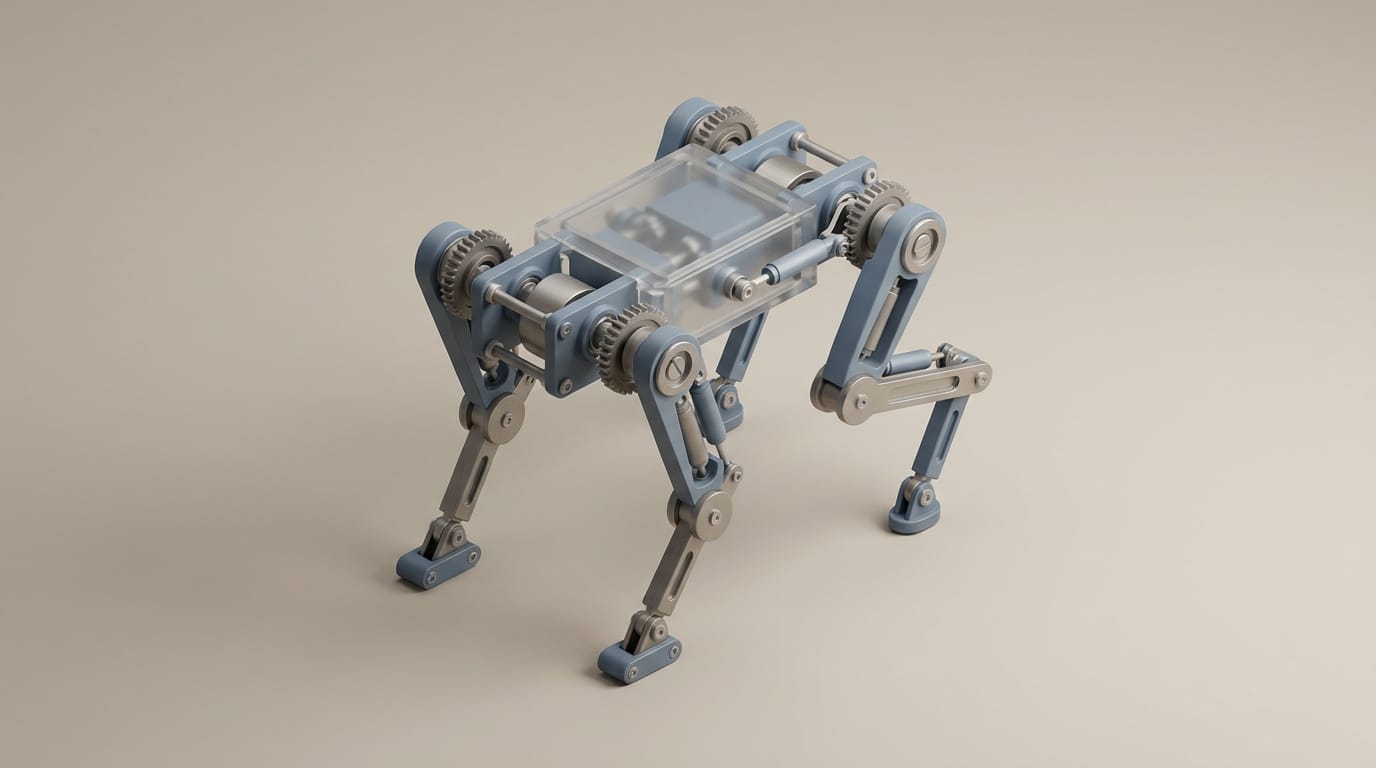
To achieve the versatility required for rough terrain, a robotic leg must have multiple degrees of freedom (DoF), typically at the hip, knee, and ankle. Each joint adds complexity to the system. The controller must solve inverse kinematics in real time to place a foot at a specific coordinate. While a simple two-DoF mechanism provides basic movement, modern quadrupedal designs often use three or more joints per limb to expand the reach and allow for lateral steps.
This increased articulation enables robots to climb stairs or navigate gaps that would stop a wheeled vehicle. However, every additional motor increases mass and complicates the distribution of inertia. Managing these hardware constraints is critical. Excessive weight at the end of the leg increases the energy needed to accelerate and decelerate during a stride, which can quickly drain battery life.
The Energetic Cost of Transport
Engineers evaluate locomotion systems using the Cost of Transport (CoT). This metric measures the energy required to move a specific mass over a distance. Historically, legged robots have struggled with high CoT compared to wheeled vehicles. On flat ground, wheels are significantly more efficient. Recent research shows that adding wheels to legged platforms can reduce the cost of transport by over 80 percent compared to purely legged designs.
This efficiency gap exists because purely legged systems must use energy to support their own weight against gravity with every step. Wheels avoid this through continuous contact. To close this gap, engineers study animal scaling formulas. These suggest that legged platforms could be as efficient as wheeled ones if the design optimizes power transmission. Reducing the CoT is essential for moving from laboratory prototypes to long-duration industrial robots.
Morphological Intelligence in Mechanical Design
The next frontier in legged robot locomotion engineering is morphological intelligence. This is the idea that the physical shape and mechanical properties of the robot can solve stability problems without software help. Instead of relying solely on fast control loops, engineers design hardware that naturally moves toward a stable gait. This approach treats the body as a primary filter for environmental noise rather than a passive tool for the software.
Modular Links and Force Filtering
Modular links and joint geometries can act as a low-pass filter for the forces felt during ground contact. When a leg hits the ground, the mechanical impedance of the limb determines how that force moves to the chassis. By optimizing link lengths and mass distribution, engineers ensure that the structure absorbs small bumps. This reduces the work for the central processor, allowing the software to focus on path planning rather than micro-adjustments for every pebble.
This concept mirrors how biological systems adapt to physical stress, where the structure of the limb is tuned for the environment. In robotics, this means using lightweight materials for the lower leg to minimize swing inertia while reinforcing the hip joints to handle the high torques required for jumping and recovery.
Passive Elasticity as a Mechanical Buffer
Integrating mechanical springs and tendons into the leg design allows the system to store and release energy. These passive elastic elements act as a buffer, protecting gearboxes from the high-frequency impact loads of a foot-strike. A well-tuned spring system can also improve energy efficiency by capturing energy during the braking phase of a step and releasing it during propulsion.
While passive dynamics simplify some aspects of control, they introduce non-linearities that the system must model. A robot with springs in its legs behaves like a mass-spring-damper system with its own resonant frequencies. If the movement frequency matches the resonant frequency of the legs, the robot moves with high efficiency. Deviating from this point can lead to instability or excessive vibration.
Actuation Systems for High-Impact Locomotion
The choice of actuator is the most critical decision in legged robot design. For a machine to survive running or jumping, its motors must handle sudden, massive forces without damaging internal gears. This has led to specialized actuation designs that prioritize transparency and back-drivability over raw power.
Proprioceptive Actuators and Feedback
Traditional industrial actuators use high gear ratios that are impossible to move by hand when powered off. In contrast, proprioceptive actuators (often called Quasi-Direct Drive) use high-torque motors with low gear ratios. This design allows the motor to feel ground contact forces directly through the gearbox. Because the system is back-drivable, the robot can detect a collision by monitoring motor current rather than relying on fragile external sensors.
The MIT Cheetah project popularized this approach, demonstrating that low-gear-ratio actuators outperform high-ratio motors in dynamic scenarios because they have lower reflected inertia. By keeping this value low, the leg can respond almost instantly to impacts. This allows the motor to move backward and absorb energy before it damages the mechanical structure.
Thermal Management and Force Control
To make these actuators work, the motors must produce immense torque at low speeds. Large-diameter motors with many magnetic poles generate the force needed for explosive movements like leaping. However, high current creates significant heat. Continuous vertical loading, such as standing for long periods, can overheat the actuators if the system does not dissipate heat efficiently.
Alternative designs, such as Series Elastic Actuators (SEAs), place a physical spring between the gearbox and the joint. This protects the gears and provides excellent force control but limits the speed at which the robot can adjust its joint positions. Engineers must choose between the high-frequency response of a direct drive system or the safety and precision of an SEA setup.
Mathematical Frameworks for Balance and Gait
Once the hardware can handle locomotion forces, the next challenge is the mathematical orchestration of those movements. Balancing a legged robot is a problem of managing angular momentum and the center of mass (CoM) relative to the ground contact points.
Zero Moment Point and Pendulum Models
For walking at slow speeds, engineers often use the Zero Moment Point (ZMP) criterion. The ZMP is the point on the ground where the net horizontal moment is zero. As long as the ZMP stays within the area enclosed by the feet, the robot will not tip. This model works well for humanoids like ASIMO but is less effective for fast movements where the robot may have only one foot on the ground.
For faster movement, the Linear Inverted Pendulum Model (LIPM) is the standard tool. In this model, the robot is treated as a point mass on a massless leg. This simplification allows engineers to calculate how the CoM should move to maintain balance. By identifying the capture point (where the robot must place its foot to stop) the controller can plan a sequence of steps that keeps the system stable even when pushed.
Model Predictive Control for Planning
Modern legged robots use Model Predictive Control (MPC) to manage multi-step planning. MPC solves an optimization problem in real time, predicting the robot’s path over a short future window. It adjusts ground reaction forces and foot placements to follow a desired velocity while maintaining a stable posture.
The strength of MPC lies in its ability to handle constraints, such as motor torque limits or ground friction. When the robot hits a slippery surface, the MPC automatically reduces horizontal forces to prevent a fall. This real-time optimization allows for smooth transitions between different movements, such as shifting from a walk to a trot, without needing a pre-programmed sequence for every scenario.
Sensory Fusion for Unstructured Terrain
For a robot to move confidently, it must know its exact position and what the ground looks like. This requires fusing internal sensor data with external data from LiDAR or cameras. The challenge is that these sensors operate at different speeds and have different noise levels.
The Inertial Measurement Unit (IMU) is the heart of the balance system. By measuring acceleration and velocity at high frequencies, the IMU provides a fast estimate of the robot’s orientation. This data is merged with leg odometry, which is the calculated position of the feet based on joint angles. This process is essential for detecting foot slip. If the IMU says the robot is falling but the leg sensors say the foot is stationary, the controller knows the ground has given way.
Advanced state estimation algorithms merge these signals into a single estimate of velocity and position. This internal sense of self provides the foundation for all navigation. While internal sensors tell the robot it is falling, external sensors tell it why. LiDAR and depth cameras create a local map of the terrain, allowing the planner to choose foot placements that avoid obstacles. Fusing high-speed internal data with visual data allows the robot to stay stable even when vision is obscured by dust or smoke. This is a primary use case for neuromorphic computing, which could process these high-speed sensory inputs more efficiently than standard processors.
Future Directions in Legged Robot Locomotion Engineering
As hardware matures, the focus is shifting toward Reinforcement Learning (RL) to handle edge-case movements. While traditional MPC is excellent for stable walking, it struggles with acrobatic maneuvers or recovery from major failures. RL allows a robot to learn a control policy through millions of trials in simulation, discovering strategies that a human might not conceive.
Training a neural network in a physics engine with randomized terrain allows researchers to create policies that are durable in the real world. These controllers have helped quadrupeds navigate terrain once thought impossible, such as loose rubble or icy slopes. The next step is to combine the long-term planning of MPC with the reactive agility of RL to create a unified framework for movement.
There is also growing interest in soft robotics and biological mimicry. Instead of rigid metal links, future robots might use variable-stiffness materials that adapt on the fly. This would allow a robot to become rigid for stability and soft for impact absorption, much like a cat landing from a jump. Combined with hybrid designs that use wheels for efficiency and legs for agility, these advances will eventually allow legged robots to work in search-and-rescue or urban delivery.
The core insight of legged robot locomotion engineering is that physical design and control logic are inseparable. When we design a machine that walks, we are building a system that understands the language of gravity and friction. By using morphological intelligence and advanced actuation, we can create machines that do not just move through the world, but actively participate in its complexity. The ultimate goal is a robot that moves with such natural ease that the distinction between its mechanical structure and its software brain disappears.