
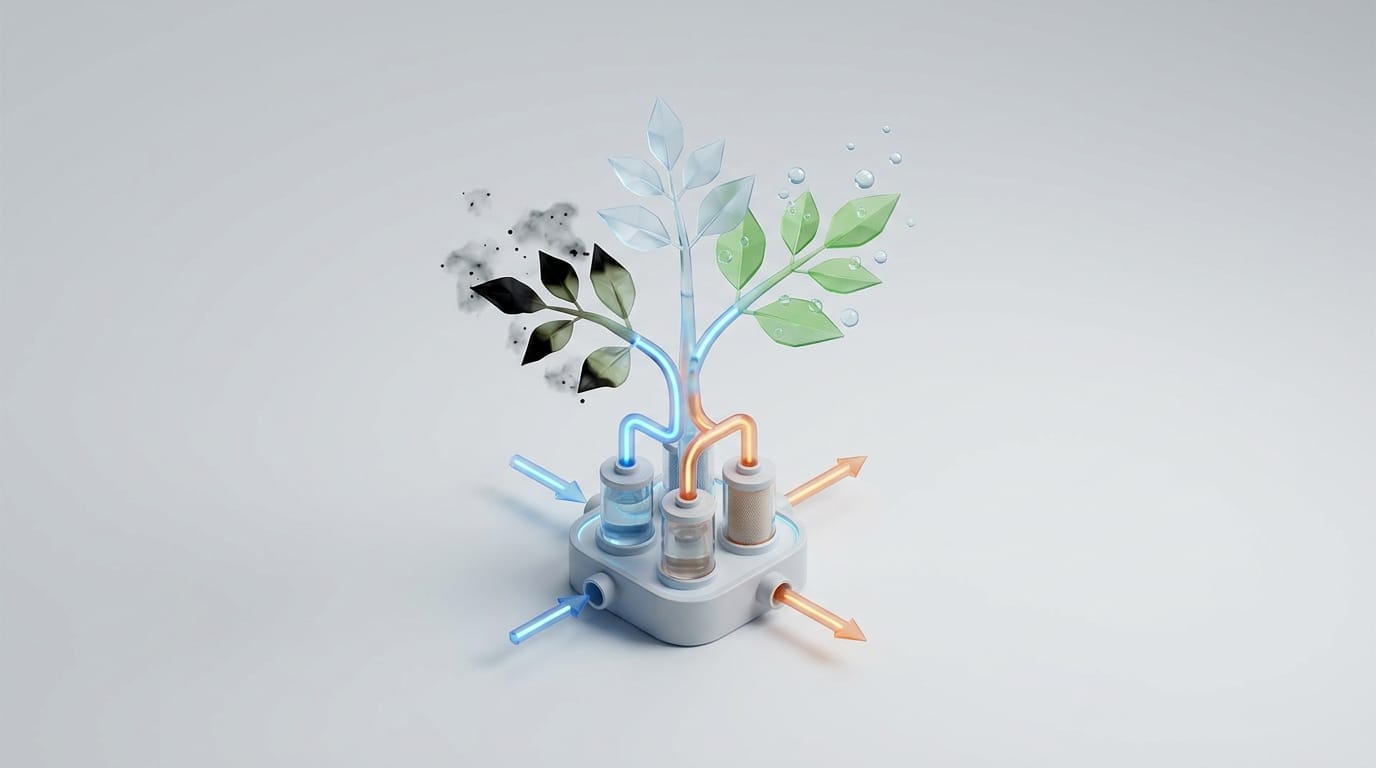
When houseplant enthusiasts see dark spots on their plants, they often reach for a watering can, but the cause usually stems from a deep failure in the plant’s water flow. Understanding botanical fluid dynamics explains why houseplant leaves turn black when internal filters fail due to indoor conditions. This dark color signals a deep health issue rather than a simple cosmetic flaw. It marks the visible result of a metabolic bottleneck where minerals build up at the leaf’s farthest reaches.
To diagnose this issue, one must look past the soil surface and into the plant’s plumbing. Plants do not drink water like animals; they function as a hydraulic column spanning from root hairs to the microscopic pores on the leaf undersides. Chemical imbalances or dry air disrupt this column, causing the system to fail at its most vulnerable points: the leaf tips and margins.
This guide explains the natural process of transpiration and how it turns sensitive plants into unintended filters for tap water additives. By viewing houseplants as a series of pressure gradients and terminal sinks, you can move beyond guesswork and address the root causes of tissue death in your indoor garden.
The System of the Transpiration Stream
The air’s thirst drives water movement through a plant. Inside the plant, xylem tissues transport water and dissolved minerals upward. Unlike the human circulatory system, the plant relies on negative pressure. As water evaporates from the leaves, it pulls the entire column of water up through the stem.
Xylem and Nutrient Transport
Xylem vessels act like biological straws made of dead cells. Because water molecules stick to each other, they form a continuous chain. When the air pulls a molecule from the top, the tension draws the next molecule up to take its place. This system works efficiently but pulls in everything dissolved in the soil water.
This transport mechanism supports health by moving nutrients like calcium to growing tips. However, external factors like light and temperature control the speed of this flow. If the stream moves too slowly, the plant lacks nutrients; if it moves too quickly, it imports high levels of minerals into the foliage.
Stomatal Gas Exchange and Water Flow
The system uses stomata as valves. These microscopic openings, usually on leaf undersides, regulate the exchange of carbon dioxide for oxygen while serving as the exit point for water vapor. When stomata open, the plant breathes and cools itself. This process allows real-time sensors to track internal water pressure before visible wilting occurs.
If the plant faces high heat or low humidity, the stomata close to save water. While this prevents drying, it also stops the transpiration stream. This stoppage leads to mineral logjams within the leaf tissue because the water can no longer distribute them. Maintaining home balance helps the plant keep this delicate dance of cooling and feeding.
Understanding Why Houseplant Leaves Turn Black
The concept of a terminal sink clarifies why houseplant leaves turn black because it identifies the end of the plumbing line. For a plant, the leaf tips and outer margins are the final destinations. While water can exit as a gas, dissolved minerals cannot. This makes the leaf tips act as filters that catch everything the water leaves behind.
The Problem with Fluoride and Chlorine
Municipal water often contains fluoride and chlorine. While safe for humans, these elements act as poisons for certain plant species. When a plant takes up fluoridated water, the fluoride travels through the xylem to the leaf margins. Since fluoride cannot exit through pores, it stays in the tissue. Over time, the concentration increases as water evaporates, reaching lethal levels according to researchers at the University of Missouri.
Species like Peace Lilies and Dracaena show this clearly because their leaf shapes funnel water toward a single point. As water leaves the plant, fluoride levels at that specific tip rise far above the levels in the soil. This explains why a healthy leaf may have a single, coal-black tip while the rest of the leaf remains green.
How Mineral Buildup Causes Tissue Death
When minerals like fluoride or sodium reach high levels, they trigger cellular necrosis. This is a chemical burn from the inside rather than rot from a fungus. These minerals block photosynthesis and destroy cell walls. As cells die, they lose the ability to hold water, causing the tissue to collapse and turn black. The plant uses this localized death to trap toxins in a dead zone, protecting the rest of its body.
Telling the difference between chemical burns and fungal rot helps with proper care. Chemical burns usually show a sharp line between dead black tissue and healthy green areas. Fungal infections often display a yellow halo or a mushy texture that spreads unevenly. If the blackening stays at the tips and edges, you likely have a transpiration failure rather than a disease.
How Water Quality Affects Plant Health
The water you provide serves as the main input for the plant’s internal system. When that input contains high levels of salts or additives, the soil becomes hostile. This disruption often starts in the potting medium before showing up as black leaves. As the plant uses water, minerals stay behind and form a crust on the soil and pot.
Tap Water Additives and Soil Balance
Tap water often carries high levels of calcium and magnesium. While plants need these, too much can make the soil alkaline. High pH levels can lock out iron, creating more stress. Furthermore, experts at Michigan State University note that water softeners replace calcium with sodium. Sodium is highly toxic to houseplants and speeds up the blackening of leaf tips.
Setting water out for a day does not solve the problem. While some chlorine gas may leave, this method does nothing to remove fluoride or salts. In fact, as some water evaporates, the fluoride concentration actually increases. To remove these additives, you must use reverse osmosis, distillation, or rainwater.
Salt Buildup in Potting Mix
Fertilizers also add soluble salts to the water stream. If a plant grows slowly, it cannot use these minerals fast enough, leading to soil buildup. High soil salinity pulls water away from the roots. This makes it hard for the plant to drink, even if the soil feels damp. Professionals call this state a physiological drought.
Salty soil can also repel water. To keep the system flowing, you must use effective methods for fixing soil that repels water to flush out salts. Without this care, mineral levels in the leaf tips will exceed the plant’s tolerance and cause the margins to turn black.
The Impact of Humidity on Respiration
The air acts as the pull on the transpiration stream. In tropical environments, moist air doesn’t pull hard on the leaves. In a climate-controlled home, especially during winter, the air is very dry. This creates a high Vapor Pressure Deficit, which measures how much moisture the air wants to pull from the plant.
Air Dryness and Leaf Stress
Thirsty air pulls water out of the leaves aggressively. This speeds up the transpiration stream. If the water contains minerals, this high evaporation rate causes toxins to build up at the tips much faster. Dry air essentially forces the plant to process more water and more toxins through its terminal sinks every day.
When the air’s pull becomes too strong, the plant may close its stomata to stay hydrated. However, room heat continues to stress the leaf. Without the cooling effect of water movement, the leaf temperature rises and damages cells. The plant faces a hard choice: lose too much water and poison its tips, or stop water flow and overheat.
Why Misting Fails
Closing stomata also stops the flow of carbon dioxide, which halts photosynthesis. A plant that cannot make food cannot repair damaged cells. This explains why misting a plant usually fails. Misting provides a brief humidity boost that lasts only minutes. It does not solve the deep respiration issues caused by constant dry air. Using a humidifier provides a steady base of moisture to reduce stress on the water stream.
Methods to Prevent Leaf Blackening
Once you see leaf blackening as a plumbing issue, the solutions become clear. You must improve the water quality or clean out the soil. While you cannot fix a leaf tip that has already turned black, you can stop the spread and protect new growth.
Switching Water Sources
The fastest fix for sensitive species involves stopping the use of tap water. Distilled water, reverse osmosis water, and rainwater contain almost no dissolved minerals. Switching to these sources stops the flow of new fluoride and chlorine into the leaf tips. Over several weeks, the plant uses the remaining water in its system, and the mineral logjam stops growing. This is a vital step for choosing the right garden supplies and keeping plants resilient.
Flushing the Soil
To fix the soil, you must perform a mechanical flush. Pour a volume of distilled water equal to twice the size of the pot through the soil. This water dissolves built-up salts and carries them out through the drainage holes. This resets the soil’s chemistry and allows roots to absorb water more easily. Doing this every few months maintains health for sensitive plants.
You can also balance the soil by adding small amounts of garden lime or gypsum. These materials can adjust pH and bind certain minerals, making them less harmful to the roots. Always check the plant’s specific needs before adding these. Balancing water inputs with soil flushing creates a stable environment where water supports life rather than carrying toxins.
Black leaf tips signal a complex hydraulic system struggling with its environment. By viewing leaves as terminal sinks and air as a driving force, you can diagnose these issues with precision. When you provide clean water and maintain humidity, the transpiration stream stays healthy. This understanding shifts your care from reacting to damage to managing the environment. Success depends on whether the roots can keep up with the air’s demand.