
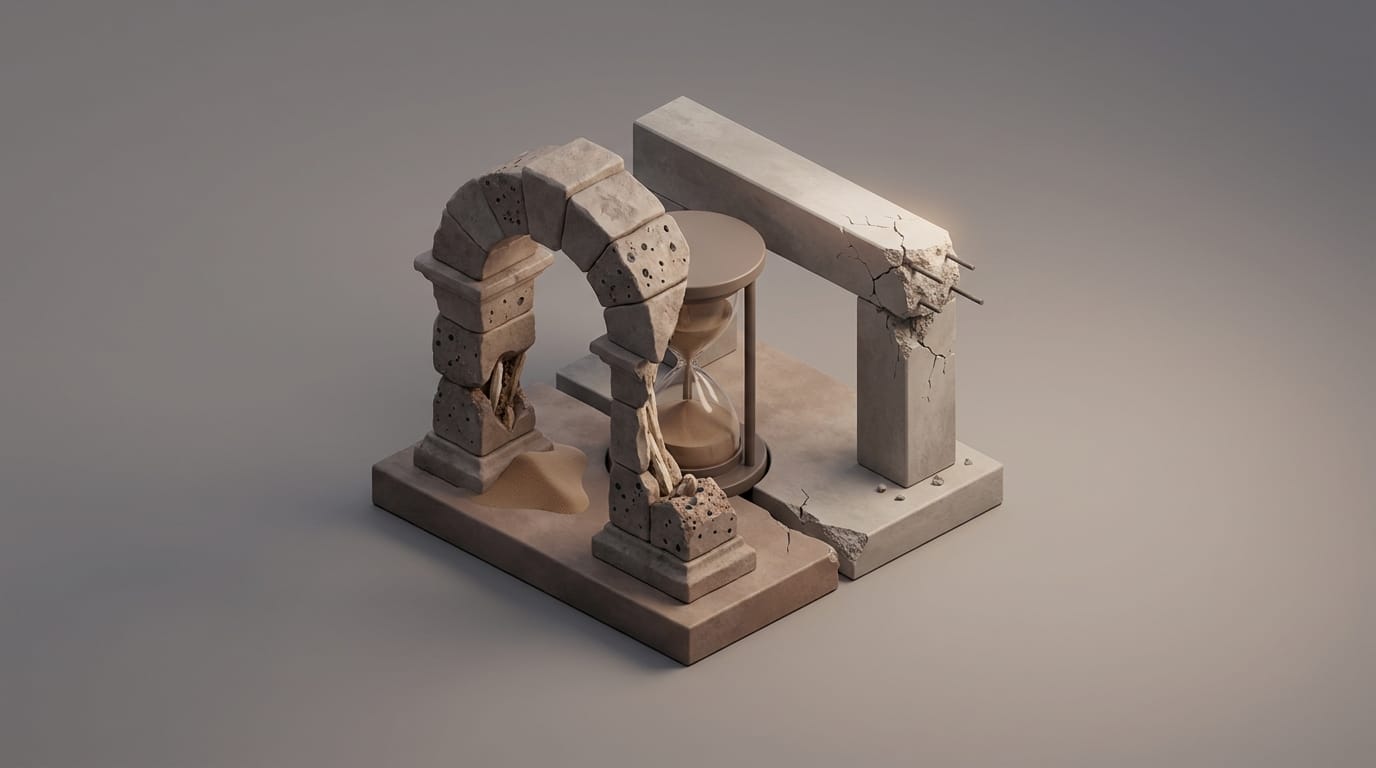
While modern concrete structures often begin to crack and crumble within a few decades, Roman marine barriers and temples have survived two millennia of salt-water erosion and seismic activity without any steel reinforcement. When evaluating roman concrete vs modern concrete, we discover a fundamental difference in how these materials interact with time and the surrounding environment. Modern construction prioritizes rapid setting and predictable results to satisfy global logistics and high-rise demands. In contrast, the Romans engineered a material that functions as a living geological system. This difference explains why ancient harbor piers in Italy have grown stronger over centuries, while modern sea walls require constant maintenance to survive even fifty years.
To understand why these ancient structures outlast our own, we must look past the visible masonry and into the chemical reactions occurring at a molecular level. The longevity of Roman work is not a mystery of lost magic; it is the result of a specific engineering philosophy that favored chemical evolution over static stability. By embracing the natural reactive properties of volcanic materials, ancient builders created a substance that heals itself rather than breaking down under stress.
Roman Concrete vs Modern Concrete: The Chemical Difference
The primary distinction in roman concrete vs modern concrete lies in the binder used to hold the material together. Modern engineers rely on Portland cement, a mixture of limestone, clay, and other minerals fired at about 1,450 degrees Celsius. This creates a uniform, inert material that provides immense compressive strength quickly. This speed is a requirement for the fast-paced cycles of the global construction industry, where projects must be finished in months rather than decades.
Roman builders followed a different path by using a mix of volcanic ash, known as pozzolana, and quicklime. Unlike the inert sand and gravel used as fillers today, this volcanic ash is a reactive material. When builders mixed it with water and lime, it triggered a pozzolanic reaction that continues for decades. This slow process transforms the internal matrix of the structure into a dense network of interlocking minerals that become more stable over time.
Engineers today almost always reinforce modern concrete with steel rebar to provide tensile strength, which allows for slender beams and tall buildings. However, steel often becomes the primary point of failure. Over time, water and salt penetrate the porous modern cement and cause the steel to rust. As the rust expands, it creates internal pressure that leads to spalling, a process where the concrete cracks and falls away from the inside out. Roman concrete lacks this internal vulnerability because its chemical structure is naturally more flexible and resistant to fractures. By avoiding steel, the Romans removed the most common cause of structural decay.
How Seawater Functions as a Strengthening Catalyst
For a modern engineer, seawater is an aggressive corrosive agent that destroys infrastructure. For the Romans, however, salt water acted as a vital catalyst. Research into ancient maritime structures has revealed that the interaction between seawater and the volcanic minerals produces rare crystals known as aluminous tobermorite and phillipsite. These minerals do not form during the initial set of the concrete; instead, they grow over centuries as seawater moves through the material.
According to a study led by researchers at MIT, this process allows the concrete to become a dynamic entity. The seawater dissolves the volcanic glass and replaces it with these interlocking crystals, which are remarkably resistant to fracturing. This mineral growth acts as a form of secondary reinforcement that develops long after the builders leave the site. While modern concrete becomes more brittle as it ages, Roman maritime concrete actually gains structural integrity.
The long, plate-like crystals of tobermorite allow the material to bend slightly under stress rather than snapping. This flexibility is a critical advantage in high-energy environments like crashing surf or seismic zones. By allowing the environment to complete the chemical process, the Romans created a material that was perfectly suited for its location. This shift from resisting the sea to using the sea as a partner in construction represents a peak of ancient material science that we are only now beginning to fully grasp.
The Self-Healing Mechanism of Ancient Masonry
One of the most striking differences in roman concrete vs modern concrete is the presence of lime clasts. For centuries, archaeologists viewed these small white chunks of lime as evidence of poor mixing or sloppy workmanship. However, recent analysis has shown that these clasts are actually the secret to the self-healing properties of the material. The Romans used a process called hot mixing, where they added quicklime to the volcanic ash at extremely high temperatures.
This process created a brittle, reactive source of calcium throughout the structure. When a micro-crack forms in the concrete, it eventually hits one of these lime clasts. This reaction mimics biological systems, much like how the bone remodeling process adapts to physical stress by filling in small fissures to maintain skeletal integrity. When water enters a crack in the Roman concrete, it dissolves the lime clast to create a calcium-saturated solution.
This solution quickly recrystallizes as calcium carbonate, which effectively glues the crack shut before it can expand into a major failure. Modern concrete is rigid and chemically finished once it cures, so it has no such mechanism to repair itself. Once a modern structure cracks, the path for water and corrosive elements remains permanently open. By embedding these “healing packets” of lime, the Romans ensured that their buildings could survive the minor shifts and settles of the earth without collapsing.
The Sustainability Paradox of Ancient Construction
There is a common misconception that Roman concrete was greener to produce than modern Portland cement. The reality is more complex because producing lime required significant energy to heat limestone to 900 degrees Celsius. While this is lower than the 1,450 degrees required for modern cement, Roman kilns were far less efficient. This often resulted in a carbon footprint per volume that is similar to what we see in modern methods.
However, the sustainability of a material depends on its total lifecycle rather than just its initial production. A modern bridge or pier that must be replaced every fifty years carries a massive recurring carbon debt. If a structure can last two thousand years, the initial energy investment is spread across twenty centuries. This makes the environmental impact per year almost negligible. Durability and sustainability are functionally linked; a material that does not need to be replaced is always more efficient than one that must be rebuilt every generation.
By creating structures that do not require constant maintenance or frequent sealing against the elements, the Romans avoided the disposable infrastructure model of the modern era. This long-term thinking reduces the need for new raw materials and avoids the massive emissions associated with demolition and reconstruction. Ancient builders prioritized the legacy of their work, recognizing that a building’s true value is measured by its permanence rather than the speed of its assembly.
Applying Ancient Engineering to Modern Infrastructure
If the Roman method is so superior, the question remains why we do not use it for every skyscraper and highway today. The answer lies in the trade-offs of modern engineering. Roman concrete takes a long time to set; it sometimes requires months to reach full strength, whereas modern construction schedules require concrete to bear full loads within twenty-eight days. Furthermore, Roman concrete is not suitable for the thin, tension-heavy designs of modern high-rises that rely on the tensile strength of steel.
However, a growing movement is working to apply these ancient lessons to specific types of infrastructure. In coastal protection and sea wall construction, where seawater is already present and structures must endure for generations, Roman-inspired materials are becoming a reality. These new mixtures are designed to be reactive by incorporating volcanic elements and lime clasts to ensure they heal themselves in harsh marine environments.
Modern researchers also study ancient transport methods to understand how these massive projects were managed. Just as the transport systems of the Olmecs show how ancient societies moved massive resources, the Roman concrete industry shows how a society can optimize for longevity. Current efforts to lower the carbon footprint of the building industry, as seen in recent life cycle assessments, may rely on combining modern speed with ancient chemical resilience.
The fundamental insight of the Roman system is that permanence is not achieved through rigidity, but through adaptation. By engineering a material that interacts with its environment rather than resisting it, the Romans created a built environment that outlasted their empire. Modern engineering is beginning to realize that the most sustainable structure is the one that never needs to be rebuilt. This shift toward a living infrastructure could redefine how we approach the climate challenges of the coming century. If we can master the chemistry of self-healing and environmental catalysis, we might finally build structures that our descendants can study two thousand years from now. We must ask if we can afford to continue building for decades when the ancients proved it is possible to build for millennia.