
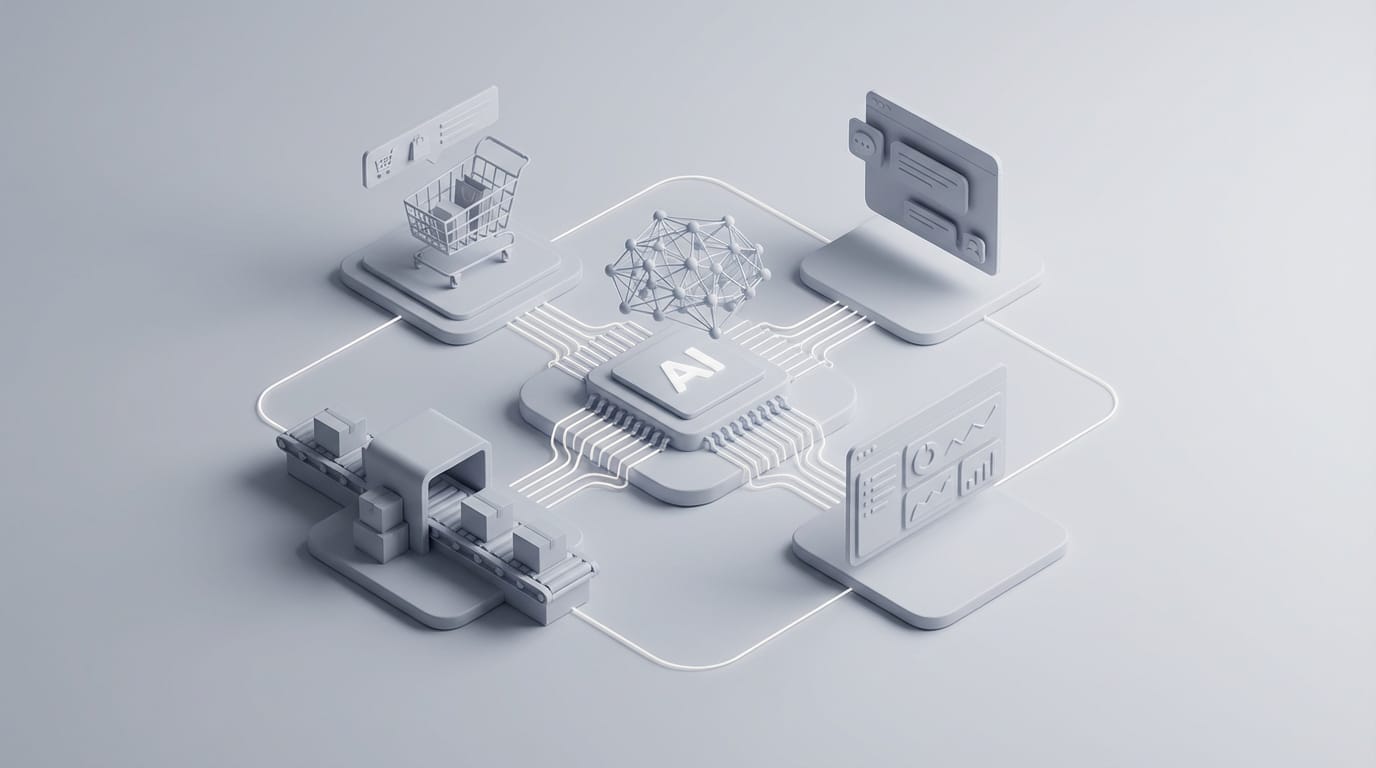
The true cost of modern retail is rarely found in marketing spend alone, but rather in the integration debt created by siloed data that prevents a responsive customer experience. As digital environments shift, the successful use of AI in e-commerce has moved from being a luxury of the elite to a core requirement for survival. Businesses that fail to bridge the gap between their marketing insights and shipping realities often find themselves trapped in a cycle of wasteful spending and missed sales.
When we discuss artificial intelligence in this context, we are moving beyond the surface-level magic of chatbots and into the structural mechanics of how a business functions. The goal is internal agility, a state where inventory systems, advertising platforms, and shipping centers operate as a single, living organism. By reducing the friction between these departments, companies can finally stop reacting to yesterday’s data and start predicting tomorrow’s demand. This shift allows a company to spend its budget on the customers most likely to buy and the products most likely to ship on time.
A unified data strategy ensures that every department speaks the same language. For many brands, the marketing team uses one set of tools while the warehouse team uses another, and these systems never trade notes. This lack of communication leads to “ghost inventory,” where a website says an item is in stock even though the warehouse shelf is empty. By the time the systems sync up, the brand has already paid for an ad and frustrated a customer. Fixing this requires a move toward a central brain that watches every part of the business at once.
The Evolution of Artificial Intelligence in Online Retail
History shows that intelligence in digital stores once meant simple sorting. These systems relied on basic logic; if a customer bought a hammer, the system would suggest nails. While this worked for basic sales, these models were static and could not account for the nuance of human behavior or the sudden changes in global supply chains. They solved specific problems in isolation without understanding the broader context of the business. They could not tell the difference between a one-time gift buyer and a loyal fan of the brand.
Moving Beyond Basic Product Recommendations
The move from simple logic to deep learning has changed how retailers use their data. Modern machine learning models now look at thousands of factors at once, including how fast a user scrolls, regional weather patterns, and social media trends. This shift allows for a more fluid discovery process where the system doesn’t just respond to a search but anticipates a need before the user says it. Looking at how software platforms change to meet user needs shows a clear trend toward predictive design rather than reactive tools. These systems learn that a customer looking at umbrellas in a rainy city needs different options than a customer looking at umbrellas in a sunny beach town.
The Shift from Customer-Facing Tools to Operational Core
The real frontier is no longer just what the customer sees, but how the business operates behind the scenes. We are seeing a pivot where companies use AI to fix the operational core, which consists of the invisible systems that manage stock, price, and transit. Market data suggests that the global AI-enabled retail market recently reached approximately $8.65 billion, according to market data from industry analysts. This investment flows into backend agility rather than frontend gimmicks, as leaders realize that a personalized recommendation is useless if the item is out of stock in the nearest warehouse. A strong backend ensures that when a customer sees a “buy now” button, the promise of delivery is actually kept.
Solving the AI in E-commerce Integration Debt Problem
Integration debt occurs when a company stacks multiple high-tech solutions—like a top-tier CRM and a sophisticated warehouse manager—that cannot communicate. In a standard setup, the marketing team might launch a high-budget campaign for a product that is currently stuck in a port, leading to customer frustration and wasted ad spend. AI in e-commerce acts as the connective tissue that solves this by creating a unified data truth across the entire company. It watches the port, the warehouse, and the ad manager at the same time to ensure they are all in sync.
By using digital agents for business work, companies can sync their advertising bids with real-time stock levels. If a specific item drops below a certain level in a regional hub, the system can automatically lower ad spend for customers in that area. It then redirects those funds toward products with higher availability. This level of synchronization reduces the hidden costs of fragmented systems and ensures that every dollar spent on finding customers is backed by the physical ability to fulfill the order. This prevents the “out of stock” emails that destroy customer trust and brand reputation.
Breaking down these walls also enables a more accurate model for customer value. When marketing data combines with returns data and shipping costs, the system can identify which customers are actually profitable. Some customers drive high revenue but create even higher costs through constant returns or support calls. This clarity allows retail managers to prioritize service and stock for their most valuable segments, ensuring long-term health over short-term sales spikes. It turns the business from a broad net into a precision tool that keeps the most loyal customers happy.
Optimizing the Supply Chain Through Predictive Intelligence
Supply chain management used to be a game of best guesses based on old spreadsheets. However, the fragility of global shipping means that past performance no longer predicts future results. AI-driven demand forecasting uses machine learning to process vast datasets, including geopolitical shifts and micro-economic trends, to provide a granular view of what will sell and where it needs to be located. Instead of shipping everything to one central hub, companies can pre-position stock in smaller, local centers based on predicted demand.
- Demand Forecasting: Systems reduce stockouts and overstock by predicting regional spikes before they happen.
- Route Optimization: Models analyze traffic, fuel costs, and delivery windows to save time on the last-mile delivery.
- Automated Warehousing: Computer vision and robotics manage sorting and packing with minimal manual work.
Walmart provides a clear example of this in action. The company used AI to drop its stockout rates from 5.5% to approximately 3%, according to operational case studies from large retailers. By reducing surplus stock by 15% at the same time, they proved that precision is the best way to stop waste. This type of efficiency is critical because logistics networks break down not because of a lack of product, but because of poor distribution logic. When a product is in the wrong city, it is as good as being out of stock.
Beyond simple shipping, predictive tools help manage the “returns crisis” that plagues modern retail. AI can analyze common reasons for returns in specific regions or for specific items. If a shirt is frequently returned for being too small in one region, the system can adjust the size recommendations for future buyers in that area or flag the product for a quality review. This proactive approach stops the return before it happens, saving the business the high cost of reverse logistics and restocking.
Personalization That Drives Genuine Customer Loyalty
While backend systems keep the business running, the customer-facing side must integrate with the broader strategy to be effective. Hyper-personalization is the goal, where every touchpoint—from the initial search to the post-purchase follow-up—fits the individual’s context. This is no longer just about putting a name in an email; it is about conversational commerce and dynamic pricing that reflects market conditions in real time. The system should know that a customer who buys baby clothes will soon need toddler gear, and it should adjust the storefront accordingly.
Dynamic pricing models allow retailers to adjust costs based on competitor prices, stock age, and even the time of day. This is not about charging more, but about finding the right price that clears inventory while maintaining healthy margins. When paired with generative assistants, the discovery phase becomes smooth. Instead of filtering through dozens of categories, a customer can simply state their needs, such as a durable backpack for a three-day hiking trip in wet weather. The AI in e-commerce can then curate a list based on technical specs and current stock availability, ensuring the customer sees products they can actually receive quickly.
The post-purchase experience is where loyalty is truly won or lost. AI can monitor the delivery process and reach out to a customer if it detects a delay, offering a discount or alternative before the customer even complains. This proactive stance, driven by practical AI integration, shifts the relationship from a simple sale to a long-term connection. When a brand admits a mistake and fixes it before the customer notices, it builds a level of trust that marketing campaigns cannot buy. This automation handles the repetitive tasks of customer service, leaving human agents to handle the complex problems that require empathy.
Smart Implementation for Long Term Agility
For leaders looking to use these systems, the challenge is rarely the technology itself, but the move away from old infrastructure. High-performing organizations do not try to replace every system at once. Instead, they prioritize projects that solve data fragmentation first. The goal is to build a foundation where data flows freely before adding complex predictive layers on top. If the data is messy, even the smartest AI will produce poor results. Cleaning the data and connecting the pipes is the most important first step.
Measuring the success of these internal systems requires a shift in key metrics. Instead of looking only at conversion rates, managers should track internal agility metrics, such as the time it takes for a stock change to reflect in marketing spend. Another key metric is the reduction in manual touches per order. Success in AI in e-commerce is measured by how much invisible work the system handles. This allows human staff to focus on high-level strategy and creative problem-solving rather than spending their day updating spreadsheets or manually adjusting ad bids.
Training also plays a vital role. As these systems become more autonomous, the role of the retail associate and the manager shifts from doing the task to managing the system. Ensuring that your team understands how to read AI outputs and when to override them is essential for maintaining a strong organization. Exploring how to manage enterprise AI integration provides a roadmap for secure and scalable setup. A team that trusts the system but knows its limits will always outperform a team that follows the software blindly.
The move to an AI-driven retail model is an exercise in structural alignment. By moving past the hype of cool tools and focusing on the hard work of reducing integration debt, retailers can build systems that are genuinely responsive to a complex world. The competitive advantage of the next decade won’t belong to the company with the best ads, but to the one with the most unified data. As we look toward the future of retail, the question for every leader is no longer whether to adopt these systems, but how quickly they can dissolve the silos that hold their business back. Success requires a commitment to a single version of the truth across the entire enterprise.