
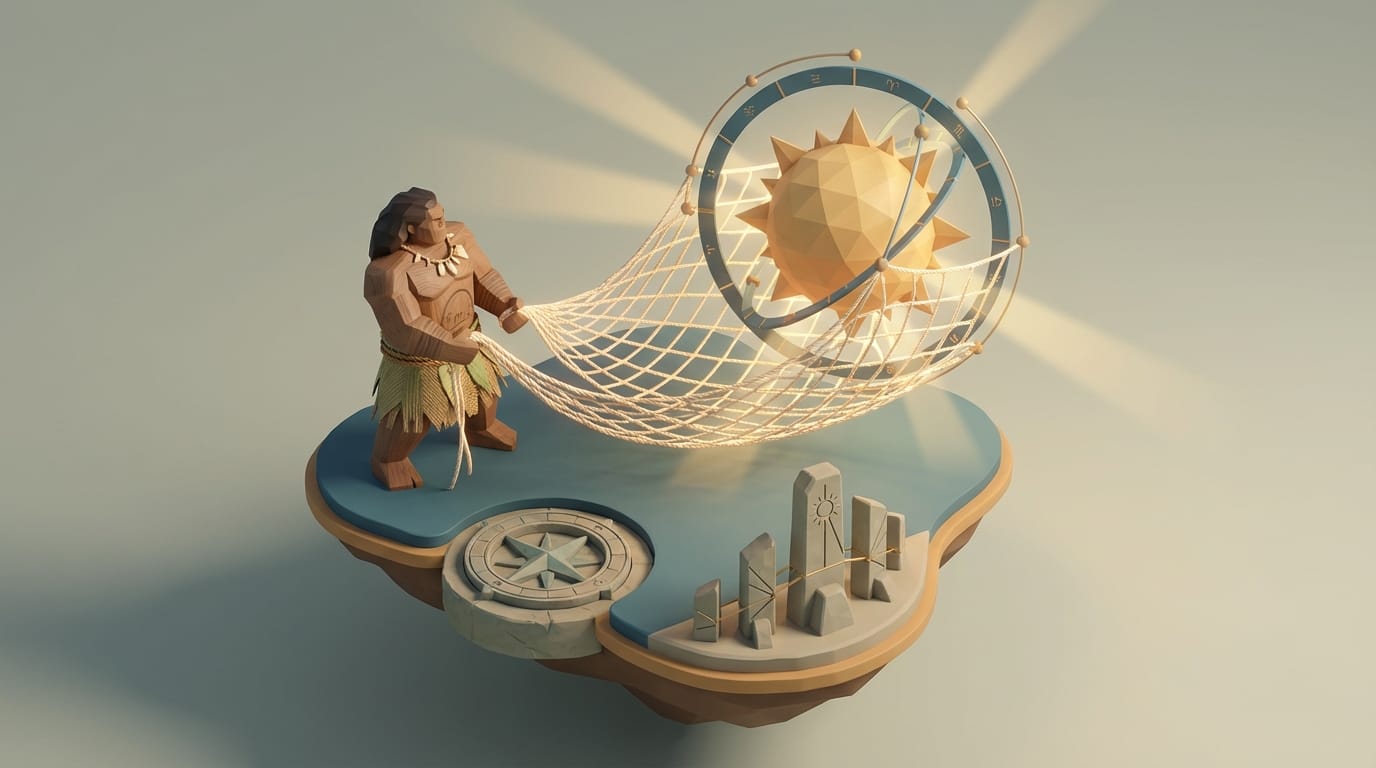
When people dismiss ancient myths as bedtime stories, they lose access to thousands of years of astronomical data hidden in verse. The legend of maui taming the sun represents more than a folk tale for children. It functions as a preserved manual for tracking how the sun moves across the horizon throughout the seasons. In oral cultures, these stories served as the primary storage for collective knowledge, ensuring that critical data survived environmental shifts and social changes. By treating the sun as a living entity that someone could rope, Polynesian navigators defined the specific points of sunrise and sunset that dictated the rhythms of life. Understanding this legend reveals the birth of the Polynesian calendar and the emergence of precision navigation.
Oral Mythology as an Ancient Data Storage System
Before societies used written records, they relied on narrative to preserve their observations. In Polynesian history, myths were practical systems for storing data rather than just creative explanations for the unknown. When a story describes a demigod performing a feat of nature, it usually serves as shorthand for a technological or scientific breakthrough. These stories changed as a society mastered its environment. Early versions of a myth might focus on why a natural phenomenon happens, but as a culture develops tools, the narratives explain how it happens. The technical details in Maui’s story, such as the rope materials and the snare location, served as a repeatable mental map for future astronomers.
This method of preservation proved durable. By putting astronomical constants into a high-stakes adventure story, the data remained resistant to corruption over time. A student might forget a list of compass degrees, but they would never forget the specific sequence of actions Maui took to halt the sun. This narrative approach mirrors how ancient solar metaphors helped track precise motion long before modern tools existed.
The Mechanics of the Maui Legend
The core problem in the legend is the “rushing sun.” In the narrative, the sun moved so quickly that crops could not grow, cloth could not dry, and people had no time to work. This provides a vivid metaphor for a pre-agricultural society struggling with the constraints of the solar day. The rushing represents the chaos of an unregulated schedule where the length of the day felt unpredictable. Maui solved this by making ropes and snares to capture the sun as it rose. In many versions, he used specialized materials like his mother’s hair or coconut husk fibers. These ropes represent tracking instruments. To snare the sun is to mark its position against the horizon, fixing its movement within a framework that allows for a stable calendar.
The tools in the myth reflect the materials available to Polynesian navigators. Just as the evolution of calendars redefined the modern world by organizing human activity, Maui’s snares synchronized planting and voyaging. The motivation to slow the sun represents the human realization that while we cannot change the sun’s speed, we can manage it through the predictability of its cycles.
Geographic Precision in the Polynesian Solar Map
The choice of Haleakalā on the island of Maui as the setting for the sun’s capture was no coincidence. The summit of Haleakalā serves as a premier natural observatory. From this height, the horizon is unobstructed, providing the 360-degree view necessary to track the sun’s migration throughout the year. In Polynesian ethnoastronomy, specific landmarks acted as fixed sights on a giant compass. When the legend describes Maui waiting at the edge of the crater to catch the sun’s first leg, it is describing a solstice event. During the summer and winter solstices, the sun reaches its furthest northern and southern points on the horizon. For an observer at the summit, these points are clearly defined against the physical world, marking the corners of the sun’s home.
The landing points mentioned in the story often align with actual solar positioning. By linking the demigod’s actions to specific peaks, the myth provided a geographic key for measuring the year. This precision allowed communities to predict the arrival of seasons with high accuracy. They knew exactly how much solar energy was available for their crops at any time. This connection between story and geography turned the island itself into a scientific tool.
Decoding the Snares: The Data Behind maui taming the sun
One of the most significant insights in the story of maui taming the sun lies in the number of ropes used. While variations exist, many accounts mention Maui using 16 or 32 ropes to bind the sun. In traditional Polynesian navigation, the horizon is divided into a 32-point star compass. These divisions, or houses, allow a navigator to maintain a course by referencing where celestial bodies rise and set. The 32 ropes are likely a direct reference to these 32 directions on the horizon. By binding the sun with these specific snares, Maui essentially created the star compass. Each rope represents a bearing. When the myth describes Maui tying the sun’s legs to these ropes, it refers to the sun’s path through these houses as the seasons change.
The broken legs of the sun, caused by Maui’s beating, serve as a metaphor for the solar standstill. At the solstice, the sun’s apparent motion along the horizon slows down significantly before it reverses direction. It appears as if it has been forced to limp. Research into Polynesian navigation shows that the star compass is a mental construct developed by master navigators like Nainoa Thompson to divide the horizon into small intervals. The legend encodes this 32-part division into a memorable story. The snares are the measurement points that allow a navigator to know their position on the ocean without instruments, simply by observing which house the sun is rising in on a particular day.
Taming as a Metaphor for Predictability
Taming represents the transition from chaos to regulated knowledge. Before Maui, the sun was an unpredictable force that governed humans. After Maui, the sun became part of a larger system. This shift allowed Polynesians to move beyond simple survival and into advanced agriculture and long-distance exploration. Knowledge of the predictable solar path allowed for agricultural schedules that were vital for island survival. By knowing exactly when the sun would slow down at the summer solstice, farmers could time the planting of crops that required maximum daylight. They could plan for the shorter days of winter and ensure food stores were sufficient. The sun was no longer a threat, but a clock to be read.
This understanding also extended to navigation. A tamed sun provided a reliable heading. By understanding the cyclical nature of the sun’s path, navigators could compensate for their latitude and maintain a steady course over thousands of miles of open water. The legend celebrates the moment human intellect overcame the seemingly erratic nature of the world, turning the sky into a tool for expansion. The predictability of the sun allowed explorers to colonize distant islands with the confidence that they could find their way home.
The Legacy of Polynesian Ethnoastronomy
Modern science validates the astronomical accuracy hidden within these oral records. The beating of the sun perfectly aligns with the physics of the ecliptic, where the sun’s daily progress along the horizon slows as it approaches the solstices. Researchers in cultural astronomy now view the Maui cycle as a sophisticated record of scientific methodology that rivals the written records of other civilizations. Preserving this indigenous technical knowledge is crucial for a complete understanding of human history. These myths demonstrate that science does not always require a laboratory; it requires observation, verification, and a system for sharing findings. The story of Maui shows that Polynesian societies mastered the complex geometry of the solar year long before contact with Western explorers.
The sophistication of these methods is reflected in the work of organizations like the Polynesian Voyaging Society, which continues to use traditional wayfinding techniques to navigate the Pacific today. By deconstructing the legend, we see that Maui was a scientist whose nets were the mathematical divisions of the world around him. His legacy is the realization that the universe operates according to a set of rules that people can understand and use. The story reveals a fundamental truth about how humans interact with the systems they live inside. We only gain agency when we move from observation to calculation. By encoding the 32-point star compass and the mechanics of the solstice into a legendary battle, ancient Polynesians ensured that the map of the sky would never be lost. This was not a story about changing the sun; it was a story about changing the human capacity to measure it. As we look to future technologies for tracking our environment, the durability of these ancient systems serves as a reminder that the most powerful tools are often the ones we carry in our minds.