
The Evolution of Automotive Industry Electrification
Treating electric vehicles as mere replacements for internal combustion engines ignores the fundamental shift in how we manufacture transportation and manage the global power grid. Beyond simple battery chemistry, automotive industry electrification represents a change in the mechanical and economic architecture of movement, turning cars from static goods into dynamic energy assets. For over a century, the automotive sector relied on a linear model of assembly and a singular purpose for the finished product. Today, those boundaries are dissolving. The vehicle is no longer just a tool for transit; it is a software-defined node in a larger energy system, capable of powering a home or stabilizing a municipal grid during peak demand. Understanding this system requires looking past the tailpipe to the assembly floor and the electrical socket.
The Transition from Internal Combustion to Electric Systems
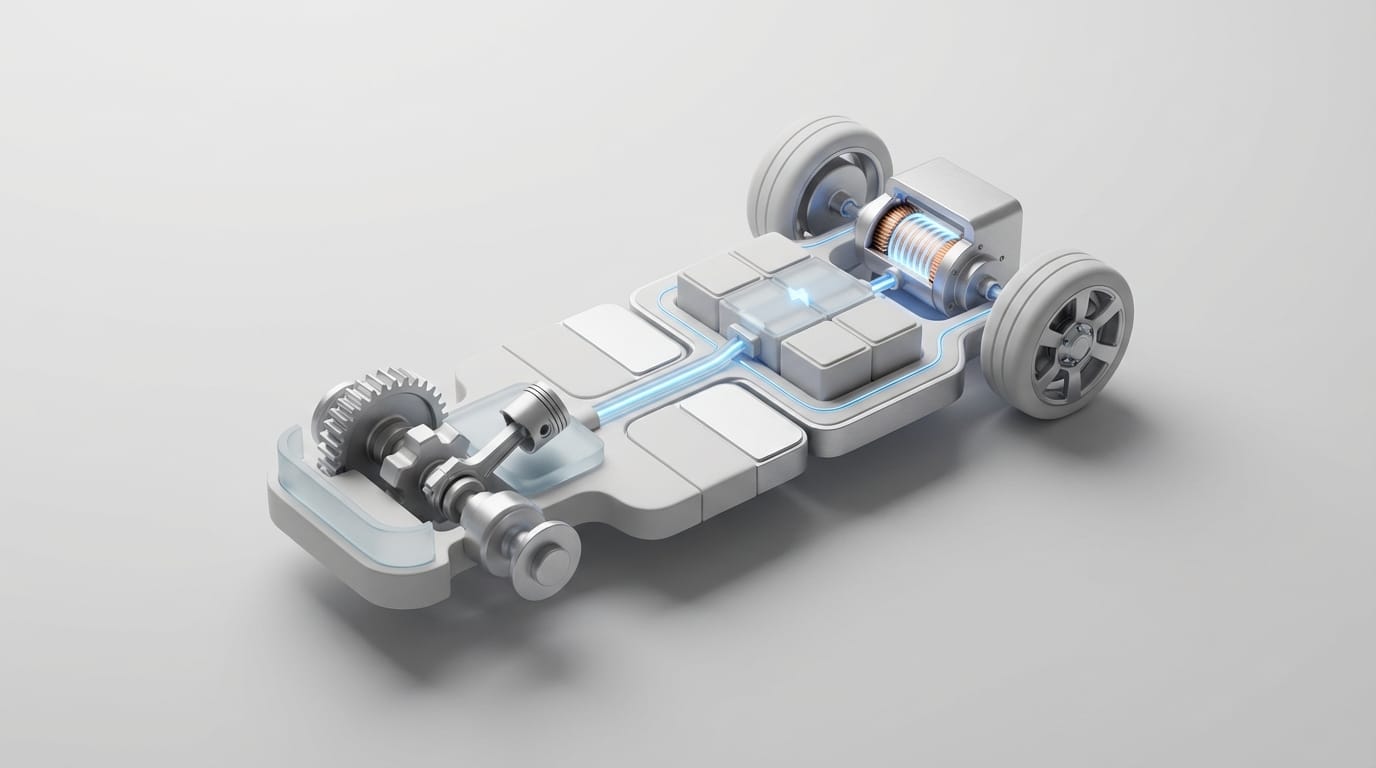
Electric drivetrains simplify the physical makeup of the modern vehicle, marking a stark departure from traditional engineering. A typical internal combustion engine drivetrain contains over 2,000 moving parts, each requiring precise lubrication, cooling, and synchronized timing to function. In contrast, an electric drivetrain often consists of fewer than 20 moving parts, primarily centered around the motor and the gearbox. This reduction in physical components serves as the catalyst for a total system redesign that changes how manufacturers value their products.
Mechanical Complexity and Software Integration
Because an electric motor provides instant torque and requires no multi-speed transmission to reach highway speeds, the hardware becomes a secondary concern. The primary value shifts to the Battery Management System and the vehicle’s operating software. To understand the underlying science of how these power sources function at a molecular level, you can explore the way batteries store and release energy through electrochemistry. This shift allows manufacturers to improve a vehicle’s range or acceleration through wireless updates, effectively repairing or upgrading the car without it ever entering a service bay. The vehicle becomes a living product that improves over time, rather than a mechanical tool that begins to degrade the moment it leaves the lot.
The Structural Advantage of the Skateboard Platform
The removal of the bulky engine, transmission tunnel, and exhaust system has allowed engineers to adopt a flat architecture often called the skateboard platform. This design places the battery pack and motors in a heavy slab at the base of the vehicle. By lowering the center of gravity, the skateboard improves safety and handling while offering immense design freedom. Without a fixed engine bay, the interior cabin can be expanded and reconfigured to suit different needs. This versatility is already shaping the economic impact on urban infrastructure as cars transform into mobile offices or shared living spaces. Modern designers no longer work around a vibrating, heat-spewing metal block, which lets them prioritize passenger comfort and utility in ways previously impossible.
Unboxed Manufacturing and Modern Production Economics
Traditional car manufacturing has followed a boxed assembly line model since the early twentieth century. In this system, a single metal shell moves down a line while workers or robots reach through windows and doors to install components. This process is physically restrictive and limits how many people or machines can work on the car at once. The next phase of automotive industry electrification involves a radical departure from this tradition through a method known as unboxed manufacturing. This approach treats the car as a collection of modules rather than a single hollow shell, allowing for faster and more efficient production cycles.
Large Scale Casting and Part Consolidation
The shift toward unboxed manufacturing relies on large-scale casting, where manufacturers use massive presses to create entire sections of the vehicle as single modules. Instead of welding together hundreds of stamped steel parts to form a rear underbody, a giga-press casts the entire section from aluminum. This reduces the number of parts, decreases the vehicle’s weight, and eliminates thousands of points of failure such as welds and fasteners. Simplified structures are a prerequisite for the next leap in assembly efficiency, as they allow robots to move more freely and precisely during the construction process. By reducing the number of individual pieces, companies also simplify their inventory management and reduce the energy needed for high-heat welding processes.
Reducing Production Footprints and Costs
In an unboxed assembly process, workers build the front, rear, sides, and floor of the vehicle simultaneously in modular sub-sections. These modules are fully finished, including paint and interior trim, before they join in a final assembly step. This method could reduce factory floor space requirements by 40% and lower production costs by up to 30%, according to industry analysis of modern manufacturing goals. For the consumer, this suggests a future where entry-level electric vehicles can finally reach price parity with gasoline counterparts. Lowering the cost of production is the most direct path to mass adoption, as it allows manufacturers to maintain healthy margins while offering competitive pricing to the middle market.
Electric Vehicles as Bidirectional Energy Assets
Perhaps the most misunderstood aspect of this transition is the vehicle’s role after the driver parks it. Most cars sit idle for 90% of their lives, representing a massive underutilized capital investment. Through bidirectional charging, an electric vehicle becomes a mobile energy storage unit that can interact with the power grid in real-time. This capability transforms automotive industry electrification into a tool for national energy security rather than just a way to get from one point to another. As more vehicles connect to the grid, they form a massive, distributed battery that can absorb excess renewable energy during the day and release it when the sun goes down.
The Mechanics of Vehicle to Grid Technology
Bidirectional charging allows energy to flow back out of the car to power a home or support the wider grid. If a storm knocks out local power, a fully charged electric vehicle can power a standard residence for several days. On a larger scale, vehicle-to-grid technology allows the car to sell energy back to the utility company when demand is high and prices peak. This turns the car from a depreciating expense into a revenue-generating asset that helps pay for its own upkeep. Smart charging software manages this process, ensuring the battery always has enough charge for the owner’s next trip while contributing to the stability of the local network.
Stabilizing the Infrastructure During Peak Demand
Utilities now view the millions of electric vehicles on the road as a distributed battery system. By drawing small amounts of power from parked cars during a heatwave, the grid can avoid blackouts without firing up expensive, high-emission backup plants. Electric vehicle owners can save significant amounts annually through these grid service payments and optimized home energy use, according to current energy market projections. This systemic integration effectively makes the car part of the nation’s critical infrastructure. Instead of being a burden on the electrical grid, a fleet of connected vehicles provides the flexibility needed to integrate more wind and solar power into the energy mix.
Critical Hurdles in the Global Supply Chain
While the mechanical and manufacturing potential is high, the system remains fragile at the supply chain level. The transition requires a massive increase in the extraction of minerals like lithium, cobalt, and nickel. These materials are difficult to mine and often concentrated in specific geopolitical regions, creating new dependencies that manufacturers must manage carefully. To ensure long-term stability, the industry is moving toward more diverse battery chemistries that use more abundant materials, reducing the pressure on rare mineral deposits.
Battery Chemistry and Mineral Sourcing
To mitigate supply risks, many companies are shifting toward Lithium Iron Phosphate batteries for mass-market vehicles. These batteries are cheaper to produce and more durable over thousands of charge cycles, although they offer slightly lower energy density than nickel-based alternatives. Managing these material flows involves analyzing the structure of global semiconductor supply chains, as the scarcity of raw minerals can lead to the same production bottlenecks currently seen in the computer chip industry. Diversifying the supply chain and investing in recycling programs will be necessary to keep pace with the growing demand for battery-grade materials.
The Infrastructure Gap in Urban Charging
Technical specifications like vehicle range often dominate consumer discussions, but the real barrier to adoption is charging availability. For those living in multi-unit urban housing, the lack of a dedicated driveway or garage makes owning an electric vehicle difficult. Bridging this gap requires a massive investment in curbside charging and fast-charging stations that can replenish a battery in the time it takes to grab a coffee. The success of automotive industry electrification depends less on the cars themselves and more on the ubiquity of the plugs that feed them. Without accessible charging for apartment dwellers, the transition will remain limited to suburban homeowners, slowing the overall rate of decarbonization.
Long Term Impacts on Ownership and Investment
The long-term economics of car ownership are being rewritten by the inherent longevity of electric motors. Because electric drivetrains are simple, they have significantly longer lifespans than internal combustion engines. It is common to see batteries designed for hundreds of thousands of miles of service, which fundamentally changes the used car market and how we calculate the value of an aging vehicle. This durability means that a car purchased today might stay on the road for two decades, requiring a different approach to long-term maintenance and software support.
The Shift in Maintenance and Dealer Revenue
Traditional auto dealerships rely heavily on service departments for their profit margins. Oil changes, spark plug replacements, and transmission repairs are the lifeblood of the dealer model, but in a world dominated by electric vehicles, these needs vanish. This shift forces a consolidation of the retail automotive world as dealers pivot to software services and battery health monitoring to remain solvent. Investors now prioritize companies that view the vehicle as a software platform rather than a hardware product. The focus has moved from selling a one-time physical item to providing a continuous service that includes navigation, entertainment, and energy management.
The move toward automotive industry electrification is a systemic overhaul of how we move and how we power our lives. It is a transition from a world of mechanical friction and fossil fuels to one of digital precision and distributed energy. While the challenges of mineral sourcing and charging infrastructure remain, the efficiency gains of unboxed manufacturing and the utility of bidirectional charging suggest that the car of the future will be unrecognizable to the drivers of the past. The real change isn’t just what we put in the tank, but what a vehicle can do for society when it isn’t even moving. As vehicles become more integrated with our homes and our power grids, they will cease to be isolated machines and become the foundations of a more resilient, electrified world.