
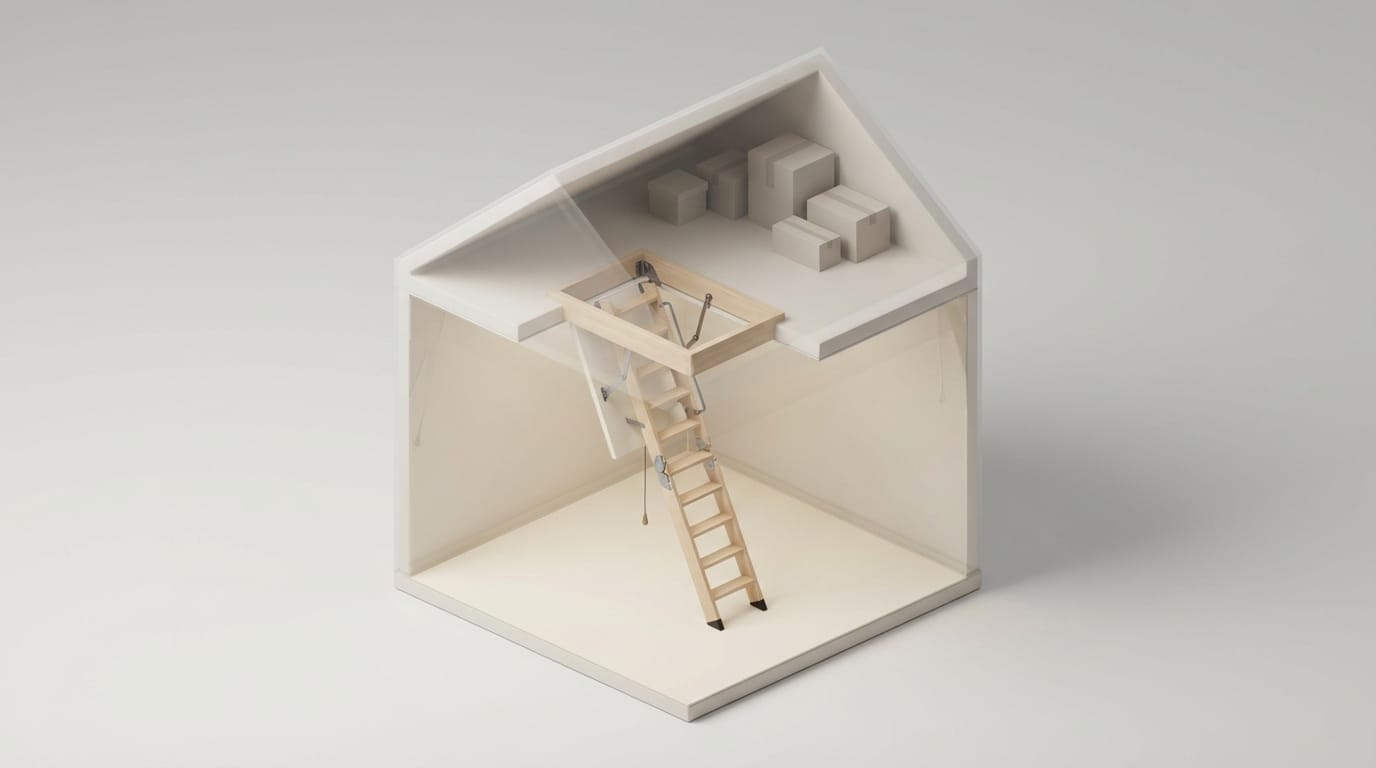
An improperly installed attic ladder creates a permanent breach in a home’s thermal envelope and can weaken ceiling structural integrity if the load is not distributed correctly. Learning how to install an attic ladder requires a grasp of both carpentry and building science, as this modification involves altering the primary framing of a house while introducing a potential point of significant energy loss. For the owner who enjoys complex projects, the goal is not merely to create an access point but to build a system that supports a person carrying heavy storage bins while maintaining an airtight seal. Cutting a ceiling joist redirects the structural load to adjacent members; if done without precision, the result is a sagging ceiling or a ladder that feels spongy underfoot.
This guide explains the process through technical phases, beginning with structural evaluation and ending with insulation steps that prevent the stack effect (a phenomenon where warm air escapes into the attic, pulling cold air into the living space from below). By following these engineering principles, you can transform an underutilized attic into a functional storage vault without compromising safety. Proper planning ensures that the ladder remains a functional asset rather than a structural liability.
Selecting the Optimal Mounting Location
Identify a location that satisfies both the structural requirements of the house and the functional needs of the ladder before making any cuts. This decision involves more than finding a spot where the ladder fits. You must locate where the framing can best support the new opening without requiring extensive renovation of the home’s primary load-bearing system.
Evaluating Joist Direction and Spacing
Most residential ceilings use joists spaced 16 inches or 24 inches on center. Standard attic ladder kits fit these spans, measuring 22.5 inches wide for 24-inch spacing or 25 inches wide for specialized units. Determine if the joists are standard lumber (2×6 or 2×8) or engineered trusses. Homes using trusses (identifiable by their W or M shaped webbing) require a structural engineer’s approval before any modifications. Trusses are precision-engineered systems where every member is under specific tension or compression, and cutting one can lead to immediate structural failure.
For standard joist construction, place the ladder parallel to the joists to minimize the number of structural members you must cut. Aim to place the ladder in a hallway or large closet where the swing will not be obstructed by walls or furniture. Treat the layout with the same precision used when planning the perfect wall-mounted bathroom faucet layout, ensuring enough clearance for the ladder to deploy fully before any tools touch the ceiling.
Calculating Swing Clearance and Landing Requirements
Every attic ladder has specific swing clearance and landing space requirements. The swing clearance is the arc the ladder makes as it unfolds; if this arc hits a wall or door, the ladder cannot fully deploy. The landing space is the distance from the header to the point where the ladder feet touch the floor. Measure the ceiling height and consult the manufacturer’s chart to ensure at least 18 to 24 inches of additional floor space exists beyond the landing point for safe movement. Check for invisible obstacles using a high-quality stud finder or a small inspection hole to find electrical conduits, plumbing lines, or HVAC ductwork over the site. Rerouting a single electrical wire is a minor task, but moving a main waste line significantly increases the project’s complexity. Ensure the exit point in the attic provides enough headroom so the roof pitch does not prevent standing.
Pro-Tip: Check for load-bearing walls near the site. If the joists lap over a wall, that wall likely bears a load. Placing the ladder opening near these points provides maximum structural stability, as the redirected weight has a shorter distance to travel to a vertical support.
Framing the Rough Opening: How to Install an Attic Ladder Safely
The rough opening is the rectangular hole in the ceiling that houses the ladder frame. Creating a wide enough gap (typically 54 inches long) requires cutting at least one joist and redistributing its load to its neighbors. This phase is the most critical part of the process. Accuracy here determines if the ladder will function correctly for the life of the home.
Cutting the Ceiling Materials
Mark the dimensions of the rough opening on the ceiling using a framing square. Install temporary support boards before cutting by nailing 2x4s across the joists you intend to cut, approximately 2 feet back from the marks. These boards prevent the ceiling from sagging or the cut joists from shifting during the work. Use a reciprocating saw to cut through the joists and drywall simultaneously while wearing a respirator and eye protection. Attic dust and insulation will fall the moment the seal is broken, creating a messy environment. Once the hole is open, the weight of the cut tail joists is no longer supported, requiring immediate bridging with headers.
For a standard installation, the International Residential Code (IRC) guidelines for floor framing state that if the header span exceeds 4 feet, you must double both the headers and the trimmer joists (the joists on the sides of the opening). This ensures the weight of the roof or storage items above safely transfers around the breach.
Installing Headers and Trimmers
Cut two pieces of lumber to fit between the side joists to serve as headers. If doubling them, nail the first header to the ends of the tail joists using 16d nails, then sister the second header to the first. Ensure these are flush with the bottom of the joists to avoid creating bumps in the drywall later. Precision is vital; if the opening is out of square by even a quarter-inch, the ladder frame will bind and the door will not sit flush. Check for squareness by measuring the diagonals of the opening. If the measurements from opposite corners are equal, the opening is square. This structural preparation is as essential to the house as building essential budgeting skills for financial independence; mastering these framing fundamentals ensures the long-term stability of the ceiling structure.
Mounting and Securing the Ladder Assembly
With the rough opening framed, the ladder unit is ready for installation. Modern attic ladders are often pre-assembled kits, but they are heavy, typically weighing between 50 and 90 pounds. Do not attempt to lift the unit alone while standing on a stepladder, as this increases the risk of injury. Instead, use mechanical advantages or an assistant to position the unit safely within the opening.
Positioning Temporary Support Cleats
The best way to manage a solo or two-person install is with temporary support cleats. Nail two 1×4 boards across the bottom of the ceiling opening, overlapping the edges by about 2 inches to create a shelf. When you push the ladder assembly into the attic from below, the cleats catch the frame and hold it in place while you move into the attic to secure it. This technique ensures the frame stays level with the ceiling surface while you prepare for final fastening. Once the unit rests on the cleats, check the gap between the ladder frame and the headers. Use cedar shims to fill these gaps at every point where you will drive a fastener. Shims prevent the frame from bowing or distorting when you tighten screws. A bowed frame causes the ladder to stick or leads to premature spring mechanism failure.
Fastening the Frame to the Joists
Use only the lag screws or specialized structural screws provided by the manufacturer to secure the ladder. Drywall screws lack the shear strength to hold the weight of a person. Drive fasteners through the frame, through the shims, and into the joists. According to recognized professional installation standards, you should use at least two fasteners on each end and three along each side. Observe the frame during tightening; if the wood begins to pull or bend, add more shims to keep the frame straight. Once secured, remove the temporary cleats and test the door’s operation. It should swing freely without rubbing against the rough opening. If it rubs, adjust the shims or slightly trim the drywall edge to clear the path.
Calibrating the Ladder Stringers for Safety
A common error in how to install an attic ladder is failing to cut the legs (stringers) to the correct length. A ladder that is too long bows outward, putting immense pressure on the hinges, while a ladder that is too short dangles, causing the hinges to snap under weight. Proper calibration ensures the ladder functions as a solid, unified structure.
Measuring for the Final Cut
Most ladders require unfolding the first two sections and then measuring the distance from the second section’s hinge to the floor. Measure this at the exact angle the ladder sits. Many kits include a sliding foot or a cardboard template to find this angle. Double-check measurements on both the left and right sides because floors are rarely perfectly level. Use a fine-tooth saw when cutting the stringers to prevent splintering. For wood ladders, a miter saw provides a clean, angled cut, while aluminum ladders require a hacksaw or a reciprocating saw with a metal-cutting blade. Once cut, install the provided rubber feet to increase the surface area of the contact point and prevent the ladder from sliding on hard surfaces.
Adjusting Feet for Flush Floor Contact
The goal is total contact between the feet and the floor. When the ladder is fully extended, the joint between the ladder sections should be tight without visible gaps. If a gap exists at the hinge, the legs are too long. If the ladder kicks out at the bottom, they are too short. Adjust the feet until the entire bottom surface of the stringer is flush with the floor, distributing weight evenly through the frame rather than concentrating it on the hardware. Check the tension of the assist springs or gas pistons. Most units allow mounting point adjustments to make the door easier to operate. The door should stay closed under its own tension without a latch but should not snap shut violently. A well-calibrated ladder feels as stable as a permanent staircase.
Mitigating Energy Loss Through the Attic Breach
A professional installation must address the stack effect. Because warm air is less dense than cold air, it rises and pushes against the ceiling. An attic ladder is essentially a 10-square-foot hole in the home’s insulation, and standard doors have an R-value near zero. Addressing this thermal bridge is vital for maintaining the home’s energy performance.
Eliminating Air Leaks with Weatherstripping
Air leakage often drains more energy than simple heat conduction. Install high-quality EPDM rubber weatherstripping around the stop (the ledge where the door rests). When the door closes, it should compress the rubber to create an airtight seal. Test this by having an assistant in the attic shine a flashlight at the edges of the closed door while you stand in the dark below. If light is visible, air is escaping. Learning how to caulk sinks, tubs, and windows provides a foundation for understanding how sealants bridge material gaps, which you can apply here using fire-rated expanding foam to seal the gap between the ladder’s outer frame and the rough opening. Research from HVAC experts suggests that even small uninsulated gaps in an attic can reduce ceiling insulation effectiveness by up to 25% due to concentrated air movement.
Managing the Stack Effect with Hatch Insulation
Insulate the back of the hatch door to finish the job. Glue 2-inch thick rigid foam board to the back of the door using a foam-compatible adhesive rather than using fiberglass batts, which tend to fall off over time. This provides an additional R-10 to R-13 of insulation to an area that otherwise has none. For maximum efficiency, consider an attic tent or insulated cover. These zippered enclosures sit over the ladder inside the attic, providing a double barrier between the living space and the attic. This is especially effective in extreme climates where temperature differences between the attic and the house can exceed 60 degrees. Treating the attic ladder as a high-performance component of the home’s envelope ensures the new storage space does not increase utility bills. If you have already begun a project to transform your space and life through decluttering, these extra insulation steps ensure your storage solution is as efficient as it is organized.
Technical Note: If the attic is unvented or conditioned, hatch insulation is less critical, but air-sealing remains mandatory to maintain humidity control across the home.
Installing an attic ladder is a significant structural and thermal modification. By treating the rough opening as a critical load-bearing frame and the hatch as a part of the thermal envelope, you move beyond basic DIY and into the realm of home performance engineering. The stability of the ladder depends on the precision of the framing and stringer cuts, but its long-term impact on comfort depends on how well you seal it against the stack effect. As you optimize the home’s storage, remember that every system in a house is interconnected. A stronger ceiling allows for more storage, which may eventually require better lighting and floor decking. The next step is evaluating attic ventilation to ensure the new storage area remains safe and accessible for years to come.