
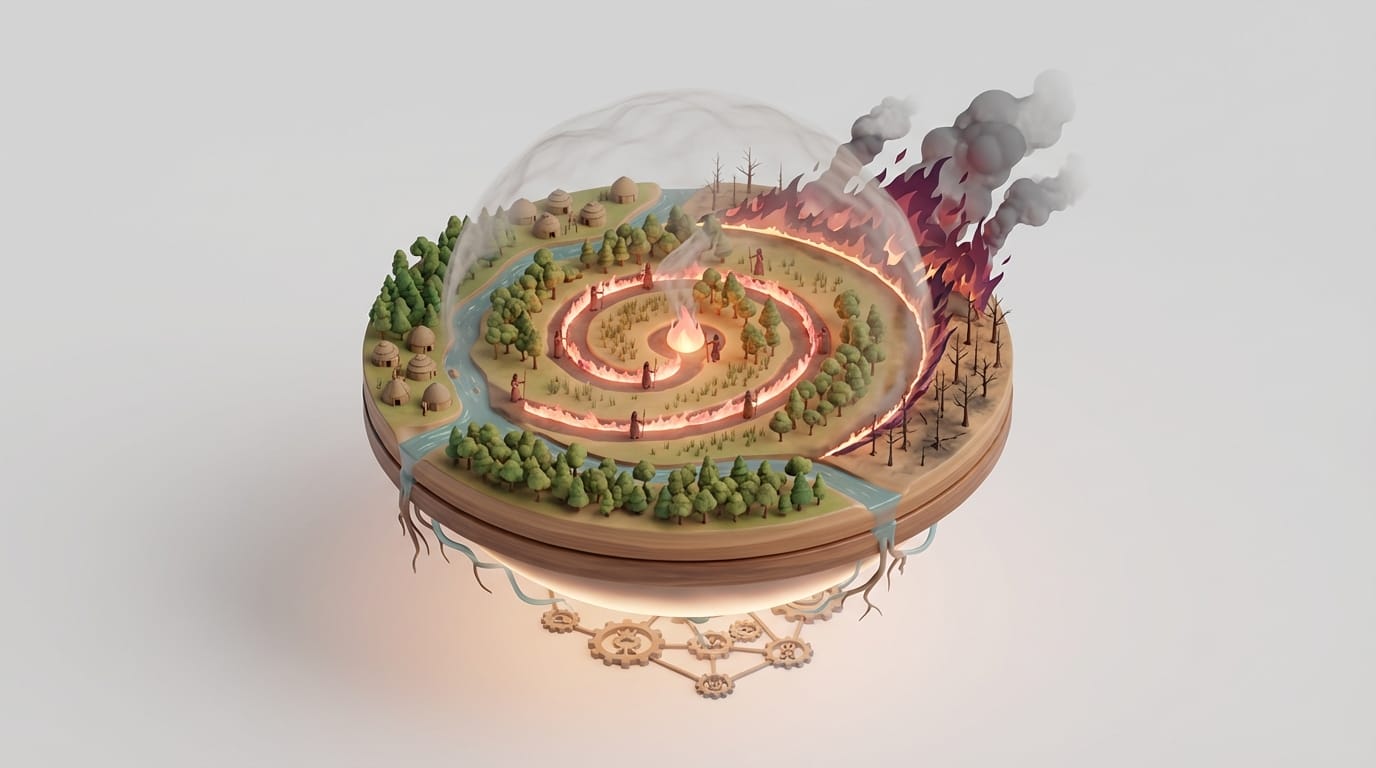
Indigenous Controlled Burning: A Systemic Approach to Global Wildfire Resilience
Decades of aggressive fire suppression have turned forests into tinderboxes, revealing a critical flaw in modern conservation: the removal of the people who once kept the environment in balance. As megafires intensify, land managers are re-evaluating indigenous controlled burning as a primary systemic defense against catastrophic wildfire events that now threaten global habitats. This shift represents more than a change in strategy; it is a recognition that fire is a necessary biological process rather than an external enemy to be defeated.
A century of total exclusion produced the current wildfire crisis. By treating every wisp of smoke as an emergency, modern systems allowed fuel loads to accumulate to unnatural levels, creating a debt that society now pays in megafires. These fires burn so intensely that they create their own weather systems and sterilize the soil. Understanding the systemic logic of cultural fire offers a path back to a resilient environment where practitioners manage fire as a regenerative tool.
Indigenous communities view fire as medicine for the land. Just as a physician applies a precise dosage of a drug to cure an ailment without killing the patient, traditional practitioners apply low-intensity fire to maintain the health of the understory. This practice ensures that when lightning or human accidents spark a flame, the fire lacks the fuel density required to climb into the tree canopy and become destructive.
The Biological Logic of Traditional Fire
To those unfamiliar with forest management, smoke in the woods looks like failure. To a practitioner of indigenous controlled burning, fire is a precise tool used to achieve specific ecological outcomes. While modern agencies use prescribed fire primarily to reduce fuel, cultural fire stewardship focuses on a broader set of systemic goals, including the cultivation of basketry materials, the health of food crops like acorns, and the spiritual renewal of the land.
How Practitioners Define Cultural Fire
Practitioners define cultural fire by its scale and timing. Unlike the massive, high-heat burns sometimes favored by state agencies to clear large swaths of land quickly, cultural burns are typically small, patchy, and frequent. Practitioners time these burns to match the moisture levels in the soil and air, ensuring the flames remain on the ground. This creates a mosaic terrain (a patchwork of areas at different stages of regrowth) which acts as a natural speed bump for larger wildfires.
Differences Between Traditional and Standard Fire Practices
The distinction between prescribed fire and cultural burning lies in the rules of the burn itself. State-led fire is often a rigid bureaucratic process governed by narrow windows of temperature and wind speed defined in a central office. In contrast, indigenous knowledge relies on local indicators like the way a certain leaf curls, the behavior of bird species, or the moisture content of the forest floor. This place-based expertise allows practitioners to burn during shoulder seasons (the early spring or late autumn) when the risk of escape is low but the biological benefit is high.
Standard prescribed fire often prioritizes the removal of fuel, a term that treats the forest as a collection of flammable wood. Cultural fire views these same materials as habitat, medicine, or food. By focusing on the health of individual species, the practitioner naturally reduces the overall fuel load as a secondary benefit. This nuanced approach helps scientists understand how regional micro-climates respond to changing fire cycles and extreme weather patterns.
How Indigenous Controlled Burning Maintained Low Fuel Loads
Before colonial intervention, the forests of North America and Australia were not the dense, overgrown thickets we see today. Historical accounts from explorers often described these lands as park-like, with massive trees spaced widely enough for a carriage to pass between them. This structure resulted from thousands of years of continuous human intervention through fire rather than an accident of nature.
The Impact of Pre-Colonial Fire Regimes
In regions like California, historians estimate that before modern settlement, millions of acres burned annually. The difference between those fires and today was the intensity. Pre-colonial fires were largely low-heat surface fires that cleared away dead grass and small shrubs while leaving thick-barked, mature trees untouched. By burning small, fast-burning fuels every few years, indigenous practitioners ensured that ladder fuels never grew high enough to carry fire into the treetops.
Why Suppression Policies Created Modern Tinderboxes
Following massive historic fires in the early twentieth century, authorities mandated that crews suppress every fire by the morning after its discovery. This policy effectively removed fire from the natural system for a century. Without the regular cleaning of the forest floor, biomass began to stack up. Forests that once held 50 trees per acre now hold 500 or more, all competing for the same limited water supply. This density makes them more susceptible to drought and pests, a phenomenon researchers track by measuring biological stress through live plant monitoring to assess forest health.
When a fire enters these modern, high-density forests, it behaves differently than a traditional cultural burn. Accumulated logs and brush act as a furnace, generating temperatures so high they melt the silica in the soil into a glass-like layer. This layer prevents water from soaking into the ground for years. By suppressing the beneficial fire, society unintentionally selected for the most destructive fires possible.
How Nature Responds to Low-Intensity Fire
The systemic benefit of fire extends beyond fire safety. Many habitats are fire-dependent, meaning they require the heat or smoke of a flame to trigger essential life cycles. Without the regular application of fire, these systems begin to collapse, leading to a loss of biodiversity. This loss eventually influences how climate shifts influence food production costs and regional economies.
Promoting Biodiversity Through Patchwork Burning
Fire variety, often called pyrodiversity, refers to the different fire histories across a territory. Because indigenous controlled burning occurs in small patches at different times, it creates a high level of diversity. One patch might have burned last year, while another burned ten years ago. This variety provides a range of habitats: fresh green sprouts for deer, older brush for nesting birds, and mature stands for predators. Indigenous-led fire management in Australia has significantly increased biodiversity by maintaining these complex habitat mosaics.
Fire as a Mechanism for Soil Nutrient Cycling
In many dry climates, decomposition happens slowly. Dead leaves and wood can sit on the forest floor for years, locking up vital nutrients like nitrogen and phosphorus. Low-intensity fire acts as a rapid decomposer, instantly breaking down this organic matter and returning it to the soil as ash. This nutrient surge triggers a burst of high-protein vegetation that is more nutritious for wildlife than the stagnant growth it replaces. Additionally, the smoke has fungicidal properties that kill off pathogens which would otherwise weaken old-growth trees.
Bureaucratic Obstacles to Tribal Fire Management
The most significant obstacle to scaling indigenous fire practices is a thick layer of bureaucratic friction. A deep irony exists in the fact that indigenous practitioners, whose ancestors managed these lands for millennia, must often obtain government certifications to light a single match on their own sovereign territory.
The Paradox of Certification for Indigenous Experts
Currently, in many parts of the United States and Canada, cultural burners must meet national standards designed for industrial-scale firefighting. These standards require hundreds of hours of classroom training in Western fire science and the use of heavy mechanized equipment. For an elder who has spent 60 years reading the wind and the soil, a lack of a federal certificate acts as a barrier to the survival of the practice.
Liability and the Legal Friction of Fire Management
The legal system also treats fire as a liability rather than a necessity. If an agency burn escapes and causes damage, the government often holds certain immunities. If a tribal practitioner conducts a burn that crosses a property line, they may face lawsuits or criminal charges. Furthermore, air quality regulations often treat the smoke from a healthy, preventative cultural burn the same way they treat the toxic smoke from a catastrophic megafire. This policy frequently shuts down the narrow weather windows where safe burning is possible, forcing communities to wait for a disaster instead of preventing one.
Creating Collaborative Fire Management Systems
Despite these barriers, a shift is occurring. Policy makers realize that the cost of prevention is a fraction of the cost of suppression. According to research from the US Forest Service, every dollar invested in fire prevention and active fuel management can save up to $35 in future suppression and loss costs. This economic reality drives new partnerships between tribal nations and state agencies.
Successful Case Studies in Modern Integration
Legislative shifts have begun to dismantle some of the bureaucratic friction. New agreements allow tribal practitioners to burn for traditional purposes without certain state permit requirements. In Australia, the Savanna Fire Management program has combined ancient knowledge with carbon-credit markets. By burning early in the dry season, Indigenous groups prevent massive late-season fires that release significantly more greenhouse gases. These groups then sell carbon credits to corporations, generating millions of dollars for local communities while restoring the land.
Scaling Indigenous Techniques for Global Climate Resilience
The goal is to integrate traditional ecological knowledge with modern technology. This means using satellite imagery and computer modeling to identify the highest-priority areas for indigenous controlled burning, then empowering local communities to do the work. By shifting the power dynamic from centralized command to community-led stewardship, we can build a territory that is resilient to a volatile climate.
Society currently lives inside a fire system broken by a century of misunderstanding. The historical exclusion of indigenous fire regimes was based on the false assumption that humans are separate from nature. Indigenous controlled burning proves that human presence, when guided by observation and stewardship, is a vital component of a healthy biological network. By moving past the bureaucratic friction and legal paradoxes that hold back traditional practitioners, we can transition from a state of perpetual emergency to one of healthy coexistence with fire. The question is no longer whether the forests will burn, but whether we will choose the fire that heals or the fire that destroys.