The Shift in Value from Product to Process
When the cost of making a perfect image or song drops to zero, the value of art moves from the final result to the human struggle behind it. As we watch the rise of AI in creative industries in 2026, we see that technical skill no longer proves talent. This change does not take away the role of the artist, but it forces us to rethink the systems that have ruled creative work for a century. For years, people defined a creative professional by how they used difficult tools. A cinematographer mattered because they understood light and camera parts; a designer mattered because they mastered color and lines. These walls are now falling as generative systems handle the act of creation itself.
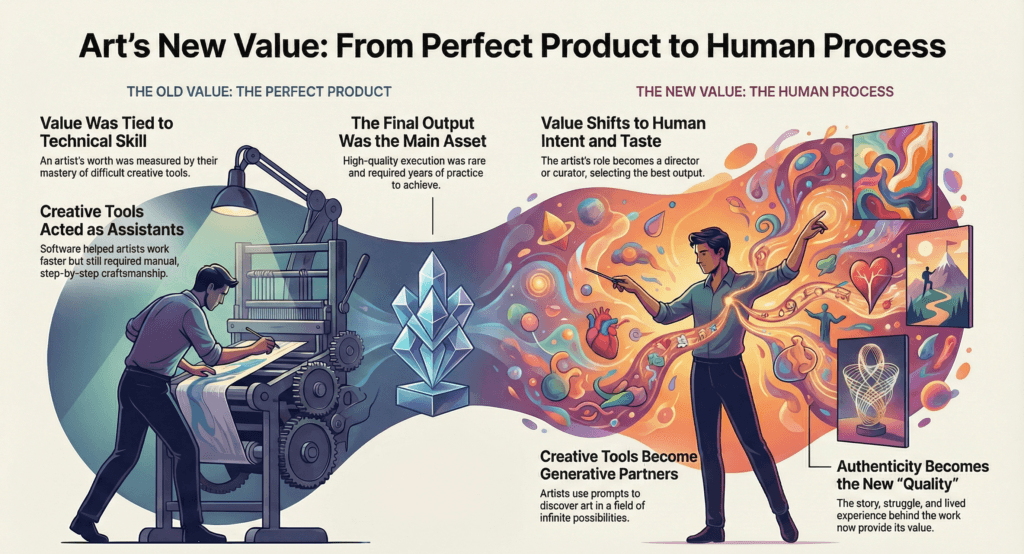
In the past, engineers built digital tools to help the human hand work faster. Software like Adobe Photoshop gave artists a digital canvas that still required them to make every stroke and cut. The software acted as a helpful assistant that reduced friction, but the artist remained the primary builder. New generative systems use a different method. We no longer use tools to build a vision; we use them to talk to a math model. These models do not understand art, but they know how billions of pixels or notes fit together. This changes the creative act from making something to choosing something. The artist now acts more like a director or a curator than a traditional craftsman.
The Evolution of Production Tools in Creative Workflows
From Assistance to Generative Automation
To understand the state of AI in creative industries, we must look at how these models work. Modern systems use diffusion and transformer methods. Diffusion models add noise to an image and then learn how to reverse that process to find the data underneath. When an artist gives a prompt, the model starts with a field of random noise. It then finds the image that best fits the text description. This is a massive shift from older digital tools. Photoshop works by changing pixels in a set space, but a model from OpenAI or Midjourney works in a space of infinite possibilities. The artist navigates this space using prompts and feedback. It is a system of discovery rather than a system of construction. This change is why many artists feel they are losing the craft of their work.
Impact Across Visual and Performing Arts
The film industry faces a massive structural shift. Tools from Runway let small teams build complex visual effects that once needed hundreds of people. This opens doors for new creators, but it also changes the job market. We now see digital actors who look real and speak any language. While this cuts costs, it creates new problems for legal rights. Production value no longer protects big studios from competition because high-end visuals are now available to everyone.
Music feels this change as well. Vocal tools from ElevenLabs can copy a human voice perfectly. Producers can now finish songs without a singer in the room. Other programs make music for games or ads in seconds. This makes functional music less valuable. If a computer can make a perfect background beat for almost no cost, the market for human stock music will shrink. This pushes human musicians to make deep, emotional work that computers cannot copy. It also makes live performance more important because it is something a machine cannot fake.
The Commodity Trap and the Devaluation of Technical Execution
When High Quality Becomes the Standard
High quality is now the standard for everyone. In the past, making something look or sound perfect required years of practice and expensive gear. When the system makes this level of quality easy to reach, the market value of perfect execution drops. If anyone can make a realistic portrait in ten seconds, the portrait itself is no longer the main product. This creates a trap for creative professionals. When skill is no longer a barrier, the supply of content becomes endless. Digital platforms now have a lot of content that looks good but feels hollow. This happens because the system lacks intent. A computer can copy a style, but it cannot understand why that style exists.
The Declining Market Value of Pure Beauty
When beauty no longer requires human effort, our feelings about it change. We usually value things based on how hard they are to find. In the past, we valued time, skill, and material. Because AI in creative industries takes away the need for time and skill, the resulting art feels like fast fashion. This creates a strange situation. The more perfect a computer-made image looks, the less it moves the viewer. We are learning to spot the patterns of these models. We feel the lack of struggle, and beauty alone can no longer demand a high price. The story of the art now matters more than the look of the art.
Understanding the Post-AI Authenticity Movement
The Shift Toward Lived Experience
As more people use generative tools, a new push for authenticity has started. Value now comes from the lived experience of the artist. People want the human-made label because it connects them to another person’s life. Small mistakes in human work now signal quality instead of failure. This shift looks like the old Arts and Crafts movement. When factories started making perfect furniture, people began to value the marks left by a hand tool. In the digital world, the story of how an artist worked is now as important as the art itself. The effort to get a shot or the pain in a performance gives the work its worth.
In 2026, artists find success by showing their process. A painter who films the hundreds of hours spent on a canvas sells the proof of their labor. This shows the work is real in a time when results are easy to fake. It creates a story that a computer cannot make because a computer has no body and no feelings. This movement defines the artist as a witness to life. When we buy art, we buy a piece of someone’s time. If the time spent was zero, the value is low. By showing the struggle, the artist shows that their time is rare. High-end brands now use these stories of human labor because they know that in an automated world, human effort is a luxury.
Navigating Intellectual Property and Creative Ownership
Legal Rules for Generated Works
The law still struggles to keep up with AI in creative industries. Most courts have decided that a person cannot copyright art made only by a computer. Ownership requires a human to do a large part of the work. This creates a risk for companies. If a studio uses a computer to make a movie, they might not be able to stop others from sharing it. This legal wall helps human creators. It forces companies to keep people involved so they can own what they make. We now see a hybrid system. The law protects the parts a human wrote, while the parts a computer made stay in a gray area. This encourages people to use computers for speed while keeping human intent as the core of the work.
Protecting Originality from Recursive Loops
AI models now train on data from other models. This can make the results stale. Some call this model collapse. When computers lack new human data, they lose their edge. This shows that AI can only look backward. It mixes things that already exist. Human ideas stay the raw material that keeps the system alive. Artists now use tools to stop computers from using their work as training data. Keeping a line between the human source and the computer echo is vital for the future of creative work.
The Future Role of the Human Creative Professional
Moving From Maker to Director
The role of a creative professional is changing from a maker to a director. In the old world, a young designer spent hours fixing an image. Now, they spend minutes looking at twenty versions to pick the best one for a brand. Value has moved from hard labor to good taste. This requires new skills. Future artists must master judgment and deep thought. They must talk about human feelings that a computer cannot feel. Skills in 2026 are less about how to draw and more about how to see. Finding something original in a sea of average work is the new way to win.
The best advantage for any artist is their unique view. A computer can copy a style, but it cannot live a life. An artist’s history, culture, and feelings are things that a computer cannot find on the web. When we use computers for boring tasks, we free up energy for deep ideas. The future of AI in creative industries is not a fight between humans and machines. It is a change that forces us to get better at being human. By giving the mechanical work to machines, we are left with the most rewarding part: the intent. As long as we want to connect with other people, the human artist will stay at the center of the system.