
The Concept and Scope of the Tesla Diner Project
Technology brands often mistake physical hospitality for a static user interface, overlooking the human variables that dictate whether a service-based extension succeeds. To analyze this shift, we must evaluate the Tesla Diner brand extension strategy as it moves from a digital concept into a tangible, high-stakes physical environment. This project represents a structural attempt to control the entire user journey of an electric vehicle owner.
From Supercharger Hub to Lifestyle Destination
What began as a social media post has evolved into a construction project at 7001 West Santa Monica Boulevard in West Hollywood. The transition from a simple charging station to a multi-use facility signals a maturation of the company’s integrated network. By moving into the restaurant space, the company is attempting to address a fundamental constraint: the battery charging interval.
Unlike a gasoline station visit, which lasts five minutes, a Supercharger stop typically requires 20 to 45 minutes of “dwell time.” Currently, this time is often spent in parking lots or generic strip malls. The diner concept aims to reclaim this window, transforming a logistical necessity into a brand-consistent experience that generates revenue beyond electricity sales.
Defining the Drive-In and Cinema Integration
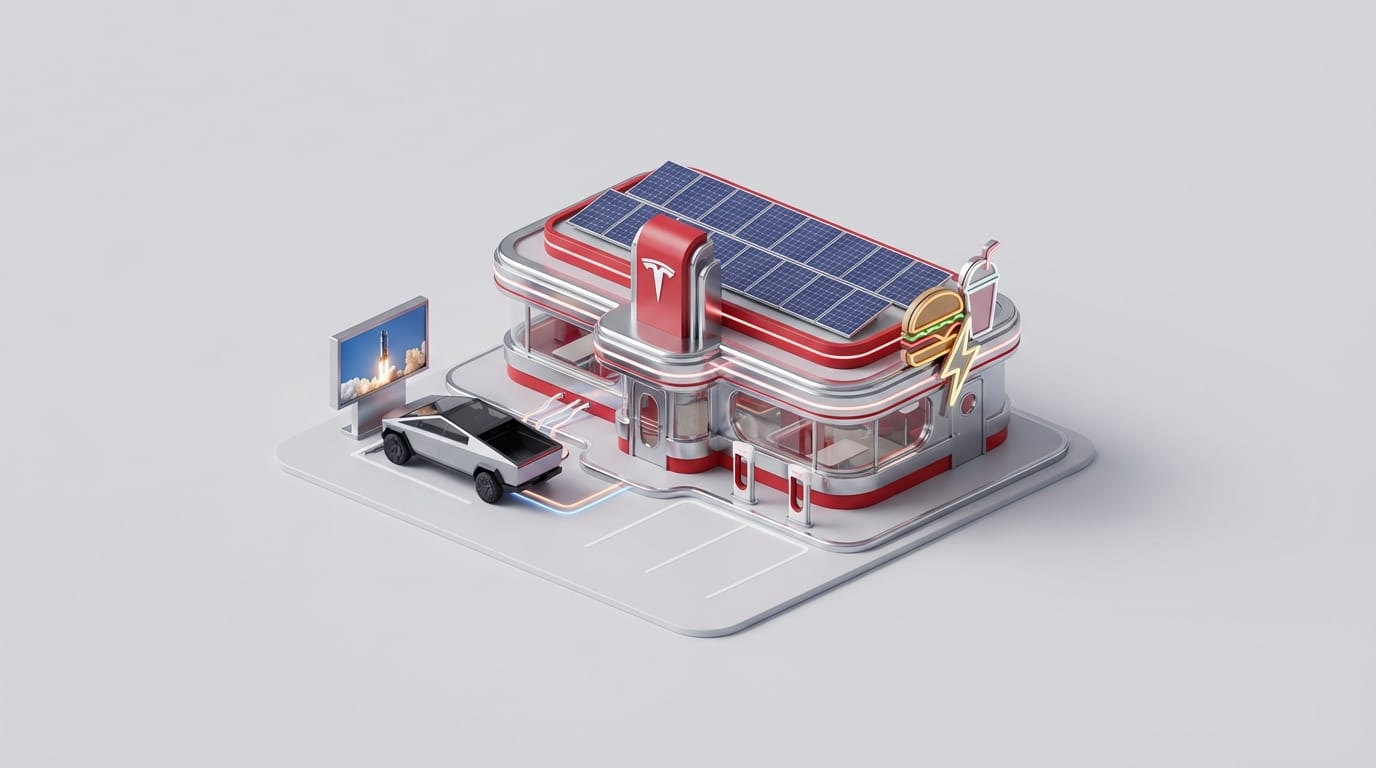
The physical layout of the site follows a retro-futuristic “Googie” architectural aesthetic, featuring two movie screens and 32 charging stalls. This is a spatial optimization strategy rather than a simple nostalgia play. By integrating a drive-in cinema, the brand provides a passive entertainment loop that matches the duration of a typical Level 3 charge.
The structural goal is to create a “closed-loop” environment where the customer remains within the brand’s influence. This integration mirrors the design philosophy seen in software stacks, where the objective is to reduce friction between different service layers. In this case, the user moves from the car’s infotainment system to a physical theater and kitchen without leaving the proprietary network.
Strategic Drivers Behind the Tesla Diner Brand Extension Strategy
The Tesla Diner brand extension strategy is driven by the need to increase the “Average Revenue Per User” (ARPU) within the existing charging network. While the automotive industry traditionally separates the manufacturer from refueling infrastructure and hospitality, the tech industry favors vertical integration. This diner is a physical manifestation of the desire to own the entire value chain.
Network Stickiness and Dwell Time Monetization
Software developers focus on “stickiness”—how long a user stays within an application. For an electric vehicle manufacturer, stickiness is enforced by the charging cable. However, if the environment surrounding that cable is unpleasant, the customer views the experience as a chore. By providing food and entertainment, the company converts a “dead” 30-minute window into a high-margin monetization opportunity.
This move also addresses the threat of charging commoditization. As third-party networks expand, a proprietary network’s competitive advantage may shift from technical reliability to superior amenities. The diner acts as a “moat,” making the choice to use a proprietary charger more attractive than a generic, amenity-free alternative.
The Shift from Tech Utility to Lifestyle Identity
There is a significant difference between selling a tool and selling an identity. Tesla is navigating a transition from a provider of high-performance transport to a holistic lifestyle brand. This strategy is similar to how Apple uses its retail stores not just to sell hardware, but to create a physical “town square” for its community.
By entering the hospitality sector, the company attempts to deepen the emotional connection with its user base. When a customer eats at the diner, they consume the brand’s aesthetic and values in a way that driving a vehicle cannot replicate. This “brand stretching” move is designed to make the company a more frequent part of the user’s daily routine.
The Operational Paradox of Tech-Led Hospitality
While the strategy is sound on paper, it faces an “Operational Paradox.” In a software system, a user interface can scale to millions with near-zero marginal cost and perfect consistency. In hospitality, every transaction is a unique physical performance involving perishable goods and human labor. This is the point where the logic of silicon meets the logic of the kitchen.
Treating Physical Service as a User Interface
Tech companies often view physical service as another interface that can be optimized through automation. However, hospitality is a dynamic service environment. A software bug might lead to a slow load time, but a “bug” in a restaurant—such as an cold meal—creates a visceral, negative physiological response.
The paradox lies in the attempt to apply an iterative “patching” mentality to a sector governed by health codes and immediate sensory feedback. You cannot fix a bad dining experience after the customer has left the table. The high-touch nature of food service requires a different management architecture than the high-tech nature of battery manufacturing.
The Failure of Vertical Integration in Culinary Services
Tesla’s success is built on vertical integration—making its own seats, batteries, and software. However, vertical integration in culinary services is difficult. Sourcing lithium is a predictable industrial process; sourcing consistent, high-quality produce and managing a kitchen staff is a volatile, localized challenge.
When a tech firm attempts to own the kitchen, they find that the “stack” is much deeper than anticipated. Food safety compliance and flavor consistency across locations are not problems solved via better algorithms. These require cultural expertise that sits outside the traditional engineering core.
Logistical Hurdles in Non-Software Environments
The Tesla Diner brand extension strategy introduces a level of entropy that automotive manufacturing rarely encounters. In a factory, inputs are standardized. In a kitchen, inputs are organic and outputs are subjective. This creates a cultural and logistical friction that can threaten the efficiency of the parent brand.
Supply Chain Complexity Beyond Raw Materials
Supply chains for automotive components are built for durability and long lead times. Hospitality supply chains are built for perishability and immediate turnover. If a shipment of microchips is delayed, production slows. If a shipment of food is mishandled, the risk is not just a delay, but a public health concern.
Managing the “last mile” of a food supply chain requires a different infrastructure than managing vehicle deliveries. The company must manage cold-chain logistics, waste, and local health department relations—all of which are fragmented and resistant to centralized, software-driven disruption.
Labor Management in a High-Churn Industry
Tesla has a culture built on high-pressure engineering. The hospitality industry is characterized by high churn and a reliance on emotional labor. The system of a restaurant depends on the morale and training of frontline staff who are often paid significantly less than engineers.
There is a risk of cultural clash. If the company manages diner staff with the same metrics used in a Gigafactory, they may face high turnover and low service quality. Hospitality requires a “soft” touch that often runs counter to a hard engineering focus. Without a dedicated hospitality management layer, the service experience may feel sterile or mechanical.
Brand Dilution and the Risk of Overextension
Every brand has a “credibility radius”—the distance from its core product it can travel before consumers stop trusting its expertise. When a company known for energy solutions starts selling burgers, it risks blurring its value proposition. If the diner fails to meet the high standards of the vehicles, the core brand trust can be eroded.
When Novelty Wearies the Core Consumer
The novelty of a drive-in cinema may drive initial traffic, but long-term success depends on repeat utility. If the Tesla Diner brand extension strategy relies too heavily on initial curiosity, the operational costs of maintaining the facility may eventually become a burden.
An operational failure in the diner—such as long wait times or poor cleanliness—can create a negative “halo effect.” A customer frustrated by a mediocre meal may start to view their vehicle’s minor software glitches with more scrutiny. The diner is no longer a perk; it becomes a point of friction that colors the entire ownership experience.
The Impact of Operational Failure on Core Brand Trust
Trust is a finite resource. For a brand that asks customers to trust it with unproven technologies like automated driving, operational excellence is paramount. If a company cannot manage a burger order efficiently, a skeptical consumer might question its ability to manage complex automotive safety systems.
This is the danger of “brand stretching.” By entering a low-margin, high-variance industry like food service, a high-precision company exposes its reputation to unnecessary risks. The operational complexity of the diner could become a distraction for a leadership team that already manages automotive, aerospace, and energy sectors.
Lessons for Tech Brand Diversification Strategies
The move toward experiential retail is a trend many tech firms are watching. However, the Tesla Diner brand extension strategy offers several cautionary lessons for any brand looking to bridge the gap between digital utility and physical service.
The Case for Strategic Partnerships over Ownership
Historically, the most successful brand extensions into hospitality have involved partnerships with experts. For example, Starbucks often partners with local operators to use their logistical knowledge. A tech company might be better served by “platforming” its hospitality—providing the space and the audience, but outsourcing the food and service to an established restaurant group.
By owning the diner outright, Tesla is betting that its internal culture can master a foreign discipline. While this fits the “first principles” thinking the brand is known for, it ignores decades of institutional knowledge held by hospitality giants. Outsourcing the human variables while maintaining control over the brand aesthetic is often a more scalable approach.
Identifying Natural vs. Forced Brand Adjacencies
A “natural adjacency” is a service that solves a problem created by the core product. Charging infrastructure is a natural adjacency for an electric vehicle company. Hospitality is a “forced adjacency”—it is beneficial, but not strictly necessary for the core product to function. When a brand moves into forced adjacencies, the margin for error narrows.
To succeed, the diner must feel like an extension of the vehicle’s engineering philosophy—efficient and futuristic—rather than a disconnected side project. If the diner feels like a standard restaurant with a logo attached, it will fail to provide the intended network lock-in. The system must be cohesive, or the distraction will outweigh the diversification benefits.
The challenge for tech companies is realizing that while software scales, human service does not. A restaurant is not an application; it is an atmosphere maintained by people. As the West Hollywood project operates through 2026, the industry will see if this strategy can overcome the Operational Paradox. If successful, it provides a blueprint for capturing “idle time.” If it struggles, it will serve as a reminder that advanced engineering must still respect the non-scalable realities of the physical world.

