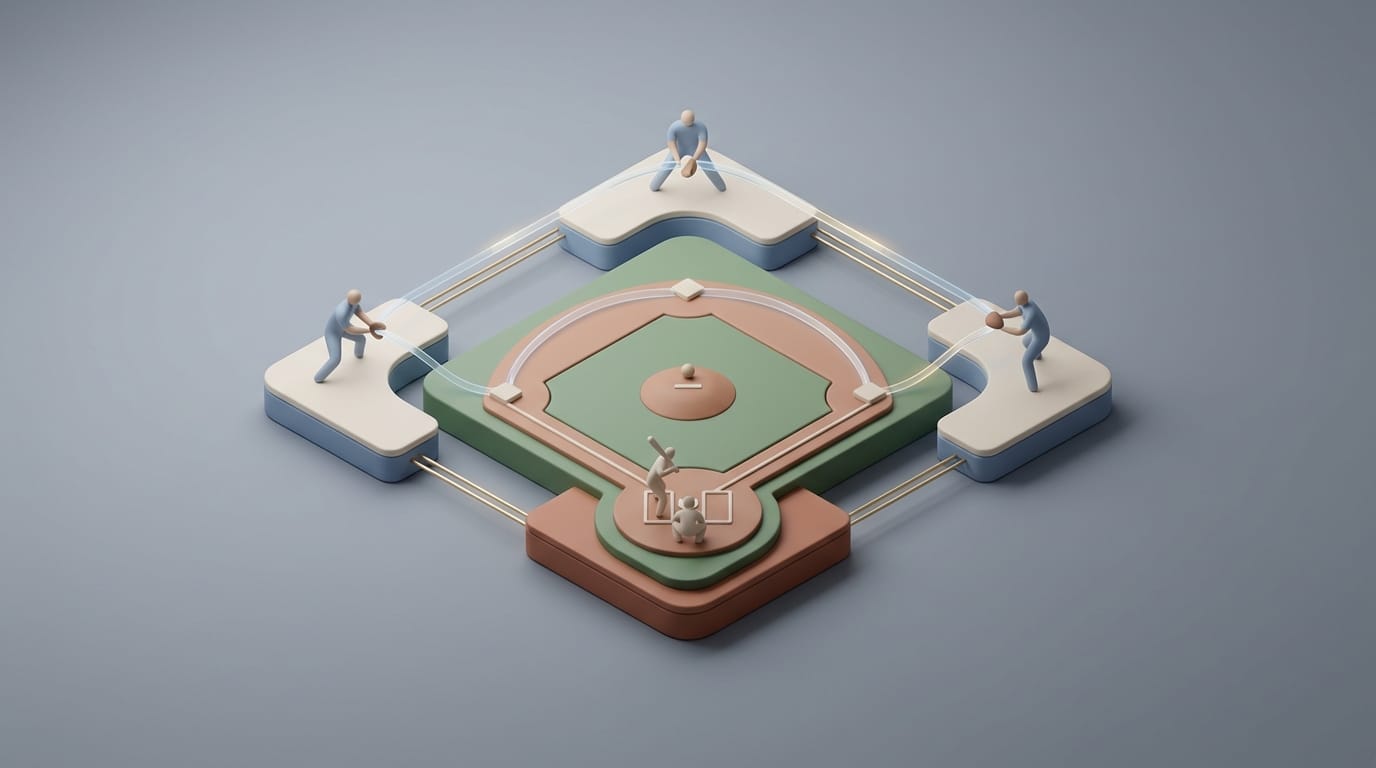
While baseball might look like a slow afternoon at the park, it functions as a high-stakes rhythmic chess match where every pause hides a mental battle between pitcher and batter. To help you navigate this complex sport, we have gathered the essential baseball rules for beginners so you can appreciate the strategy unfolding on the field. Without a clear understanding of the inner workings, the game can appear repetitive; however, once you see the systems at play, every pitch becomes a calculated risk. Most sports rely on a clock to dictate the speed of play, but baseball relies on its structure. The game exists within a set number of opportunities rather than minutes, which creates a unique form of tension. By understanding the underlying system, you can move past the surface action and begin to see the purpose behind every movement.
The Structure of a Baseball Game
Innings and the Home Team Advantage
Organizers divide a standard game into nine segments called innings, and each inning contains two halves. During the top of the inning, the visiting team bats while the home team plays defense in the field. Once the home team records three outs, the teams switch roles for the bottom of the inning. This structure grants the home team the final chance to bat, which allows them the opportunity for a walk-off victory where the game ends immediately if they take the lead in the final frame. Because the home team always has the last word, they often feel a psychological edge when the score remains close late in the game.
How Teams Score Runs and Win
Teams do not score points in baseball; they score runs. A player scores a run by successfully moving around all four bases in a counter-clockwise direction. These bases include first, second, third, and home plate. The team that has gathered the most runs by the end of nine innings wins the contest. If the score remains tied in 2026, the game continues into extra innings until a winner emerges. This ensures that every game reaches a clear conclusion, even if it takes several additional hours to settle the score.
The Meaning of Three Outs
Each half-inning serves as a race against the three-out limit. Umpires call an out in several ways, such as a batter striking out, a defender catching a ball in the air, or a runner being tagged while off a base. Once the defense records the third out, the offensive turn ends immediately, and any runners left on base must leave without scoring. This creates a high-pressure environment where the offense must act on their chances before their turn at the plate expires. Consequently, managers often take risks to move runners along before that final out occurs.
Mastering Baseball Rules for Beginners: The Pitcher-Batter Duel
The Strike Zone and Why It Matters
The core of the game is the strike zone, which is an unseen space located over home plate. It generally extends from the batter’s knees to the middle of their chest; however, the home plate umpire must decide the exact edges of this zone for every pitch. This area is the primary battleground where the pitcher tries to throw the ball through the space to record a strike, while the batter tries to identify which pitches are worth swinging at. Because the zone is not a physical object, its boundaries can shift slightly based on the umpire’s judgment, adding another layer of strategy to the match.
Understanding Balls versus Strikes
Every time a batter does not swing, the umpire must decide if the pitch was a strike or a ball. A strike is a pitch that passes through the strike zone, whereas a ball is a pitch that falls outside of it. If a batter receives three strikes, they are out; if they receive four balls, the umpire grants them a walk and they move to first base automatically. This count of balls and strikes dictates the entire rhythm of the encounter. It forces players to change their plans with every pitch, as a batter with two strikes must be more defensive, while a batter with three balls can afford to be picky.
The Mind Game Behind Every Pitch
This interaction is the mental match that defines the sport. Pitchers use various grips and arm speeds to make the ball curve, slide, or change speed to deceive the batter’s timing. The batter is not just trying to hit the ball; they are trying to predict what the pitcher will do next. Because it is nearly impossible to react to a 95-mile-per-hour fastball by sight alone, the batter must use signs and situational clues to guess the pitch. A successful hit often results from a batter correctly guessing the type of pitch before the ball even leaves the pitcher’s hand.
Defensive Positions and Their Responsibilities
The Battery: Pitcher and Catcher
People call the pitcher and catcher the battery, and their relationship is the most critical bond on the field. The catcher sits behind home plate and uses hand signals to suggest which pitch the pitcher should throw. They must work in perfect harmony to use the batter’s weaknesses against them. Additionally, the catcher serves as the field leader, directing other defenders as plays develop. You can see detailed breakdowns of these player roles on the MLB official website, which explains how these two players control the pace of the game.
The Infield: Protecting the Bases
The infield consists of four players: the first baseman, second baseman, third baseman, and shortstop. Their primary job is to stop ground balls and record outs by throwing to the correct base. The first baseman is usually a tall player who can catch difficult throws, while the shortstop and second baseman must be nimble to cover the middle of the field. These players represent the primary shield against the offense’s attempt to move around the diamond. Their quick hands and fast feet often prevent runners from reaching base safely.
The Outfield: The Final Line of Defense
Beyond the dirt of the infield lie the left, center, and right fielders. These players are responsible for catching long fly balls and chasing down hits that get past the infielders. Outfielders must have great speed to cover large areas and strong throwing arms to stop runners from taking extra bases. Their role is often the most athletic, as they must track a ball’s path over hundreds of feet while sprinting at full speed. A single mistake in the outfield often leads to multiple runs, making their consistency vital for the defense.
How Base Running and Force Plays Work
Advancing Through the Bases
Once a batter hits the ball into fair territory, they become a runner and must try to reach first base. A hit can be a single for one base, a double for two, a triple for three, or a home run for all four. Runners can also move on hits by their teammates, but they must be careful not to be tagged by a defender while moving between the safety of the bases. Strategy here involves judging the speed of the ball against the speed of the runner. If a runner misjudges the distance, the defense can easily end the inning with a quick tag.
The Difference Between Force Outs and Tag Outs
One of the most important baseball rules for beginners to understand is the difference between force plays and tag plays. A force play occurs when a runner must move forward because a teammate is moving into the base they currently occupy. In these cases, a defender only needs to touch the base while holding the ball to record an out. However, if there is no force, such as a runner trying to steal a base, the defender must physically touch the runner with the ball or the glove holding the ball. Understanding this difference helps viewers anticipate where the defense will throw the ball.
Stealing Bases and Risk Management
Base stealing is a risky move where a runner tries to move to the next base while the pitcher throws to the batter. This requires a lead-off where the runner moves away from their current base to get a head start. It is a high-speed game of nerves; if the pitcher notice the runner is too far away, they can throw to that base to catch them. This adds a layer of stress for the pitcher, who must split their focus between the runner and the batter. A successful steal can change the momentum of an entire inning by putting a runner in a position to score on a simple hit.
Common Gameplay Situations Every Viewer Should Know
The Double Play: A Pitcher’s Best Friend
A double play occurs when the defense records two outs during a single action. This most often happens on a ground ball when there is a runner on first base; the infielders quickly throw the ball to second base and then to first base. For a pitcher, this is the most efficient way to escape a dangerous situation, as it clears the bases and adds two outs to the count at the same time. You can find examples of famous defensive plays at the National Baseball Hall of Fame, which showcases how these plays have shaped the history of the sport.
Foul Balls and Their Impact on the Count
If a batter hits the ball but it lands outside the white lines of the field, it is a foul ball. Foul balls count as strikes against the batter, which helps the pitcher. However, a foul ball cannot be the third strike unless the catcher catches a foul tip. This means a batter with two strikes can stay at the plate for a long time by hitting foul balls, which wears down the pitcher and forces them to throw more than they might like. This battle of endurance often decides who wins the late stages of a game.
Fly Outs and Tagging Up
When a ball is hit high into the air and caught by a defender, the batter is out. However, runners already on base cannot move until the defender touches the ball. Once the catch is made, a runner can tag up by touching their current base and then sprinting for the next one. This creates a fast race between the runner’s legs and the outfielder’s arm, often resulting in slides at home plate. Fans love these moments because they highlight the raw athleticism of the players in a direct contest of speed and accuracy.
Why the Slow Pace is Baseball’s Greatest Strength
Appreciating the Tension Between Plays
New viewers often mistake the gaps between pitches as downtime, but these moments are full of planning and adjustment. During these seconds, the manager shifts defensive positions based on data, the pitcher chooses the right weapon, and the batter pictures the next pitch. The slow nature of the game allows for tactical depth that fast sports often lack. It is the silence before a lightning strike, where every small adjustment can lead to a massive change in the outcome. Consequently, the tension builds with every second that passes between the pitcher’s wind-up and the batter’s swing.
How to Watch a Game Like a Pro
To enjoy the experience, try to watch the game as a series of connected systems. Instead of just following the ball, look at where the outfielders stand before the pitch or check the pitch count to see if the pitcher is getting tired. By focusing on the baseball rules for beginners and the mental battle at the plate, you will find that the game is never still. It is a constant loop of pressure and release that has fascinated people for over a hundred years. Once you see the layers of strategy, the quiet moments become just as exciting as the home runs.