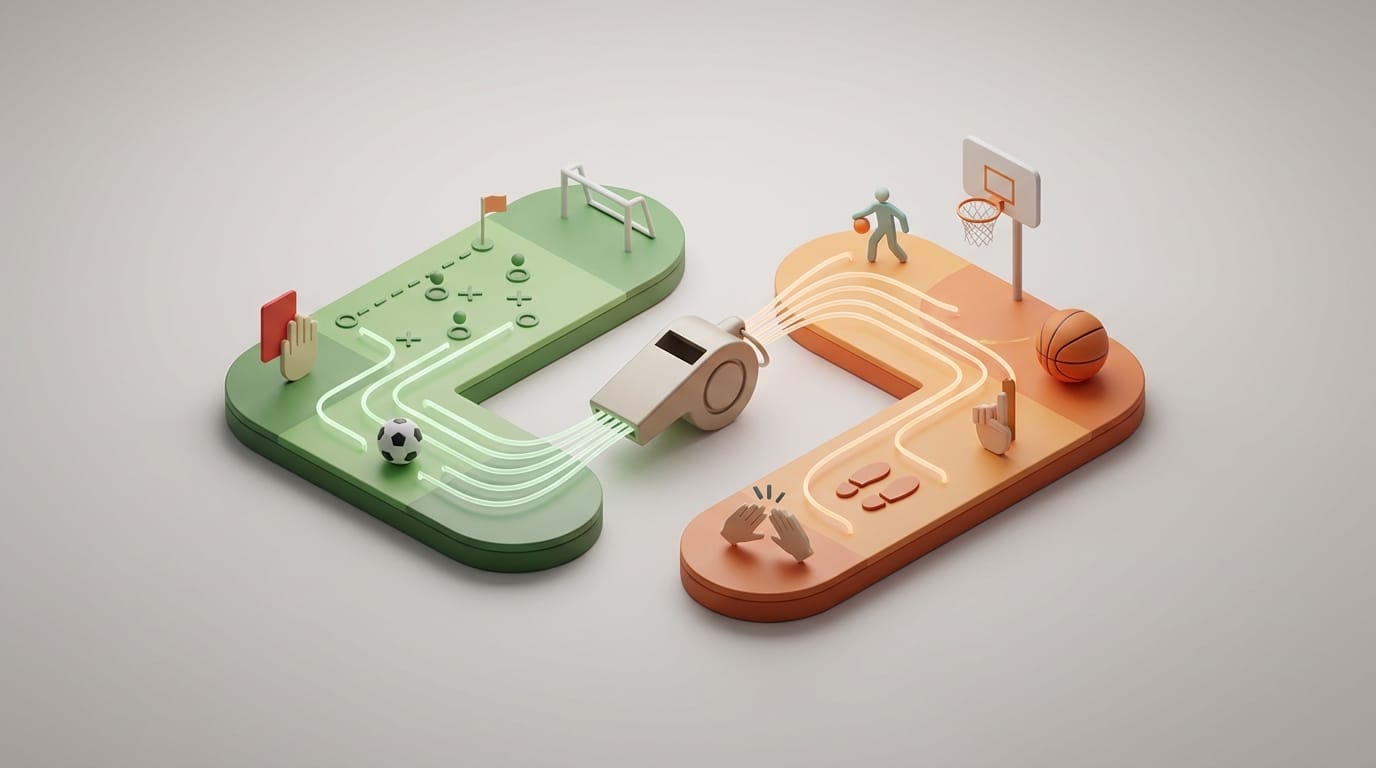
The Hidden Logic of the Whistle
Learning the logic behind referee calls requires more than memorizing a rulebook; it requires seeing how those rules shape the flow of the game. This sports fouls and violations guide shows that these rules are not just punishments but tools that force teams to play better and keep the game moving. When the referee blows the whistle, they are not just stopping a player; they are protecting the balance that makes the sport worth watching. These rules stop the game from turning into a brawl or a boring game of keep-away, ensuring that skill always remains the deciding factor.
When the whistle sounds, it usually marks one of two things: a foul or a violation. While fans often use these words in the same way, they represent two different sets of rules. A foul usually involves a player making illegal physical contact or acting in a way that goes against fair play. A violation, on the other hand, is a technical mistake. This might be a time limit or a ball-handling error that breaks the rhythm of the play. The task of judging these moments is hard because officials must tell the difference between fair play and illegal contact in a split second.
This difference matters because it keeps the game competitive. If players could win by simply standing in the way or holding the ball forever, the sport would lose its energy. Rules ensure that teams cannot win through passivity. Instead, they must move, pass, and shoot within a strict set of time and space limits. By managing these limits, officials act as the guardians of the game’s spirit, making sure the physical layout of the court or field serves the players rather than hindering them.
A Sports Fouls and Violations Guide to Game Constraints
Defining fouls versus violations
In basketball, the line between a foul and a violation is very clear. A violation, like traveling or a double dribble, leads to a simple change of ball possession. The player does not get a penalty on their personal record for these mistakes. However, a foul is a more serious break of the rules. The league records these against a player’s limit. If a player reaches too many fouls, the referee removes them from the game. This system ensures that while technical slips are just part of the game’s friction, physical force is a resource that players must use with care.
This tally system forces coaches to make hard choices. If a star player gets two fouls in the first five minutes, the coach might sit them on the bench to save them for later. This adds a layer of strategy to the game that has nothing to do with shooting or passing. It turns the rules into a resource management game where every push or reach-in has a cost that might come due in the final minutes of a close match.
The task of judging official decisions
Soccer uses a similar split, though the words change. A foul happens when a player acts in a way that is careless or uses too much force. These acts usually lead to a direct free kick for the other team. A violation, like being offside, is a technical error that leads to an indirect free kick. Referees act like system managers, constantly checking if the physical play on the grass matches the rules of the game.
The referee must also use “advantage” in soccer. This is a special power where the official sees a foul but does not blow the whistle because the fouled team still has a good chance to score. Stopping play would help the person who committed the foul, so the referee lets the play continue. This shows that the rules care more about the flow of the game than just punishing every single mistake. It is a human touch that keeps the match from becoming a series of stops and starts.
The Anti-Cherry Picking Logic in Soccer and Basketball
One of the most important goals in sports is to stop “cherry-picking.” This is when an attacker stays near the opponent’s goal to wait for long passes without helping their team in the middle of the field. This sports fouls and violations guide highlights the soccer offside rule and the basketball three-second rule as two ways to solve the same problem. Both rules force the game to happen in the middle of the field or court rather than just at the ends.
How the soccer offside rule works
Under IFAB Law 11, a player is offside if any part of their head, body, or feet is in the opponent’s half and closer to the goal line than both the ball and the second-to-last defender. This rule moves the back wall of the game to the last defender. It forces the attacking team to move forward as a group. Without offside, soccer would become a game of long balls kicked to tall players standing by the net. The rule makes the midfield the most important part of the field, where teams must use passing and vision to break through the defense.
The basketball three-second rule and lane limits
Basketball uses the three-second rule to stop offensive players from staying in the “paint” or the area near the basket. By limiting an attacker’s time in this spot to three seconds, the game forces players to move in and out. This stops a very tall player from just waiting for an easy shot. The NBA also uses a defensive three-second rule. This stops defenders from standing in the paint for more than three seconds unless they are close to the person they are guarding. These rules make sure the game is a contest of movement and space rather than just a test of who is the biggest person on the floor.
Technical Breakdown of Possession Violations
Travel and double dribble rules in basketball
The way players move in basketball depends on the pivot foot. Once a player holds the ball with two hands, they can only take two steps to stop or shoot. Moving the pivot foot before starting a dribble, or lifting it and putting it back down while holding the ball, is a travel. These rules make sure that players gain an edge through fast feet and ball skills rather than just walking with the ball. It keeps the game fast and prevents players from “shielding” the ball with their bodies while moving toward the hoop.
The double dribble rule works in the same way. A player cannot dribble, stop and hold the ball, and then start dribbling again. This rule forces the player to make a choice: pass or shoot. If they could stop and start whenever they wanted, the defense would find it almost impossible to steal the ball. These constraints create the “dribble-drive” style of play that fans love to watch.
Illegal ball handling and throw-ins in soccer
Soccer has its own set of rules for how to restart play. A legal throw-in requires the player to face the field, keep both feet on the ground, and use both hands to throw the ball from behind and over their head. These rules stop the throw-in from becoming as powerful as a corner kick. If a player could throw the ball like a baseball, it would change the balance of the game. These limits keep the throw-in as a simple way to get the ball back into play rather than a primary way to score.
Physics of Physicality and Illegal Contact
Soccer fouls: careless, reckless, and excessive force
The level of a foul in soccer depends on how hard the contact is. A “careless” hit is a simple foul. A “reckless” one earns a yellow card, which is a formal warning. Contact with “excessive force” leads to a red card and the player must leave the game. This scale lets referees change how they act based on the safety of the players. Just as game design must balance difficulty to keep people playing, sports rules balance physical play to keep the game safe but tough.
Basketball fouls: the cylinder and guarding position
Basketball refs use the “cylinder principle” to judge fouls. Every player has a right to the space in an invisible tube that goes from the floor to the ceiling around them. If a defender moves into an offensive player’s tube and makes contact, it is a foul. However, if a defender gets to a spot first and stands still with both feet on the floor, they have “legal guarding position.” If the offensive player runs into them, it is a “charge” and the foul goes on the attacker. This rule rewards defenders for being fast and smart enough to beat the attacker to a spot.
Strategic Consequences of Tactical Fouling
Tactical fouling is when a player breaks a rule on purpose to get a head start or stop a scoring chance. In soccer, this is often called a “professional foul.” A defender might trip a player in the middle of the field to stop a fast break. They take a yellow card to prevent a goal. Understanding this sports fouls and violations guide helps fans see that these choices are calculated risks. In basketball, teams foul on purpose at the end of a game to stop the clock. They want the other team to shoot free throws because there is a chance they might miss, giving the losing team a shot to get the ball back.
Leagues change the rules often to stop this kind of “cynical” play. For example, the NBA made the “clear path” rule. If a defender fouls a player who has an open lane to the basket, the penalty is much harsher. The team gets two shots and keeps the ball. This makes the cost of the foul higher than the reward. These changes are like software updates that fix holes in a system to make it run better for everyone.
Evolution of Officiating Through Technology
The search for the truth in sports has led to the use of video reviews. Systems like VAR in soccer and Replay Review in the NBA try to fix big mistakes that the human eye might miss. These tools focus on high-stakes moments like goals or shots taken right before the buzzer. The goal is to make sure the right team wins while keeping the game fair.
As of early 2026, semi-automated offside tech uses cameras and sensors inside the ball to track players with great detail, according to FIFA’s technical overview. This tech can tell if a player is offside by a few millimeters. While this makes the game more accurate, some fans feel it takes away the human side of the sport. As we use more robots to watch the lines, the challenge is to keep the game feeling like a human contest rather than a lab test. The flow of the game must survive the demand for perfect calls.
The goal of any sports fouls and violations guide is to show that rules are the very things that make the game possible. By understanding why a player cannot stay in the paint or why a defender must stay behind the ball, we see the hidden plan of the sports we love. These systems ensure that victory comes from skill and smart play rather than finding gaps in the rules. As tech moves forward, the way we watch games will change, but the core idea stays the same. Rules exist to make us play better, not just to stop us from playing.
In the coming years, we might see “invisible” refs. Sensors in shoes and the ball could tell an AI to flag a travel or an offside in real-time. This would send a pulse to the referee’s watch. While this might fix every error, it also makes us wonder how much “friction” a game needs. A perfectly called game might lose the tension that comes from a close call or a big debate. As we move toward a more digital future, the rules will adapt to keep the heart of the game beating.