
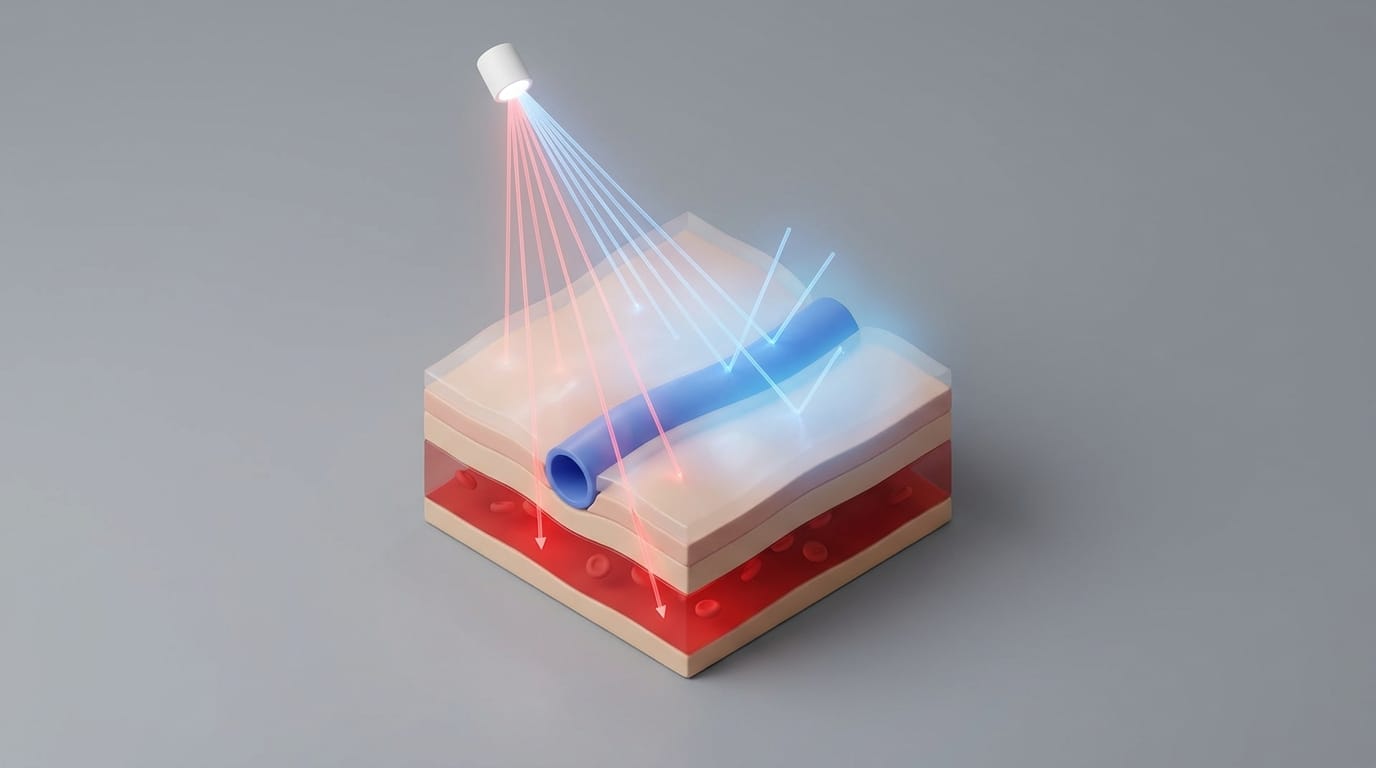
Many people believe deoxygenated blood turns blue inside the body, but your veins are actually performing a clever optical trick involving light physics and skin depth. To understand this system, we must look past biological myths and ask why do veins look blue through the lens of how light interacts with human tissue. This phenomenon is a matter of optics rather than a change in the chemical color of our blood. While anatomical diagrams color veins blue to contrast with red arteries, this is a choice for clarity rather than a literal representation. In the human body, blood remains a shade of red at all times. The cool-toned vessels on your wrist appear because of how our eyes perceive light after it travels through layers of skin and fat.
By studying the interaction between hemoglobin and light wavelengths, we can simplify this common observation. This clarity helps us understand our own biology and how medical technology uses these physical principles in 2026. When we understand the system, the illusion of blue blood disappears and reveals the truth about our circulatory health.
The Chemical Reality of Human Blood Color
How Hemoglobin and Iron Create Red Pigmentation
Hemoglobin dictates the color of human blood. This complex protein lives in red blood cells and specializes in moving oxygen through the body. At the center of each hemoglobin subunit sits a heme group containing an iron atom; this iron serves as the primary reason for the red color. When oxygen binds to the iron, it shifts the molecular shape of the protein, which changes how the hemoglobin absorbs and reflects light. This process works much like metallic pigments in industrial paints that achieve specific hues through their chemical structure.
In the presence of high oxygen levels, such as in the arteries leaving the heart, blood reflects a bright and vivid red. This is the state most people recognize from a minor cut or a blood donation. The chemical bond between the oxygen and the iron creates a bright reflection that signals a fresh supply of energy for the body’s tissues.
The Visual Difference Between Oxygenated and Deoxygenated Blood
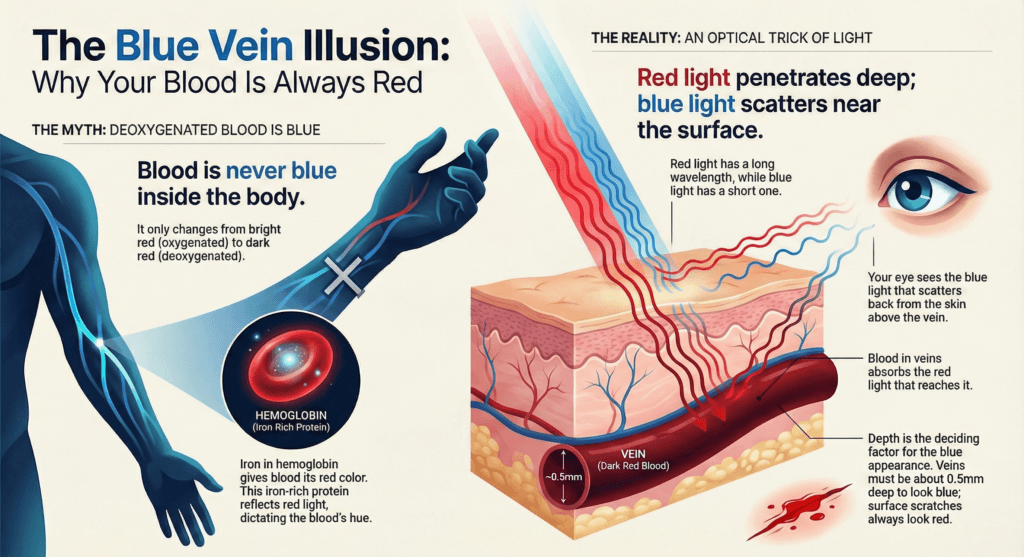
A persistent myth suggests that blood turns blue once it delivers oxygen to the body. In reality, deoxygenated blood merely shifts to a darker and more somber shade of red, often described as dark maroon or deep cherry. It never enters the blue or purple spectrum while inside the human body. If you saw deoxygenated blood in a vacuum or a sealed test tube, its darkness might make it look almost black, but the underlying red tint would remain visible under a strong light source.
The blue we see through the skin is not a property of the liquid itself; instead, it is a property of the light that manages to escape back to our eyes after entering the arm. This distinction is vital for understanding how our bodies interact with the environment. The blood remains a deep red as it returns to the heart, ready to be refreshed with a new supply of oxygen.
Why Do Veins Look Blue: The Physics of Light Wavelengths
The Absorption Spectrum of Red and Blue Light
To understand why do veins look blue, we have to look at how different light wavelengths move through human tissue. White light contains every color of the visible spectrum. When it hits your skin, it begins to scatter and move in different directions. Each color has a different wavelength; red light has a long wavelength, while blue light has a much shorter wavelength. Because red light is longer, it is much more effective at moving through the skin and reaching deeper tissues without bouncing away immediately.
Blue light acts differently because its short waves are easily deflected by the dense structure of the skin. It tends to bounce around and reflect back toward the surface much sooner than red light. This difference in penetration depth creates the foundation for the visual illusion we see on our arms and legs.
Why Short Wavelengths Fail to Reach Deep Tissues
Scientists call this phenomenon the optical window of human tissue. Human skin is relatively transparent to longer wavelengths like red and infrared light. You can see this in action by pressing a flashlight against your palm, which creates a red glow. Blue light lacks this penetrating power; it is absorbed or reflected long before it can reach the deeper layers of the subcutaneous system. When light hits a vein, the blood inside is very efficient at absorbing the red wavelengths that managed to reach it.
However, the blue light that never reached the vein is scattered back to your eye from the tissue above the vessel. Your brain interprets this lack of red reflection from the position of the vein as a blue or greenish color. This means the blue you see is actually the light that failed to reach the blood, while the red light that did reach it was swallowed by the hemoglobin.
The Optical Illusion of Subcutaneous Vein Placement
The Physics of Light Reflection from Vein Walls
The depth of a vessel is the deciding factor in its perceived color. Veins must usually sit at least 0.5 millimeters below the surface to look blue. At this depth, the red light is absorbed by the blood, while the blue light reflects off the skin and fat layers sitting on top of the vessel. This creates a high-contrast scenario where the vessel appears cool-toned relative to the surrounding skin. The surrounding tissue reflects both red and blue light, which makes the skin look pink or flesh-toned.
Because the area over the vein reflects significantly less red light than the skin next to it, the abundance of blue light becomes the dominant signal sent to the brain. It is less about the vein being blue and more about the vein removing the red light from that specific spot. This demonstrates how our brains use relative signals to determine the colors of the world around us.
Why Surface Capillaries Maintain Their Red Appearance
If you look at a tiny scratch or the small capillaries in your eyes, they always look red. These vessels are so close to the surface that the red light does not have enough tissue to travel through to be absorbed. In these cases, the light reflects directly off the blood and back to your eye before the skin can filter it. This confirms that the blue color is a product of the distance the light must travel. If blood were truly blue, even the smallest surface vessels would show that tint. Instead, we see that deeper vessels create a more pronounced shift toward a blue or purple appearance.
Practical Applications of Vein Physics
Using Near-Infrared Technology to Locate Veins
Medical professionals use this knowledge of light absorption to help patients with veins that are hard to find. Devices known as vein finders use infrared light to create a digital map of a patient’s vessels. Because deoxygenated blood absorbs infrared light differently than the surrounding tissue, these tools can project a real-time image of the veins directly onto the skin. Companies like AccuVein and Christie Medical have turned this optical principle into a standard part of medical care.
By using wavelengths that the human eye cannot see but hemoglobin readily absorbs, they answer the question of why do veins look blue and where they are located. This technology helps nurses find the right spot on the first try, which reduces the discomfort of needle sticks and speeds up treatment in 2026. It is a perfect example of how physics improves everyday healthcare.
The Use of Blue Lighting in Public Safety Infrastructure
A different application of this physics exists in public health design. In some cities, blue lighting is installed in public restrooms or transit hubs to discourage intravenous drug use. This strategy uses the optical window theory to change human perception. Under intense blue light, the contrast between the vein and the skin disappears. Because the room lacks red wavelengths for the blood to absorb, the veins become invisible to the naked eye. This makes it nearly impossible for an individual to locate a vessel for injection. While its long-term success as a social solution is still debated, it stands as a clear example of how manipulating light can change how we see our own bodies.
The blue appearance of our veins is a reminder that what we see is rarely a direct representation of reality. It is a filtered version of the world, processed through the physics of light scattering and the specific chemistry of our own bodies. Our blood remains red, even as it flows through the blue-tinted pathways beneath our skin.