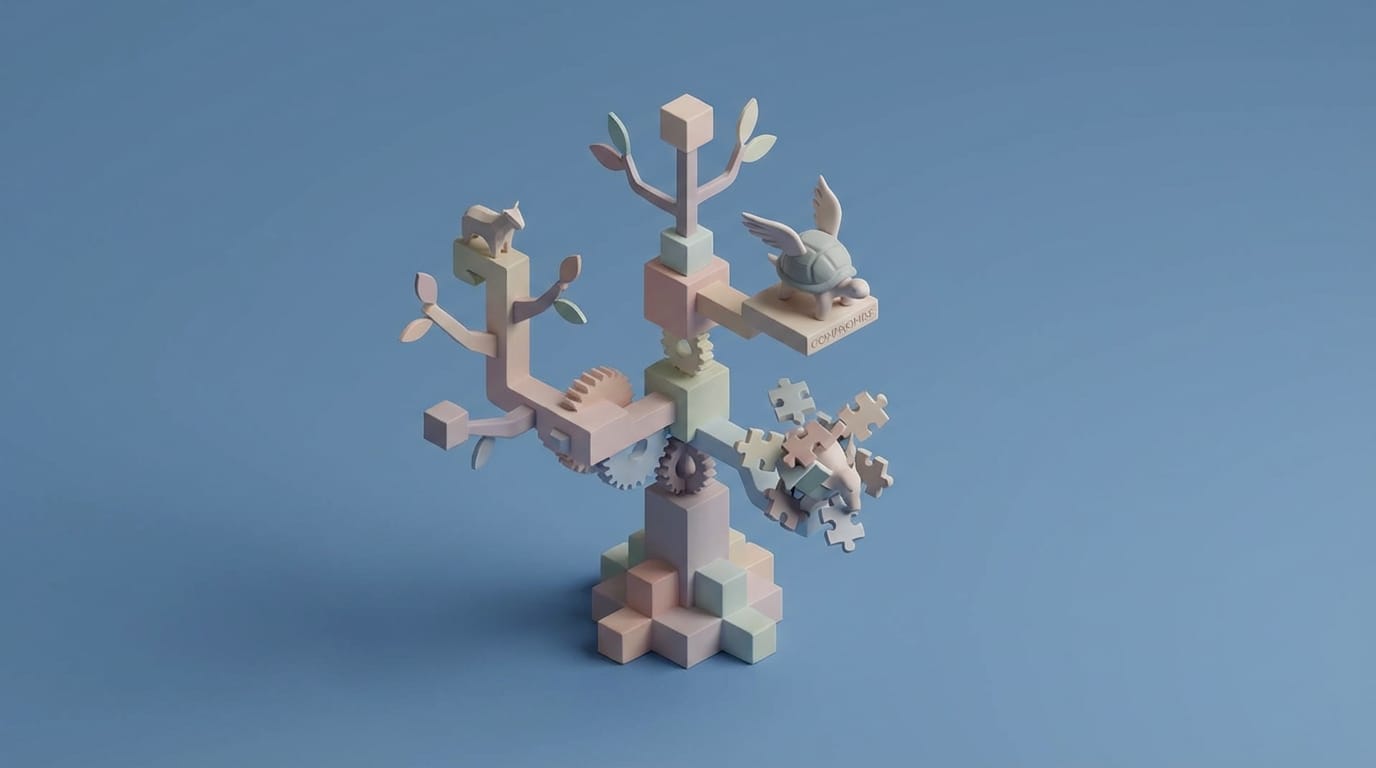
How Natural Selection Works as a Tinkerer Not an Engineer
Believing evolution produces flawless designs leads to a misunderstanding of how natural selection functions as a scavenger of existing traits rather than a master engineer. We often view the natural world as a gallery of fine-tuned machines; however, animal adaptation and evolution functions as a process of creative recycling. Instead of building the perfect solution from scratch, nature works with the genetic materials it already has on hand. This results in systems that frequently appear messy, redundant, or non-optimal.
This reality represents a structural necessity rather than a failure of biology. Because every living thing must survive in the present while evolving for the future, no species enjoys a blank canvas moment to redesign its core architecture. Understanding why animals never reach a state of perfection requires looking at the invisible boundaries that prevent radical innovation. Scientists often describe this process as tinkering with an old car while it is still moving down the highway.
When we examine the complexities of animal adaptation and evolution, we find that survival is not about reaching an ultimate finish line. It is a game of being good enough, where being slightly better than the competition is the only metric that matters. Internal and external forces, ranging from ancestral baggage to metabolic costs, ensure biological systems remain works in progress rather than finished masterpieces.
In a traditional engineering environment, a designer who realizes a structural foundation is flawed can scrap the blueprints and start over. Evolution lacks this luxury. Natural selection works like a handyman who uses whatever bits and pieces are available to create something functional. It does not innovate through foresight; it optimizes through trial and error using pre-existing components.
The Difference Between Optimization and Innovation
In biology, optimization refers to the fine-tuning of a trait that already exists. A bird’s beak might become slightly longer to reach specific seeds over many generations. Innovation, however, would be the sudden appearance of a completely new, biologically ideal structure that has no ancestral precedent. Because natural selection only acts on existing variations, it excels at making small adjustments rather than inventing radical new systems. Many new traits are actually repurposed old ones, a process known as exaptation.
The Limits of Path Dependency
Every organism remains bound by its lineage. You cannot build a better eye by deleting the current one and starting over; you must slowly modify the existing eye through generations. Each intermediate step must stay functional for the animal to survive. This path dependency means that even if a better design exists in theory, a species may never reach it. The transition would require a temporary dip in fitness that natural selection would immediately eliminate. While a computer user might restart a device to clear errors, evolution cannot perform a hard reset on a living population.
Why Phylogenetic Constraints Limit Animal Adaptation and Evolution
The history of a species acts as a set of handcuffs. These phylogenetic constraints are the inherited anatomical and genetic structures that limit the directions in which a species can evolve. While we often think of animal adaptation and evolution as an upward climb toward complexity, it more closely resembles a series of forced detours around ancestral obstacles that can no longer be removed.
Vestigial structures provide the most famous examples of these constraints. The pelvic bones in whales or the flightless wings of ostriches are not designed into the animal; they are leftovers that have not been fully phased out because no significant pressure exists to remove them. These structures persist because evolution lacks an undo button. If a trait does not actively kill the animal, it often hitches a ride through the millennia. This creates a body structure cluttered with historical baggage.
The Recurrent Laryngeal Nerve
The recurrent laryngeal nerve offers a striking example of these constraints. In fish, this nerve connects the brain to the gills by passing under a major artery near the heart (a direct and efficient route). However, as vertebrates evolved necks and their hearts descended into their chests, the nerve stayed hooked under that artery. In a giraffe, this means the nerve must travel from the brain, all the way down the neck, loop around the aorta near the heart, and then travel back up the neck to reach the larynx. This 5-meter detour represents a design flaw that no engineer would ever approve. It exists because the evolutionary path to fixing it would require breaking the nerve entirely, which would be a fatal mutation.
Balancing the Cost of Survival Through Trade-offs
No trait comes for free. In the high-stakes economy of nature, every adaptation requires an investment of energy or resources that the body could have used elsewhere. This leads to evolutionary compromise, where an organism functions as a bundle of trade-offs rather than a collection of perfect features.
High-performance traits, such as massive muscles for speed or a complex brain, are metabolically expensive. For instance, the human brain consumes roughly 20% of the body’s daily energy despite making up only 2% of its mass. Research shows that human brain glucose demands peak in childhood, which forces a trade-off that slows down physical body growth. An animal that adapts perfectly for speed might have a metabolism so high that it starves during a minor food shortage. Natural selection often favors a mid-tier trait that balances performance with caloric survival.
Specialization and Vulnerability
Specialization is a double-edged sword. An animal that adapts to eat only one type of leaf, such as the koala or the giant panda, is highly efficient in its specific niche. However, this perfection makes them vulnerable to environmental shifts. If that specific food source disappears, the animal has no secondary plan. Most successful species maintain a level of flexibility. This may be less efficient in the short term, but it provides greater resilience in the long term.
The Impact of Rapid Environmental Shifts on Adaptation
Even if an animal could reach perfection, that state would be temporary because the environment is a moving target. The world changes faster than the slow mechanism of genetic mutation can keep up with, leading to what biologists call evolutionary mismatch. Evolution is reactive rather than proactive. It can only respond to the selective pressures of the previous generation, which creates a natural lag.
If a forest becomes a savanna over several centuries, the animals living there will spend those centuries catching up to the new climate. By the time they adapt to the heat, the climate might have shifted again. This mismatch is evident in humans today; our bodies are still largely adapted for a hunter-gatherer lifestyle of high activity and scarce calories. This clashes with a current environment of sedentary lifestyles and processed foods.
Human-led changes, such as urbanization and climate change, occur at speeds that outpace animal adaptation and evolution. We see this in evolutionary traps where an old, reliable instinct becomes a liability. Sea turtles evolved to use the moon’s reflection on the ocean to find the water after hatching. In a world filled with artificial beachfront lighting, that adaptation now leads them inland toward roads and predators. Just as extreme weather mechanisms can overwhelm local infrastructure, rapid environmental shifts overwhelm biological systems tuned for a different reality.
How Modern Biology Views the Success of Imperfection
If perfection is unattainable, how do we define biological success? Modern biology has shifted away from the idea of progress and toward the concept of relative fitness. Success isn’t about being the best possible version of a creature; it is simply about being better at surviving and reproducing than the individual next to you.
Fitness is a comparison rather than an absolute score. If a mutation makes a gazelle 1% faster, it doesn’t matter if that gazelle’s legs are structurally inefficient. If that 1% allows it to outrun a predator more often than its peers, that imperfect trait will be passed on. This relative nature of animal adaptation and evolution means that good enough is the standard that drives the natural world.
Imperfection can also serve as a survival strategy. Systems that are slightly loose often have more room for future change. A rigid, perfectly optimized structure is difficult to modify if conditions change. Redundancy and inefficiency provide a buffer, allowing species to pivot when faced with new challenges. Ultimately, the lack of perfection in nature allows life to be diverse and persistent. By tinkering with the old rather than insisting on the new, evolution ensures that life can continue even as the rules of the game change. The flaws we see in the natural world are not mistakes; they are the scars of a 3-billion-year history of survival. They prove that you don’t need to be perfect to be successful.