The Biology of the Hump and Why It Stores Fat
Most people assume camels carry built-in water tanks across the desert, but this misunderstanding ignores a sophisticated energy management system. The persistent camel hump water myth hides how these animals survive weeks without a drink. Instead of a simple canteen, they use a complex biological process of fat storage and metabolic recycling. When we look at a dromedary or a Bactrian camel, we do not see a reservoir of liquid; we see a centralized battery of caloric potential. By separating the need for daily food and water from their survival, camels master environments that would kill almost any other large mammal. To understand this system, we must look past the animal’s shape and study its cellular chemistry.
The camel’s survival relies on managing heat, waste, and energy with extreme precision. Just as real-time plant monitoring tracks internal moisture levels to prevent wilting, the camel’s body constantly adjusts its internal parameters to match the harsh exterior world. This system functions through a unique anatomical solution to a caloric problem. In environments where plants are sparse and unpredictable, animals must store excess energy whenever food is available. While most mammals distribute fat in a layer beneath the skin, camels concentrate their tissue into distinct mounds on their backs.
Composition of the Adipose Tissue
The hump consists of fibrous fat that serves as a survival reserve for when grazing is unavailable. Because food is scarce in the desert, a camel can go months without a meal by slowly digesting the energy stored in its hump. When the animal depletes this fat, the hump does not simply shrink; it loses its structural integrity and can flop over to the side until the animal finds enough calories to refill it. This allows the camel to travel vast distances between feeding grounds without losing its physical strength or metabolic health.
Concentrated Fat as a Thermal Strategy
Storing fat in a single location is a smart piece of thermal engineering. Fat is a highly effective insulator, which is why whales and seals have thick layers of blubber to stay warm in cold oceans. For a desert animal, a uniform layer of fat would be a death sentence because it would trap body heat and force the animal to sweat to cool down. By moving all the fat to the hump, the camel allows heat to escape more easily through the rest of its body. This functions much like how wavelength filters manage thermal energy in the atmosphere, ensuring the core temperature remains manageable even under the direct sun.
How Metabolic Water Works During Fat Breakdown
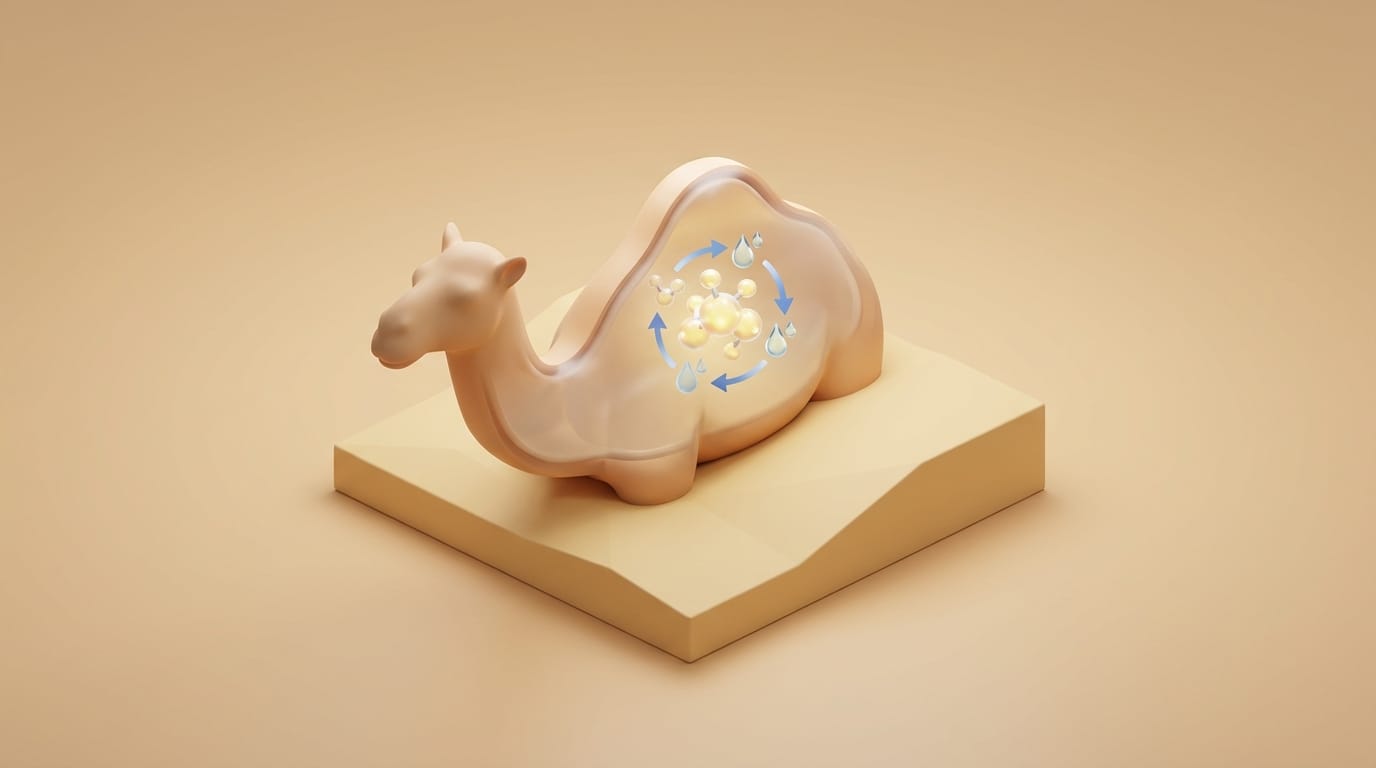
The camel hump water myth survives because of a specific chemical reality. Although the hump contains no liquid water, the process of breaking down fat creates water as a byproduct. This metabolic water helps the camel stay hydrated during long periods of drought. When the body breaks down the stored fat, it goes through a process called beta-oxidation. This chemical reaction uses oxygen to convert fatty acids into energy. As the hydrogen in the fat molecules combines with the oxygen the animal breathes, it forms H2O. This internal source of hydration provides moisture the camel did not have to drink.
This conversion is remarkably efficient. For every gram of fat used, the camel’s body produces approximately 1.07 grams of water. This means a 40-kilogram hump could yield over 40 liters of water. According to research in PMC, fat stores in desert mammals are vital sources of water that support metabolic functions when external sources disappear. However, this internal water comes at a price that often goes unmentioned in general science discussions.
The Respiratory Cost of Extracting Metabolic Water
To burn fat and get that water, the camel must breathe, which introduces a difficult trade-off. The act of breathing in dry desert air often costs the animal more moisture than it gains from the fat. To get the oxygen required for fat oxidation, the camel must ventilate its lungs. In the arid desert, every inhaled breath is dry. As that air moves into the lungs, the body must humidify it to protect the delicate lung tissues. When the camel exhales, that moisture risks escaping into the atmosphere.
Often, the water vapor lost through this increased respiration cancels out the water gained from the fat itself. Research by physiologist Knut Schmidt-Nielsen demonstrated that while a gram of fat yields a gram of water, the respiratory cost in dry air can result in a net loss. This confirms that the hump is an energy-storage system first. Its role as a water source is a secondary byproduct that only works because of other conservation mechanisms in the body.
Real Mechanisms of Camel Water Conservation
Since the hump is not a water tank, the animal relies on a suite of integrated systems to minimize waste and maximize every drop. This reality is more fascinating than the camel hump water myth because it involves specialized blood, kidneys, and nasal anatomy. These systems work together to ensure that the camel uses as little water as possible while maintaining its core functions.
Specialized Blood Cell Morphology
Camels have unique, oval-shaped red blood cells. Most mammals have circular cells that clump together when blood thickens due to dehydration, but the camel’s oval cells continue to flow even when the blood becomes viscous. These cells are also incredibly elastic; they can swell to over double their initial size without bursting. This allows a camel to drink 30 gallons of water in just a few minutes without suffering from osmotic shock. This biology is as distinct as the reasons human veins appear blue despite carrying red blood.
Nasal Passages and Moisture Recapture
The camel’s nose acts as a highly efficient heat exchanger. The nasal passages contain a large surface area of mucous membranes and complex bone scrolls called turbinates. During the night, the camel cools its nose. When it exhales, the warm, moist air from the lungs hits the cool nasal surfaces, causing the water to condense back into liquid before it can leave the body. This allows the camel to recycle the moisture in its breath and significantly reduces the water lost to the air.
Hyper-Efficient Renal Systems
The camel’s kidneys extract every possible molecule of water before the body excretes waste. Their urine can become as thick as syrup, containing twice the salt concentration of seawater. Similarly, their feces are so dry they can burn as fuel immediately. By minimizing water loss through waste, the camel ensures that its water stays in the circulatory system for as long as possible. This efficiency allows the animal to survive in conditions that would lead to rapid kidney failure in humans.
Camel Survival as a Total System Integration
The camel does not rely on a single trick to survive; it relies on the integration of its entire biology. Every part of the animal, from its thick coat to its specialized cells, works to manage the twin threats of heat and dehydration. To avoid sweating, which is the most expensive way to cool down, camels allow their body temperature to fluctuate. In the heat of the day, their internal temperature can rise to 41°C (106°F) without causing damage. At night, it drops to 34°C (93°F). This thermal buffering means the camel does not have to use its precious water supply to keep its body at a steady temperature.
The hump remains the centerpiece of this survival strategy, but not for the reasons people commonly believe. It is the ultimate energy reserve that allows the animal to navigate the world’s most barren regions. By concentrating its fat in a vertical mound, the camel minimizes its surface area contact with the sun and maximizes its ability to shed heat from its sides. This system proves the camel hump water myth is just a simple way to describe a much deeper engineering marvel. Survival in extreme environments is rarely about simple storage; it is about the efficiency of the entire body. While the hump provides the fuel, the rest of the body provides the economy. The camel does not just carry water; it manages a complex budget of moisture and heat that allows it to thrive where others vanish.