
The Mechanics of Nuclear Fusion
Scientists recently reached a goal called ignition. This made news all over the world. However, nuclear fusion technology still faces a huge problem. We must build a system that makes its own fuel. To understand this challenge, you first need to know how the physics works.
Fusion happens when two light atoms smash together. They form one heavier atom. This change releases a massive amount of energy. It follows the rule that mass can turn into energy. But atoms do not want to touch. Their centers have a positive charge. This charge pushes them apart like two magnets. Scientists call this the Coulomb barrier.
The Physics of the Coulomb Barrier
You must bring the atoms very close together to make them fuse. If they get close enough, a new force takes over. This is the strong nuclear force. It acts like glue for the center of the atom. On Earth, we must copy the center of a star to make this happen.
Stars use gravity to squeeze atoms. We do not have that much gravity on Earth. Instead, we use heat. We must heat the fuel to 150 million degrees Celsius. This is ten times hotter than the center of the sun. At this heat, the fuel turns into plasma. Plasma is a hot gas where electrons float free from their atoms. You must keep the plasma hot and thick for a long time. If you do, the atoms crash together hard enough to fuse.
Comparison of Fission and Fusion Energy Release
Current power plants use nuclear fission. This process is the opposite of fusion. Fission splits heavy atoms like Uranium apart. It works well but has risks. Fission creates waste that stays dangerous for thousands of years. It can also cause a meltdown if the cooling system fails.
Fusion is different. The most common type uses two forms of hydrogen. These are Deuterium and Tritium. This is called a D-T reaction. It creates a helium atom and a fast neutron. Fusion releases four times more energy than fission by weight. It is also safer. The reaction cannot run away. If the system breaks, the plasma cools down. The process stops in a second. The only waste is helium gas. You use helium to fill birthday balloons.
Primary Plasma Confinement Strategies
The biggest hurdle for nuclear fusion technology is holding the plasma. No metal or stone can touch something that hot. The plasma would melt any wall. Engineers use two ways to keep the fuel away from the reactor walls. These are magnets and lasers.
Magnetic Confinement: Tokamaks and Stellarators
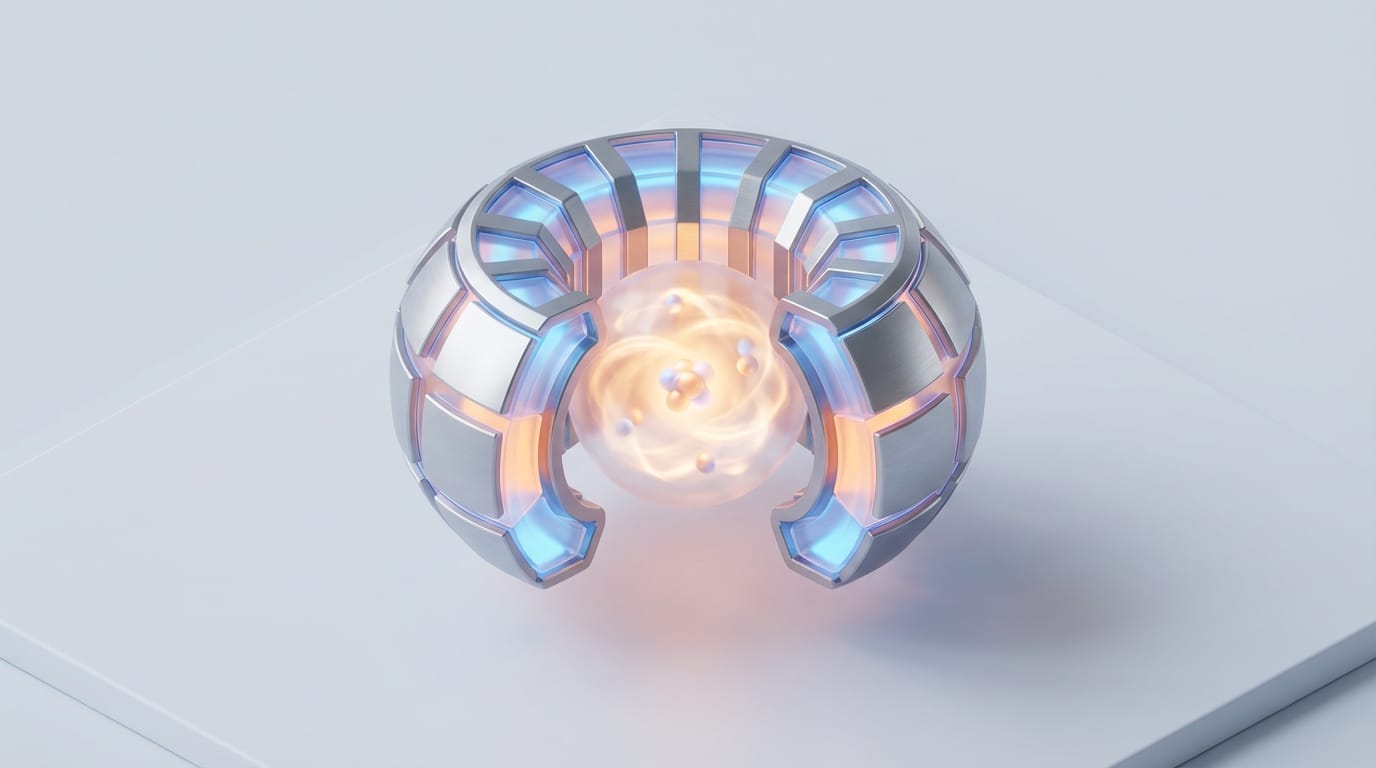
Magnetic confinement uses strong magnets to trap the plasma. It creates a “magnetic bottle.” The most popular design is the Tokamak. It is a Russian word for a donut-shaped chamber. Engineers wrap magnetic coils around the donut. They also run a current through the plasma itself. This twists the plasma into a tight loop. This keeps it from touching the walls of the machine.
The ITER project in France is the biggest Tokamak in the world. It is a massive project. Tokamaks are good at holding plasma, but they run in short bursts. Another design is the Stellarator. The Wendelstein 7-X is a famous example. Stellarators use very complex magnet shapes. They look like twisted ribbons. These magnets can hold the plasma steady for a long time. They are much harder to build than Tokamaks.
Inertial Confinement: High-Powered Laser Arrays
Inertial confinement uses a different method. It does not try to hold the plasma for a long time. Instead, it squeezes a tiny fuel pellet very quickly. The National Ignition Facility at LLNL uses nearly 200 big lasers. These lasers fire at a small capsule. The capsule contains deuterium and tritium.
The laser blast causes a tiny explosion. The pressure makes the fuel fuse before it can fly apart. Think of a Tokamak like a steady furnace. Think of this laser method like a car engine. The engine uses small explosions to make power. To run a power plant, you would need to explode several pellets every second. This is hard to do with today’s technology.
Measuring Success Beyond Energy Gain
Researchers use a number called the Q-value to measure success. This is the ratio of power out versus power in. But as an engineer, I can tell you that not all Q-values are the same.
The Q-Value: Scientific versus Engineering Breakeven
You may read about scientific breakeven. This is when the Q-value is over 1.0. This means the plasma made more energy than the lasers or magnets put into it. This is a great feat for physics. But it does not count the power needed to run the whole building. You still need power for cooling and vacuum pumps.
The real goal is “Engineering Breakeven.” To help the power grid, nuclear fusion technology must reach a higher state. The total power out must be more than the power the whole plant uses. A commercial plant will need a Q-value of 10 or more. This covers the energy lost when you turn heat into electricity.
The Role of ITER in Proving Systemic Viability
The ITER project will bridge the gap between science and power. Its goal is to make 500 megawatts of power. It will only use 50 megawatts to start the reaction. ITER will not make electricity for homes yet. It is a test lab. It will prove we can control a large burning plasma. It will also help us test the materials we need for future plants.
The Tritium Challenge and the Closed-Loop Fuel Cycle
There is a secret problem in fusion engineering. People think fuel for nuclear fusion technology is easy to find. This is true for deuterium. You can get it from ocean water. But tritium is different. It is very rare. There are less than 25 kilograms of it on the whole planet.
We get most of our tritium from old nuclear fission plants. These plants are closing down. Soon, we will have no tritium left. A fusion power plant cannot work without a steady supply. This is why we need a closed-loop fuel cycle. The plant must make its own tritium while it runs.
Lithium Breeding Blankets
The plan is to line the reactor walls with lithium. These walls are called “breeding blankets.” When the fusion reaction happens, it shoots out neutrons. These neutrons hit the lithium in the wall. This crash creates tritium and helium. Then, we pull the tritium out of the wall and put it back into the plasma.
This is very hard to do. We must make more tritium than we use. This is called the Tritium Breeding Ratio. It must be higher than 1.0. Even a small loss of fuel would shut the plant down. We must manage this fuel inside a vacuum while the machine is running. This is the hardest problem left to solve in the field.
Materials Science and Reactor Longevity
Even if we have enough fuel, we have a materials problem. Fusion releases very fast neutrons. These neutrons are much more powerful than the ones in fission plants. They do not just pass through the walls. They hit the atoms in the metal walls. This makes the metal brittle. Over time, the metal will swell and break.
Neutron Irradiation and Structural Degradation
A normal steel wall would break in a few months. Engineers are looking for new materials. They are testing special types of steel and carbon. These materials must stay strong while neutrons hit them like tiny bullets. No one wants to fix a reactor every few months.
These neutrons also make the reactor walls radioactive. This radiation does not last as long as fission waste. It fades in about 100 years. But it still means humans cannot go inside the machine. Robots must do all the repairs and maintenance. This adds more cost to the project.
Managing Heat Flux at the Diverter
Every reactor has an exhaust pipe called a diverter. This is where the waste heat goes. The heat there is extreme. It is like the heat on a heat shield of a space shuttle. It can reach 20 megawatts per square meter. We use tungsten tiles to stop the pipe from melting. We also pump water through it at high pressure to carry the heat away.
Integration into the Modern Energy Grid
We must solve the physics, the fuel, and the materials. Then, we must look at the cost. Fusion is a very expensive technology to build. It is not like wind or solar power. You cannot build a small fusion plant in your yard. It is a huge project that costs billions of dollars.
Capital Expenditure versus Operational Costs
The biggest cost for fusion is building the plant. This is the upfront cost. However, running the plant should be cheap. The fuel is not expensive once the cycle is set up. Fusion plants do not need as much security as fission plants. They also do not have the same waste costs. To win against other energy sources, nuclear fusion technology must show it can provide steady power. It must be “always-on” to justify the high price of the building.
Groups like EUROfusion are working on new designs. These are called DEMO plants. They will be the first to put power on the grid. These designs are simpler than research machines. They focus on making the plant easy to build in a factory.
Regulatory Hurdles and Public Safety Perceptions
Fusion is very safe. There is only a tiny bit of fuel in the machine at any time. A meltdown cannot happen. If a pipe breaks or the magnets turn off, the plasma just expands. It hits the wall and cools down instantly. The fire goes out. Governments are now deciding how to make rules for fusion. It is not the same as fission. It should have different rules because the risk is much lower.
“Fusion is the ultimate energy source. But to use it, we must master the hard engineering of our own world.”
The move from experiments to nuclear fusion technology in your home is a long race. We have proven the physics works. We are close to making more energy than we use. The next ten years will focus on engineering. We must build the fuel systems and the strong materials. If we succeed, fusion will become a permanent source of power for the world.