The Shift Toward Direct Plant Monitoring
Waiting for visible signs of wilting to water crops often indicates that physiological damage is already permanent. This delay results in significant yield loss that modern precision agriculture can no longer tolerate. To solve this, real-time plant monitoring has shifted focus from tracking external weather patterns to observing the internal circulatory systems of the plants themselves. This “inside-out” approach provides data hours, or even days, before a human eye can detect stress. Recent climate trends emphasize the urgency of this shift. Drought remains the largest driver of agricultural loss. Severe drought episodes cause yield losses of up to 27% in staple crops like wheat and rice, according to an OECD report on the global drought outlook. When sensors sit inside the plant, the biological organism becomes the primary sensor and creates a high-fidelity link between nature and management software.
This technical change does more than just save water; it protects the cellular integrity of the food supply. By understanding the metabolic shifts that occur when water becomes scarce, researchers can build systems that respond with speed and precision. These systems function similarly to how modern air defense systems orchestrate kinetic responses, as they prioritize the most vulnerable crops in a distributed network. Instead of reacting to a dry field, the software anticipates the specific needs of the plant before the cells begin to collapse.
The Shift from Environmental Data to Internal Plant Metrics
Why soil and weather sensors provide an incomplete picture
Traditional agricultural monitoring uses proxies to guess plant health. Soil moisture sensors measure how much water sits in the dirt, and weather stations track how much water evaporates from the surface. While these metrics help, they do not account for the individual plant’s hydraulic efficiency or its specific metabolic state. A plant might experience distress even in moist soil if its roots are damaged or if the atmospheric vapor pressure is too high for its pores to manage. Environmental data acts as a lagging indicator of plant health. By the time a soil sensor triggers an alert, the plant has often spent hours in a state of high tension while struggling to pull moisture against increasing resistance. This delay creates a reactive management cycle where farmers constantly play catch-up with the environment rather than anticipating what the crop needs to thrive.
Defining the link between physiology and technology
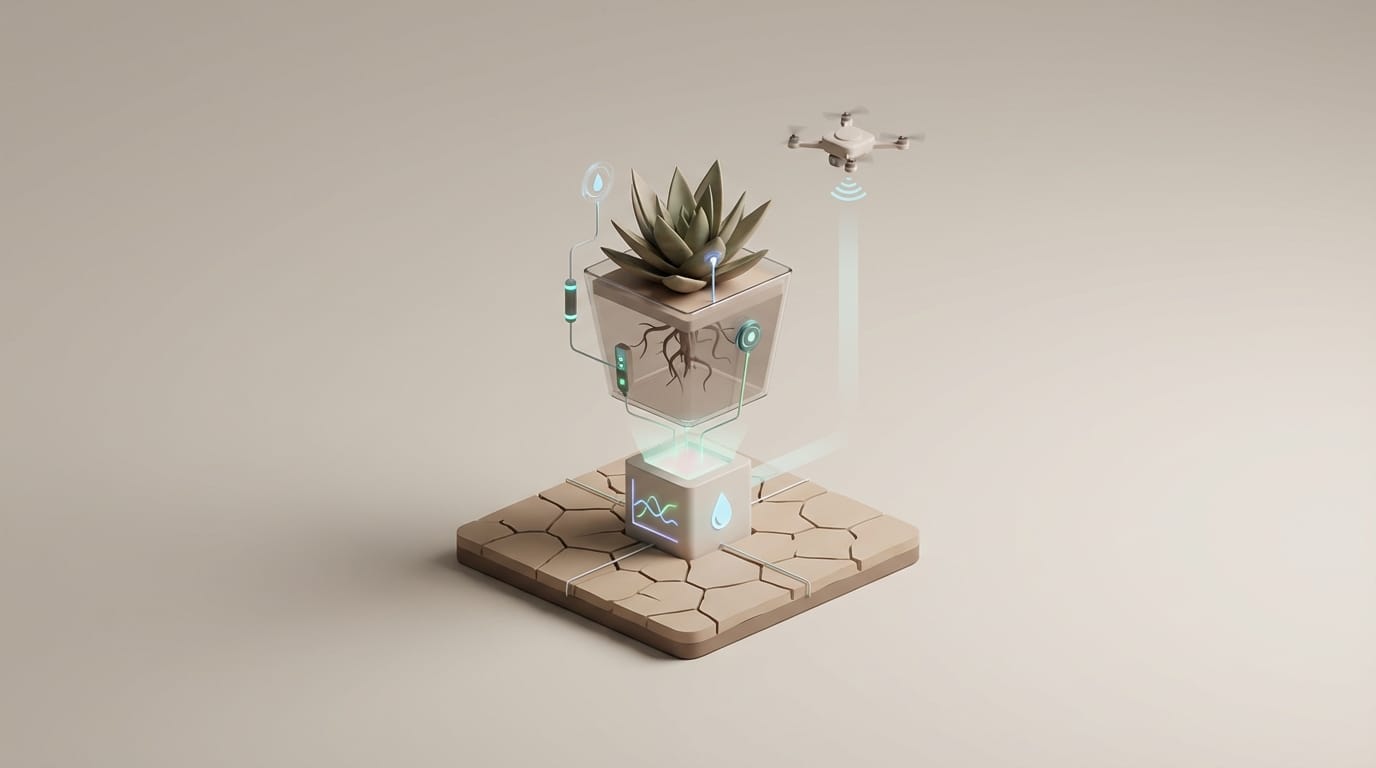
The concept of a biological link represents a fundamental change in how we view data hierarchy. In this model, the plant acts as the central processor of environmental stimuli. Instead of measuring the mechanisms of the greenhouse effect as they apply to the entire field, we measure how the internal chemistry of the plant changes in response to heat. This turns the crop into a live biological sensor that integrates soil, air, and light data into a single physiological output. This method eliminates the guesswork of environmental proxies by letting the plant signal its own status. Using these direct metrics allows managers to apply water only when the plant’s internal state demands it, which preserves resources and maintains growth rates.
How Bio-Sensors Capture Internal Physiological Changes
Monitoring xylem pH and bioimpedance for stress signals
The xylem is the plant’s vascular highway; it transports water and minerals from the roots to the leaves. When a plant begins to experience drought stress, the chemical composition of the xylem sap shifts. MIT researchers developed microneedle-based sensors that can detect a reduction in acidity within the xylem tissues. These sensors provide an early warning of drought stress up to 48 hours before physical symptoms appear. Because these needles are small enough to avoid damaging the plant, they can remain in place for an entire growing season to provide a constant stream of health data.
Bioimpedance serves as another critical metric for cellular hydration. This value measures how biological tissue opposes an electric current. When water leaves the cells, the electrical resistance of the tissue changes. Using real-time plant monitoring tools to send a tiny current through the stem, scientists have observed bioimpedance readings jumping 25% higher in less than an hour after drought conditions begin, according to reports from IEEE Spectrum. This allows for nearly instantaneous detection of cellular dehydration, which gives irrigation systems the chance to intervene before the plant enters a survival mode that would otherwise stunt its growth.
Tracking sugar content and nutrient flux in real time
Another emerging metric is the movement of sugars and nutrients through the plant. Organic electrochemical transistors can now be placed directly into the vascular tissue to monitor glucose and sucrose levels. As a plant enters a defensive state, it alters its sugar transport to protect its core functions. Tracking these metabolic handshakes in real time provides a map of how the plant allocates its energy during a crisis. This data allows farmers to intervene with nutrient-specific irrigation to stabilize the crop’s health. By seeing exactly which nutrients the plant is moving, managers can customize the water mixture to support the plant’s specific defensive response.
The Science of Stomatal Regulation Under Water Scarcity
Measuring stomatal conductance at the leaf level
Stomata are the microscopic pores on the surface of leaves that regulate gas exchange and transpiration. To prevent water loss, a plant will close its stomata during a drought. Measuring stomatal conductance (the rate at which water vapor escapes these pores) is the standard for understanding a plant’s immediate response to its environment. New wearable leaf sensors now provide continuous data on whether these pores are open, partially closed, or fully sealed. These devices are light enough to stay attached to a single leaf without pulling it down, which ensures the data reflects natural conditions rather than mechanical stress.
The impact of real-time aperture data on irrigation efficiency
When stomata close, photosynthesis stops because the plant can no longer take in carbon dioxide. By monitoring the pore openings in real time, irrigation systems can provide just enough water to keep them open without over-irrigating. This precision ensures that the plant remains in a productive state rather than a survival state. This level of optimization is similar to managing data center energy consumption, where every drop of water is tracked to prevent waste while maintaining peak performance. Every minute the stomata stay open represents another minute of growth and carbon sequestration, which directly improves the final harvest weight.
Predicting Drought Stress Through Real-Time Plant Monitoring
The gap between internal stress and physical wilting
A significant silent period exists between the moment a plant’s internal water potential drops and the moment its leaves begin to droop. During this gap, the plant suffers from oxidative stress and reduced carbon fixation. If irrigation begins only after wilting is visible, the plant may survive, but its total yield potential has already lowered. Direct monitoring closes this gap by identifying the critical window where intervention can prevent the physiological shutdown. By treating the plant as a live data source, farmers can maintain the internal pressure necessary for cell expansion and growth.
Algorithmic interpretation of early warning signals
The raw data from xylem sensors and bioimpedance probes is often too complex for a person to review manually. Modern systems use AI-driven analysis to interpret these signals and filter out the noise of daily cycles. These algorithms can distinguish between a temporary mid-day slump caused by high heat and the beginning of a genuine drought event. By identifying these patterns early, the system can trigger automated alerts or directly command irrigation valves to stabilize the plant’s internal pressure. This automation removes the need for constant human monitoring and ensures the crop receives help at the exact moment its internal chemistry changes.
Integrating Real-Time Data into Crop Breeding and Management
Accelerating the development of drought-hardy varieties
For researchers, these sensors provide a new way to study plant traits. By comparing how different genetic strains of a crop respond to water scarcity in real time, breeders can identify specific traits that allow one variety to keep its pores open longer or maintain its vascular pressure more effectively. This accelerates the breeding of drought-resistant agriculture by providing hard data on internal performance. Instead of waiting for end-of-season yield counts, scientists can see which plants handle stress better on a day-to-day basis. This immediate feedback loop allows for faster iterations in the development of crops that can survive in harsher climates.
The future of automated irrigation networks
As these sensors become more affordable and less invasive, we are seeing the rise of plant-controlled irrigation. In this setup, the crop itself dictates the watering schedule. When the sensors detect a specific threshold of bioimpedance or a change in acidity, the irrigation network responds. This represents the future of work in agriculture, as human oversight shifts from manual labor to the management of self-regulating biological networks. This shift ensures that every gallon of water is used as an investment in the plant’s specific biological needs rather than a broad application across a field.
Scaling these technologies is essential for global food security. As climate patterns become more erratic, the ability to listen to the plant’s internal signals will be the difference between a successful harvest and total crop failure. The transformation of drought resistance through real-time plant monitoring moves us past the era of looking at the sky to see if it will rain. By embedding sensors into the fabric of our crops, we treat the plant as a sophisticated biological system capable of communicating its own requirements for survival. This link enables a level of precision that preserves water while pushing the boundaries of what these organisms can produce. As these sensors move from the lab to the field, the question for farmers will no longer be if the soil is dry, but rather what the plant is telling them.