Living Inside the Sensory Bubble of the Umwelt
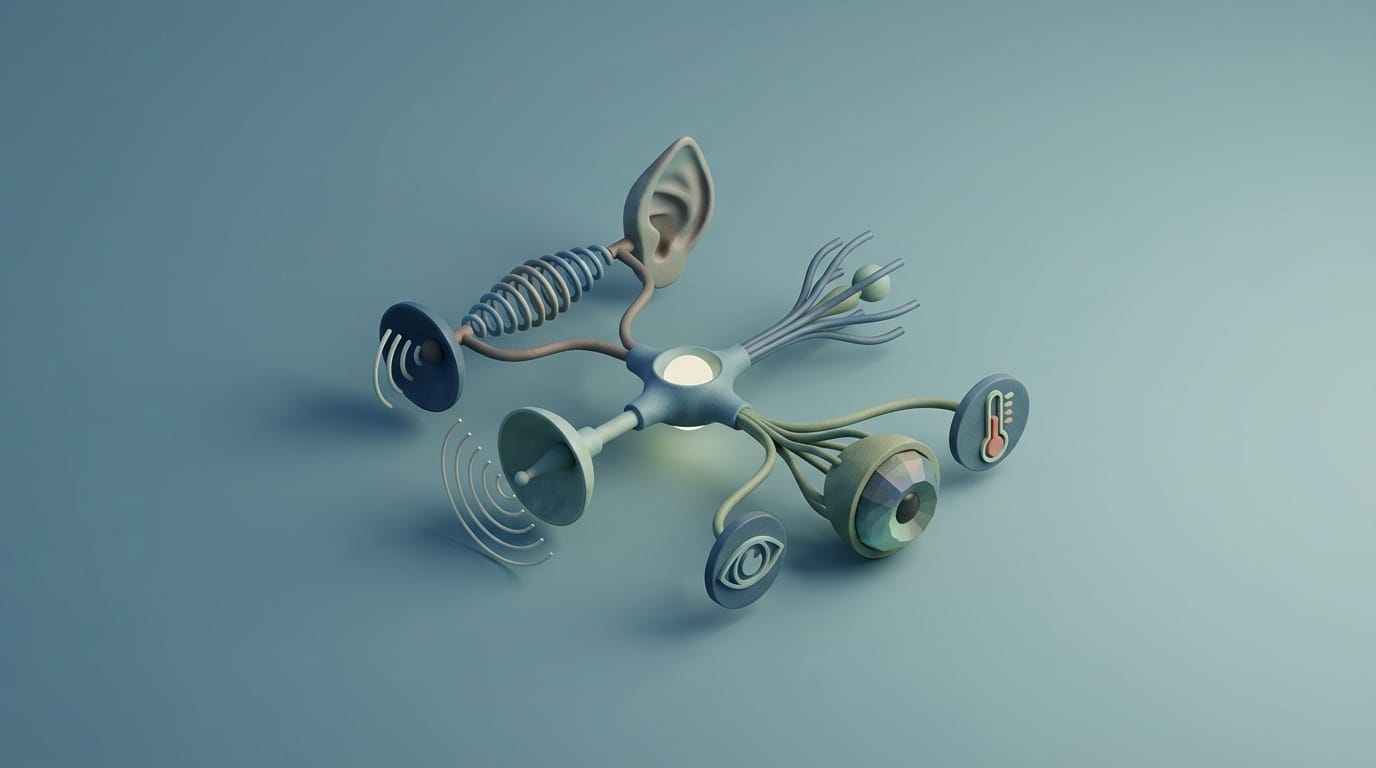
Imagine walking through a forest where the air hums with electric signals and the trees glow in colors your brain cannot process. This is the reality of animal sensory perception, a system that defines the boundaries of existence for every living creature on Earth. While we perceive our surroundings as an objective reality, we operate within a specific biological window. Every organism lives within an “Umwelt,” which is a sensory bubble that filters the chaos of the universe into a manageable stream of data. For humans, visible light and audible sound shape that bubble. However, most animals inhabit different worlds where the invisible is visible and silence is a map of information. Understanding these hidden layers reveals that we are missing entire dimensions of the natural world.
Jakob von Uexküll pioneered the concept of the Umwelt, arguing that an animal’s environment is a personalized construction rather than a shared stage. A tick ignores the beauty of a flower or the sound of the wind; its world consists of the scent of butyric acid and the detection of heat. This specialized survival filter prioritizes only what is necessary to stay alive. Biological limitations act as hardware constraints because if our brains processed every magnetic field and ultraviolet ray, the resulting noise would paralyze us. To understand how external triggers affect biological systems, we must accept that our own senses are a curated experience designed for a specific niche. We remain blind to most of the data swirling around us.
By studying how other species break these boundaries, we can reconstruct the fullness of reality. Animals inhabit spaces where sound creates a three-dimensional map and the ground communicates through seismic waves. This shift in perspective helps us move beyond a human-centric bias and recognize that our experience is just one version of the world. Animals do not just see the same world better; they access data points that our biology simply ignores.
How Echolocation Turns Echoes Into Three-Dimensional Maps
For bats and whales, sound is something to be seen. Echolocation allows these animals to render their environment in total darkness by emitting high-frequency pulses and analyzing the returning echoes. A bat navigates a complex cave system or tracks a moth by calculating the time delay and frequency shift of its own voice. This biological sonar is so precise that a bottlenose dolphin can distinguish a ping-pong ball from a football field away, as researchers at Dolphins Plus have observed. The detail of these echoic maps is staggering because sound travels through water differently than light.
Since the human body is mostly water, a dolphin can perceive a person’s skeleton and lungs. This internal map provides a structural transparency that no photograph can replicate, turning the ocean into a translucent architectural space. Unlike human radar, biological echolocation integrates into the animal’s consciousness as an active sensing system where the distinction between hearing and vision disappears. For a dolphin, the shape of a fish’s swim bladder is a visual signature that identifies exactly what prey hides in the murky depths. This ability to see through matter transforms the dark, opaque ocean into a world of clear shapes and densities.
This sensory skill is not passive. Whales and bats constantly adjust their clicks and pulses based on the environment, focusing their “acoustic gaze” on specific targets. They are effectively drawing their surroundings in real-time. By the time an echo returns, the animal has already processed the distance, size, and even the texture of the object. This level of environmental awareness allows for hunting and navigation in conditions where human eyes would be useless.
The Impossible Colors of the Ultraviolet and Infrared Spectrum
The human eye stays stuck in a narrow band of the electromagnetic spectrum, but many animals thrive in the fringes. Modern animal sensory perception in bees and birds includes the ability to see ultraviolet (UV) light, which reveals hidden messages. Flowers often have UV landing strips that act as neon signs for pollinators, guiding them to nectar. This is a vital part of how light interactions shape our view of the natural world. While we see a solid yellow petal, a bee sees a complex pattern of targets and pathways.
The mantis shrimp takes this complexity to an extreme. While humans have three types of color photoreceptors, the mantis shrimp possesses twelve. For years, scientists assumed this meant they saw millions more colors than we do, but research from Johns Hopkins University suggests their vision focuses on speed rather than nuance. Twelve dedicated channels allow them to recognize colors instantly without needing complex brain comparisons, which helps them strike quickly in a coral reef. Our brains cannot imagine these colors because we have no mental category for them. Just as a person born without the ability to see red cannot be told how to see it, our hardware traps us.
The mantis shrimp’s world is a kaleidoscope where light carries information about depth, polarization, and motion that we cannot simulate. Beyond the shrimp, some snakes use pit organs to “see” infrared heat, allowing them to track the thermal signature of a mouse in pitch-black conditions. These animals are not just seeing a different color; they are seeing a different source of information entirely. For them, the distinction between day and night is less about light and more about the presence of heat and UV signals.
Navigating the Planet via Electric Pulses and Magnetic Fields
Some exotic senses involve forces that humans can only detect with machines. Sharks and rays possess a form of animal sensory perception called electroreception, using a network of gel-filled pores called the Ampullae of Lorenzini to detect tiny electrical fields. They are so sensitive they can detect the heartbeat of a fish buried under the sand. This acts as a targeting system, allowing the shark to strike with precision even when silt blocks its eyes. The ocean is not a quiet void for a shark; it is a grid of electric pulses emitted by every living thing.
Over longer distances, many animals rely on magnetoreception to feel the magnetic field of the Earth. Migratory birds likely have a protein called cryptochrome in their eyes that allows them to perceive the magnetic field as a visual overlay, effectively seeing a compass on the horizon. This internal GPS guides them across thousands of miles of ocean with a reliability that rivals satellite navigation. These senses are vulnerable to human interference because our world creates a cacophony of electromagnetic noise from power lines and cellular towers. Just as light pollution hides the stars, our electronic infrastructure can create a fog that disorients animals.
Much like artificial blue light disrupts biological cycles, our electronic footprint can fracture the migratory paths of birds and the hunting grounds of sharks. When we build near these habitats, we are not just occupying physical space; we are flooding the sensory space with static. To a creature that feels the pull of the north, a power substation might feel like a blinding light. Understanding these fields is the first step in creating technology that coexists with the natural world rather than blinding it.
Feeling the Ground as a Symphony of Vibrations
For some species, the ground is a communication network. Elephants use infrasound, which are frequencies too low for humans to hear, to communicate over vast distances. These low rumbles travel through the air and the earth as seismic waves. By listening with their sensitive feet and trunks, elephants can detect a thunderstorm or a distant relative from nearly twenty miles away. To an elephant, the earth is a vibrating drumhead that carries the history and movement of everything around them.
In the miniature world, spiders use their webs as a tactile ear. Every strand of the web is tuned to different frequencies, allowing the spider to read the vibrations caused by a fly, a mate, or a predator. The web acts as an extension of the spider’s nervous system, providing a sense of distance and time that is purely physical. This tactile language is so sophisticated that spiders can tell if a vibration comes from the wind or a struggle. They do not need to see the fly to know its size and weight; the silk tells them everything they need to know.
Seismic sensing provides these animals with a sense of time and distance that humans lack. We perceive an earthquake as a sudden event, but an elephant may perceive the tremors as a predictable sequence of data. This level of connectivity allows for social structures and safety protocols that operate outside our observation. Whether through the massive feet of an elephant or the delicate legs of a spider, these creatures are constantly plugged into the physical vibrations of the planet, reading a story that we walk over every day without noticing.
Why Recognizing Other Sensory Realities Changes Our Worldview
Acknowledging these different sensory realities is a necessary act of humility. When we realize that a bird’s sky is full of magnetic highways and a bee’s flower is a glowing UV beacon, we stop seeing ourselves as the sole arbiters of reality. Our perception is just one of many ways to experience the universe. This understanding is critical as we navigate the modern age, where sensory pollution from ships, cities, and radio waves can shatter these fragile bubbles. Protecting the natural world requires us to protect the sensory space as much as the physical habitat.
A forest that is quiet to us might be deafening to an animal that hears infrasound; a dark sea might be blindingly bright to a creature that sees the electric hum of undersea cables. By developing empathy for how other species perceive their world, we can make better decisions about how we design our own. True animal sensory perception study begins when we stop asking what an animal looks like and start asking what it feels like to be that animal, suspended in its own unique bubble of light, sound, and electricity.
The systems of nature are interconnected through these invisible threads of data. Every creature is a specialist that evolved to master a specific slice of the world. As we continue to uncover these hidden worlds, we find that the planet is much larger than we imagined. The real immense world is not in distant galaxies; it is in the garden, the ocean, and the air. The ultimate insight of sensory ecology is that reality is a collaborative effort. No single species has the full picture. Instead, life on Earth is a vast, overlapping network of different perceptions that together form a complete system. This realization invites us to look at a simple tree or a stretch of ocean and wonder what is happening there right now that we are not equipped to see. By staying curious about these hidden worlds, we can better appreciate the complexity of the life that surrounds us and our own humble place within it.