
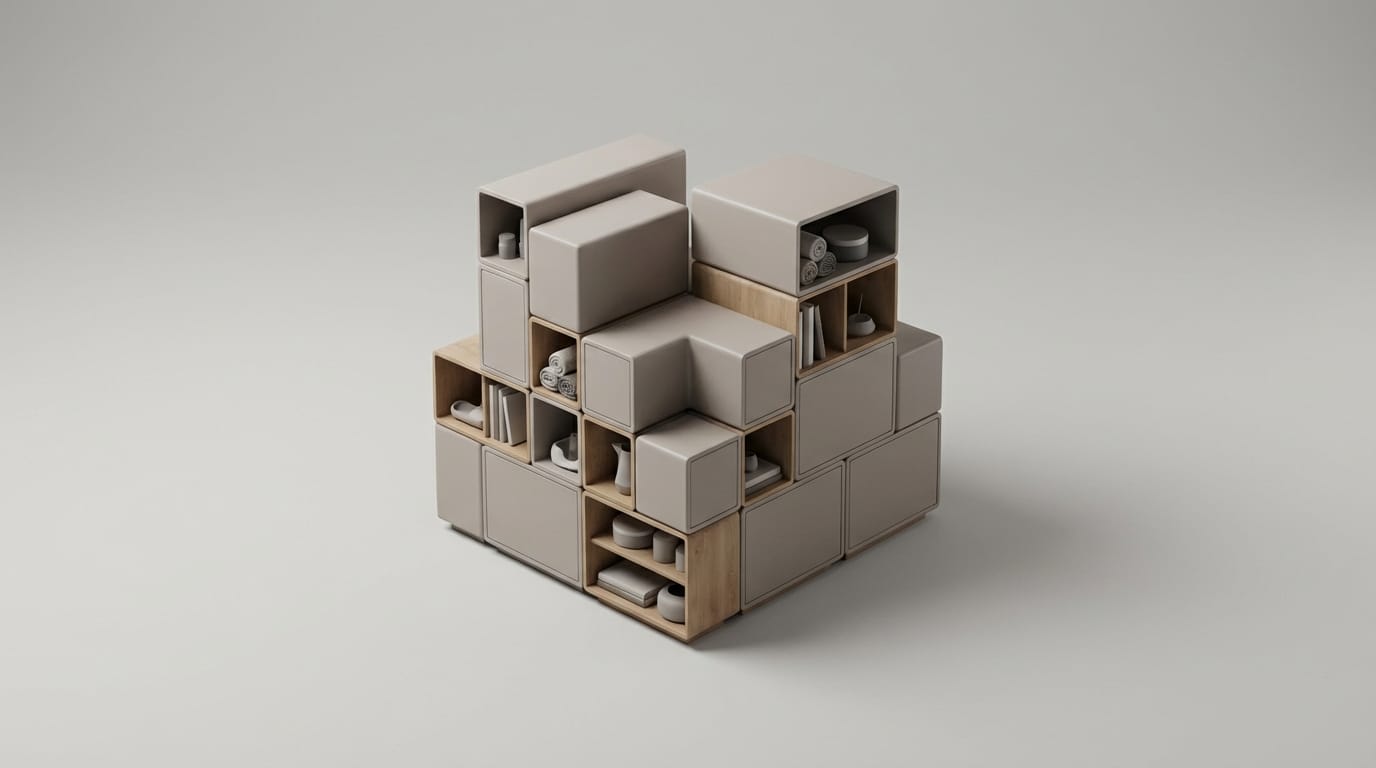
Standard storage systems often fail because designers build them for static lives, leaving people with messy rooms the moment their needs change. In small apartments, the stiff nature of built-in cabinets or heavy armoires leads to wasted corners and poor use of floor space. Using modular storage solutions for small spaces lets residents treat their homes as a growing system rather than a finished product.
When you view your home as a series of changing zones, your furniture must serve as a flexible frame. This shift moves away from hidden storage (which often just masks a mess) toward a style based on moving parts. By picking systems that you can take apart, grow, or reuse, you ensure your furniture stays helpful whether you live in a studio or a large house. This choice works well when you pair it with this guide to clearing out your home, as it provides the physical base for a clean life.
The Hidden Limits of Traditional Fixed Storage
Why permanent shelving lacks long-term use
Fixed shelves assume that your list of items will stay the same in size and count. If you put in a permanent shelf for small books, it fails when you switch to large art books or need that space for a desk screen. These stiff designs often create dead space in nooks where standard furniture cannot reach the ceiling, wasting nearly a third of the room’s height. This lack of growth forces owners to choose between their things and their floor space, a trade-off that rarely ends well for the resident.
The high cost of replacing furniture for every move
For those who rent, old-style furniture loses value and creates work. Heavy pieces move with difficulty and rarely fit the exact size of a new flat, leading to a cycle of buying and tossing that costs both money and waste. The move toward city living has made this worse; demand for flexible furniture has risen 15%, according to market data from Global Market Insights, as buyers seek pieces that can survive many moves. People now want items that act as tools they can take with them rather than heavy loads they have to leave behind.
How Modular Systems Create Dynamic Living Environments
The core mechanics of swappable parts
At its heart, modular design works like building blocks. A small set of standard parts and sizes allow for nearly endless setups. This system uses a grid, often in set steps, which ensures a drawer from a bedroom unit can fit into a living room shelf. This fit is the key to a long life; you are not just buying a cabinet, but a kit of parts including frames, shelves, and doors. These parts allow you to build up or out without having to start over from scratch every time your room changes.
Transitioning from wall units to freestanding islands
A smart modular system can change from a wall unit to a room wall that stands on its own. In a studio, a floor-to-ceiling shelf can act as a floating wall that parts the bed area from the kitchen without needing real construction. This follows the same logic used in building multi-use outdoor spaces, where the goal is to define specific zones within one open spot. By using furniture to shape the room, you gain control over how you live without the cost of a full home remodel.
Reconfigurability as a Strategy for Modular Storage Solutions for Small Spaces
The true value of modular storage solutions for small spaces lies in how they switch between roles. Instead of buying one piece for one problem, you buy a system that moves with your needs. This flexibility drives a market that analysts expect to reach over $130 billion in the coming years, according to data from Future Market Insights. When the furniture adapts to the user, it stops being a static object and becomes an active part of daily life.
Turning a bedroom bookshelf into a kitchen pantry
Consider how a high-quality modular unit lives. In your first flat, it might hold books for a home office. A few years later, after a move to a place with a smaller kitchen, those same parts can become a pantry with deeper shelves and wire bins. Since the wall parts and frame stay the same, the change costs you nothing but an afternoon of work. This ease of use is why many buyers now pick modular paths over old, stiff designs that only serve one purpose.
Scaling systems up or down as square footage changes
Old furniture either fits in the room or it does not. Modular systems grow or shrink as needed. If you move to a larger home, you can buy more parts and shelves to grow your current unit. If you move to a smaller place, you can split a large wall unit into two small cabinets for different rooms. This stops the problem of the furniture graveyard, where pieces are too big for the new floor plan but too pricey to throw away. It keeps your home feeling planned rather than crowded.
Maximizing Vertical Space with Specialized Modular Hardware
Wall-mounted rails vs. floor-to-ceiling tension poles
There are two main ways to hold modular weight: wall rails and tension poles. Wall systems, like those from Vitsoe or Elfa, use tracks that spread weight across the wall. These work well for a fixed feel that still offers shelf height choice. However, if you rent and cannot drill into the walls, tension poles are a better path. Good tension systems can hold a lot of weight (often over 100 pounds per set) and stay steady even when loaded with heavy kitchen gear or books. They use the floor and ceiling to lock in place, leaving no marks when you leave.
Integrating workstations into storage arrays
In small homes, the office is rarely its own room. Modular parts let you put a fold-down desk or a deep shelf right into your storage unit. By using the same frame for both your books and your laptop, you clear the visual clutter of having two separate pieces of furniture. This creates a single zone for many tasks that you can close or tuck away at night, helping you keep work and rest apart. It turns a simple wall of shelves into a hub for both work and home life.
Designing for Both Aesthetics and Functionality
Balancing open shelving with concealed cabinetry
One risk of modular shelves is that they can look messy. To stop this, a good system should follow a 60/40 rule: 60 percent hidden storage (drawers or doors) for tools and wires, and 40 percent open shelves for display. This keeps the room feeling light while hiding the small bits that cause visual stress. When picking a system, look for those that offer boxes you can move as easily as the shelves. This lets you hide the mess exactly where it happens to be at that moment.
Choosing materials that withstand frequent disassembly
How well the joints hold up is where cheap systems fail. If you plan to move your modular storage solutions for small spaces every year, stay away from low-cost particle board. That material tends to break around screw holes after you take it apart once or twice. Instead, look for systems made from metal, solid wood, or high-grade plywood with steel parts. These materials cost more at first, but they last for decades across many homes. They can handle being built and rebuilt without losing their strength or shape.
Building a Future-Proof Modular Storage System
Starting with foundational starter kits
The best way to start is with a basic kit of two rails and a few shelves. This lets you test how easy it is to build and how it looks in your home without spending too much. As you find new needs (like more shoe space or a place for coats), you can buy the exact parts to fix that problem. This step-by-step approach to furniture stops you from over-buying storage you do not need. It ensures every piece has a job and earns its place in your home.
When to choose custom vs. off-the-shelf modules
While low-cost systems are easy to find, they often lack enough part types. For long-term use, pro-grade systems from firms like Rakks or String offer more hardware choice, such as corner parts and heavy rails. These are better for users with odd rooms, like slanted ceilings or thin halls, where standard sizes might fail to use every inch. As trade paths face new shifts, learning how costs rise on imports can help you decide when to buy local parts versus high-end systems from abroad.
Modular storage is more than just a way to pack boxes; it is a way to handle the fast pace of modern life. By picking parts that focus on change rather than a fixed shape, you turn your furniture into an asset that grows with you. The power of this system is not in hiding your things, but in its ability to change with your life. You stop buying furniture for the room you have now and start building a system that fits any room you might live in later.