
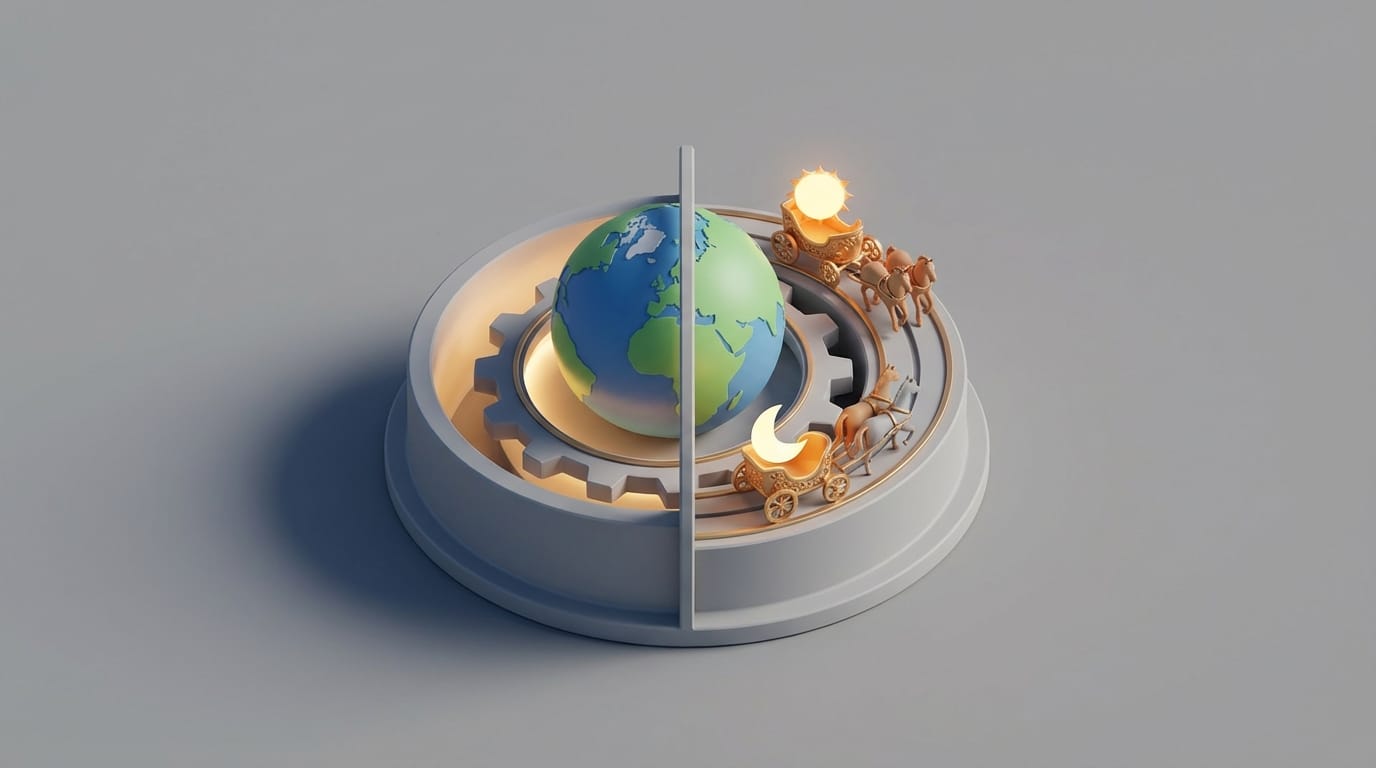
Long before we understood planetary motion, human civilizations used the imagery of golden chariots to track the sun’s path with surprising mathematical precision. The historical transition of earth’s rotation vs sun chariot myth represents more than a victory of science over superstition; it marks the refinement of human observation from metaphorical storytelling to precise mechanical measurement. When ancient cultures described a god hauling the sun across the heavens, they were building a systemic framework to record the predictable movements of the celestial sphere. These early observers mapped the sky with tools that fit their era, creating a logic that explained the light and heat they depended on for survival.
To the modern eye, the idea of a sun-god like Helios or Sol driving a team of horses across the sky seems like a primitive explanation for a physical event. However, these myths served as the original data-logging systems for humanity. By anthropomorphizing the sun, ancient observers could map its daily arc, the shift of the seasons, and the varying length of the day. This shift from mythology to mechanics was a gradual evolution, moving from the visible movement of the sun to the underlying physics of the planets. It suggests that our ancestors were far more observant than we often realize, using narrative to stabilize their understanding of a complex world.
Understanding this transition requires us to look at the sky as our ancestors did. They saw a sun that rose, peaked, and set with rhythmic consistency; today, we know this is an illusion created by the ground beneath us spinning at nearly 1,700 kilometers per hour. To bridge these two worlds, we must examine how a myth about a chariot paved the way for the orbital mechanics we rely on today. This journey from gods to gravity shows that while our explanations change, the phenomena we observe remain the constant anchor of human curiosity.
The Function of Mythology in Ancient Astronomy
Ancient Greeks lacked telescopes and atomic clocks, so the sun chariot myth worked as a sophisticated mnemonic device. For these cultures, the figure of Helios was more than a deity; he was the personification of the sun’s repeatable trajectory across the sky. By assigning specific characteristics to his horses, Pyrois, Eos, Aethon, and Phlegon, astronomers could communicate the intensity and position of the sun at different times of the day. This narrative structure allowed information to pass down through generations without the need for written logs, ensuring that farmers and navigators understood the timing of the solar day.
Solar chariots as mnemonic devices
The sun chariot story provided a rhythmic structure to the day. In Norse mythology, the siblings Sol and Mani were chased by wolves; this narrative emphasized the relentless and unstoppable nature of the sun and moon’s passage. These stories were about the ecliptic, which is the apparent path the sun follows across the sky throughout the year. By mapping the sun’s journey to a chariot’s route, ancient cultures could identify the solstices where the sun appeared to stand still before reversing its north-south migration. These “stops” on the chariot route allowed early societies to predict seasonal changes with enough accuracy to plant crops and prepare for winter.
Tracking the ecliptic through celestial metaphor
Modern researchers often underestimate the sophistication of these tracking systems. While the ancient mind lacked the concept of axial tilt, people were acutely aware of the sun’s shifting position. The myth of Phaethon, the son of Helios who lost control of the chariot, served as a cautionary tale about the dangers of deviating from the established solar path. In many ways, this myth mirrored the observation of planetary “wanderers” and the effects of celestial irregularities. Scholars often discuss this level of observation in the context of other historical misconceptions, such as the origin and evidence of the medieval flat earth myth, which highlights how ancient scholars often possessed more accurate data than we give them credit for today.
How Earth’s Rotation vs Sun Chariot Myth Explains Day and Night
The fundamental shift in human understanding happened when we realized that the sun was not moving across the sky; instead, we were moving beneath it. This transition from a geocentric to a heliocentric perspective redefined the sun from an active traveler to a central anchor. In the modern model of earth’s rotation vs sun chariot myth, the movement of the sun is an apparent motion caused by the Earth spinning on its axis. This axial rotation serves as the engine of our 24-hour cycle, creating the transition from light to dark without the need for a celestial driver or a team of mythical horses.
The mechanics of axial rotation
Earth rotates eastward in what scientists call prograde motion. At the equator, the planet’s surface moves at approximately 1,674 kilometers per hour, according to Earth’s rotational speed data from NASA. Scientists calculate this speed by dividing the Earth’s circumference by the time it takes to complete one full rotation relative to the stars, which is known as a sidereal day. Because we move with the atmosphere and the ground, we do not feel this incredible speed. Instead, we perceive it as the sun rising in the east and setting in the west, which is a perfect inversion of our actual physical movement through space.
Defining the terminator line
What we experience as sunset or sunrise is actually our location on the globe crossing the terminator line. This moving boundary separates the illuminated day side from the dark night side and constantly sweeps across the Earth’s surface as the planet spins. While the ancient Greeks might have described this as Helios putting his horses away for the night, we now understand it as a simple geometric consequence of a sphere rotating in front of a light source. This interaction of light and atmosphere also determines the colors we see in the sky, as explained in the science behind why is the sky blue through Rayleigh scattering.
Physical Proof That the Planet Is Spinning
For centuries, the primary argument against Earth’s rotation was that we cannot feel the movement. Critics argued that if the Earth were truly spinning at over 1,000 miles per hour, the winds would be unbearable and objects would fly off the surface. It was not until the 19th century that physicists provided the proofs that moved the rotation of the Earth from a mathematical theory to an observable fact. These proofs shifted the standard for truth from celestial observation to terrestrial measurement, proving that our senses can be deceptive when measuring the scale of the planet.
Visualizing motion with the Foucault Pendulum
In 1851, Léon Foucault suspended a 28-kilogram lead-filled brass sphere from the dome of the Panthéon in Paris. This device, the Foucault Pendulum, provided the first direct evidence of Earth’s rotation without looking at the stars. As the pendulum swung, its plane of oscillation appeared to rotate slowly over time. In reality, the pendulum’s swing remained constant in space while the Earth literally turned underneath it. This experiment demonstrated that the ground is not a static platform but a moving stage, a concept that Foucault’s pendulum still demonstrates today in science museums around the world.
The Coriolis effect on global wind patterns
Another invisible proof of rotation is the Coriolis effect. Because the Earth is wider at the equator than at the poles, different latitudes spin at different speeds. As air or water moves north or south, its inertia carries the rotational speed of its origin point, which causes it to veer off a straight path. This is why hurricanes rotate counter-clockwise in the Northern Hemisphere and clockwise in the Southern Hemisphere. This deflection is a direct consequence of the planet’s spin and is a critical factor in understanding the climate systems described in the greenhouse effect explained. Without rotation, our weather patterns and ocean currents would be entirely unrecognizable.
Why Modern Physics Inherited Ancient Observations
The transition from the sun chariot to axial rotation was not a process of debunking ancient ignorance; it was an upgrade to the system of measurement. The data points collected by ancient observers (the timing of the solstices, the angle of the sun at noon, and the length of the solar day) remained valid. Modern physics simply took those same observations and applied a mechanical explanation to them. We still track the same ecliptic, but we now understand that we are the ones doing the traveling. This continuity shows that science often builds upon the foundations of metaphor and storytelling.
From geometric metaphors to orbital mechanics
The ancient chariot tracks are now known as the plane of the ecliptic. When we calculate the Earth’s orbit today, we find that the ancient Greeks were remarkably accurate in their timing of solar events. The 24-hour cycle they mapped to the gods is the same cycle we use to synchronize our global networks. The difference is that we now account for the slight variations between a solar day and a sidereal day. This distinction allows for the precision of GPS and satellite communications, proving that the ancient observations were the first steps toward our global positioning technology.
The evolution of human measurement
Humanity’s curiosity about the light-dark cycle has remained constant for millennia. We moved from the golden reins of Helios to the gravitational pull of the sun, yet the goal remains the same: to understand the systems that govern our existence. This continuity shows that even our most modern scientific theories are built on the foundations of ancient observation. We traded the poetry of the chariot for the precision of the pendulum, but we are still looking at the same sky and trying to find our place within the spin.
The transition from solar myths to planetary mechanics illustrates a fundamental pattern in human progress where we often describe what we see before we understand what is happening. By reframing earth’s rotation vs sun chariot myth as an evolution of a tracking system rather than a replacement of wrong ideas, we can appreciate the sophistication of our ancestors. They built a bridge of metaphor that eventually allowed us to enter the realm of measurement. As we look forward to deeper space exploration, we should remember that our most advanced orbital calculations are the direct descendants of the stories told about a golden chariot crossing the sky. Our current understanding of physics represents the most precise metaphor we have available today to explain the eternal dance of the stars.