
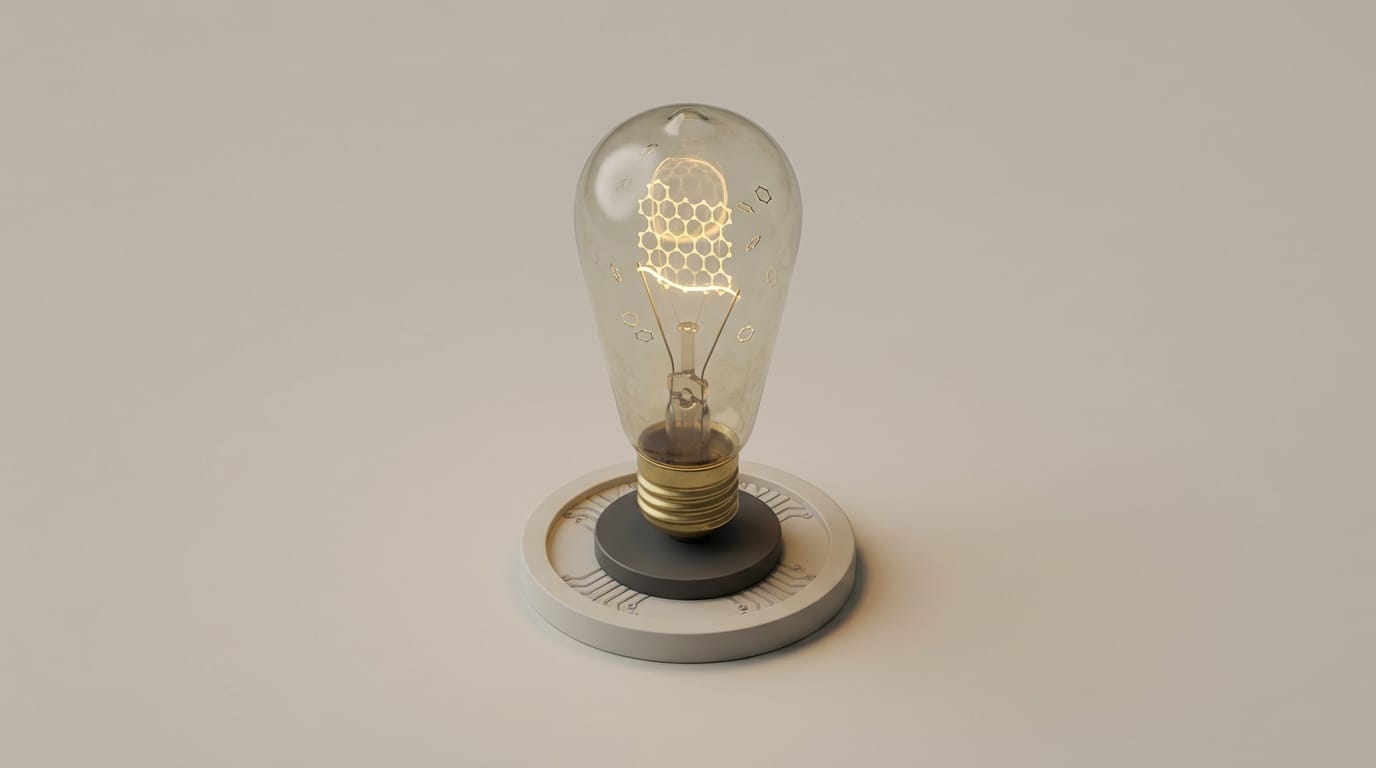
The Carbon Mystery Inside Menlo Park
Innovation rarely follows a straight line. We often miss the fact that the most prized material of our modern age likely burned inside a New Jersey workshop over 140 years ago. The Edison graphene light bulb story proves that what we call modern nanotechnology might be a simple rediscovery of a 19th-century accident. Thomas Edison did not set out to find wonder materials. He wanted a way to stop a thread from burning up in a vacuum, but in his drive to sell a working electric lamp, he built a reactor that could create two-dimensional carbon. This hidden history shows that the systems we build often produce breakthroughs we lack the tools to see.
In the late 1870s, the lab at Menlo Park worked like a factory for trial and error. Edison tested over 6,000 materials ranging from boxwood and hickory to exotic grasses and human hair. The main hurdle was the failure of materials available at the time. Early inventors tried using carbon, but their vacuum systems were too weak to keep oxygen from burning the filament. Edison tried using platinum, but it cost too much and was hard to shape. This struggle eventually led him back to carbon, the same material that defines current lighting technology.
The turning point came when Edison’s team moved away from metals and used carbonized cotton thread. By baking these threads in high-heat ovens without oxygen, they made a carbon filament that was flexible and could carry a charge. This shift did more than just win the race for the light bulb. It created a system that could move carbon at an atomic level, even if the team did not have a name for it yet. The key to this win was the Sprengel pump. This device removed air down to one-millionth of an atmosphere. In this space, carbon acted in ways that defied the physics of the day. Without air to cause a fire, the heat from the electricity began to change the atomic map of the carbon itself. Just as the evolution of industrial trust systems helped patents grow, this mechanical precision helped Edison push materials to their physical limits.
Modern Tools Unlock the Edison Graphene Light Bulb
For a century, people saw the first light bulbs as simple heaters. Recently, researchers at Rice University looked at these old tools through the lens of modern science. They did not just study the bulbs; they copied Edison’s old tests using the notes from his lab. By sending 110 volts of current through carbonized bamboo filaments, the team saw a strange change. They used a tool called Raman spectroscopy to look at the molecular patterns. They found the clear mark of graphene. They discovered turbostratic graphene, where atomic layers stack loosely and sit slightly out of line.
The proof suggests that the Edison graphene light bulb was a working nanomaterial factory. The first surge of power through the carbon filament created heat over 3,600 degrees Fahrenheit. At these levels, the carbon atoms broke off and built the hexagonal grid that makes up graphene. Edison may have made a substance that is now vital to our tech-heavy world, according to the Rice University research team. This find forces us to rethink the path of material science. It means we have lived with the miracle material of the future for nearly 150 years without knowing it.
How the Light Bulb System Made Nanomaterials by Accident
To see how a 19th-century shop made a modern material, we must look at the light bulb as a reactor. In modern labs, scientists grow graphene by heating carbon gases in a vacuum until they form thin layers on a base. Edison’s bulb did something similar with solid carbon. When the power hit the filament, it started a process called flash Joule heating. This method uses a burst of high voltage to raise the heat of a material fast, causing its atoms to move and change. In the vacuum of the bulb, no gas molecules got in the way. The carbon atoms on the surface cooked into a layer only one atom thick.
The vacuum did more than keep the filament from burning. It acted as a shield that let the carbon stay in its two-dimensional state. In open air, the graphene would have turned into gas right away. By taking out the air, Edison made the exact pressure and heat needed for atomic work. As the filament reached its peak heat, the messy carbon parts began to line up. They formed the grids that mark graphene. This change turned the dull gray filament into something bright and silver. This process works much like the ways software refines digital images to make them look better. Edison was essentially upscaling the molecular map of bamboo into a better form.
The 13-Hour Irony of Edison’s Success
A deep irony sits at the heart of the Edison graphene light bulb story. Edison wanted his bulbs to last. His early tests lasted only a few minutes. When he finally made a bulb that stayed lit for 13.5 hours, he saw it as his best work. However, the long life he wanted is likely what destroyed the graphene he had made. Graphene is a flighty material at high heat. The Rice University team found that graphene only stays alive during the first few seconds of the heating process. If the power stays on, the heat causes the thin layers to fail and fuse back into graphite, the same common material found in pencils.
Edison’s 13-hour win was actually a slow burn of his most modern byproduct. By succeeding as an inventor, he wiped out the nanotechnology inside his bulb. To find the graphene, Edison would have had to stop the test early and fail in his goal to make a long-lasting light. This trade between finding something new and making something useful happens often in science. It mirrors the complex trials of nuclear fusion, where the heat needed for a win can destroy the tools used to reach it. Even if we had the first bulb Edison used, any graphene made during the test would have turned to graphite long ago.
This irony suggests that science is full of breakthroughs that people threw away because they did not fit the goal of the moment. Edison wanted a lamp, not a new way to move power. In his world, a material that only lived for 20 seconds was a failure, even if that material would one day be worth billions of dollars.
What the Graphene Light Bulb Teaches Today
Knowing that graphene lived in 1879 forces us to look at how we define progress. We think of new ideas as steps toward a known future. In truth, the future often hides in the background of our current tools, waiting for us to find the words to describe it. Modern science is now going back to these old ways. Scientists study the flash heating that happened in Edison’s bulb to make graphene from waste like wood and plastic. By seeing the light bulb as a blueprint for a reactor, we can find cheaper ways to build modern tech.
This story shows why we must look at old systems again. Just as modern software updates find hidden power in old hardware, modern tools act as updates to our view of the past. We are finding that our ancestors were often better at their jobs than they knew. They simply did not have the tools to see the atoms they were moving. The Edison graphene light bulb reminds us that the tools we use every day are deeper than they seem. The next big thing might not be a new tool at all, but a part of a system we have used for over a century. By looking at our tools with new eyes, we can find the miracles that have been hiding in plain sight.
Success often hides the very shifts that could lead to the next big change. Edison’s drive for a long burn time gave the world light, but it burned a material that could have changed the electronic age much sooner. This shows that in any system, the data we toss out as noise might be the signal of a new reality. As we move into the age of quantum computers, we must ask what miracles we are burning away today. The history of the light bulb tells us that the future is not just something we build. It is something we have to stop destroying by mistake.