
The Mystery of the Sailing Stones Death Valley
For decades, researchers wondered how heavy boulders navigated the desert floor on their own. These geological travelers, known as the sailing stones death valley, left long furrows in the earth without a single witness to their journey. Some stones weigh up to 700 pounds and sit at the end of trails stretching for hundreds of meters across the flat, sun-baked mud of Racetrack Playa. This persistent mystery invited many theories, ranging from magnetic anomalies to unusual weather patterns, yet the rocks remained silent about their movement.
The solution to this puzzle lies in a delicate mechanical symphony of physics and climate rather than the supernatural. Understanding how these rocks move requires looking past the static environment and imagining a rare set of circumstances where the desert floor transforms into a friction-free laboratory. To see a stone in motion is nearly impossible for a visitor; it is an event that occurs so rarely that the rocks stay stationary for almost their entire existence.
By examining the structural systems of the Racetrack Playa, we can clarify how a light breeze and a thin sheet of ice displace boulders that no human could easily nudge. This process reveals a hidden world of sensory details, including a specific auditory signal that precedes the movement. This sound provides a rare glimpse into the mechanical logic of the natural world, showing how simple physical inputs create complex outcomes.
The Mystery of Racetrack Playa
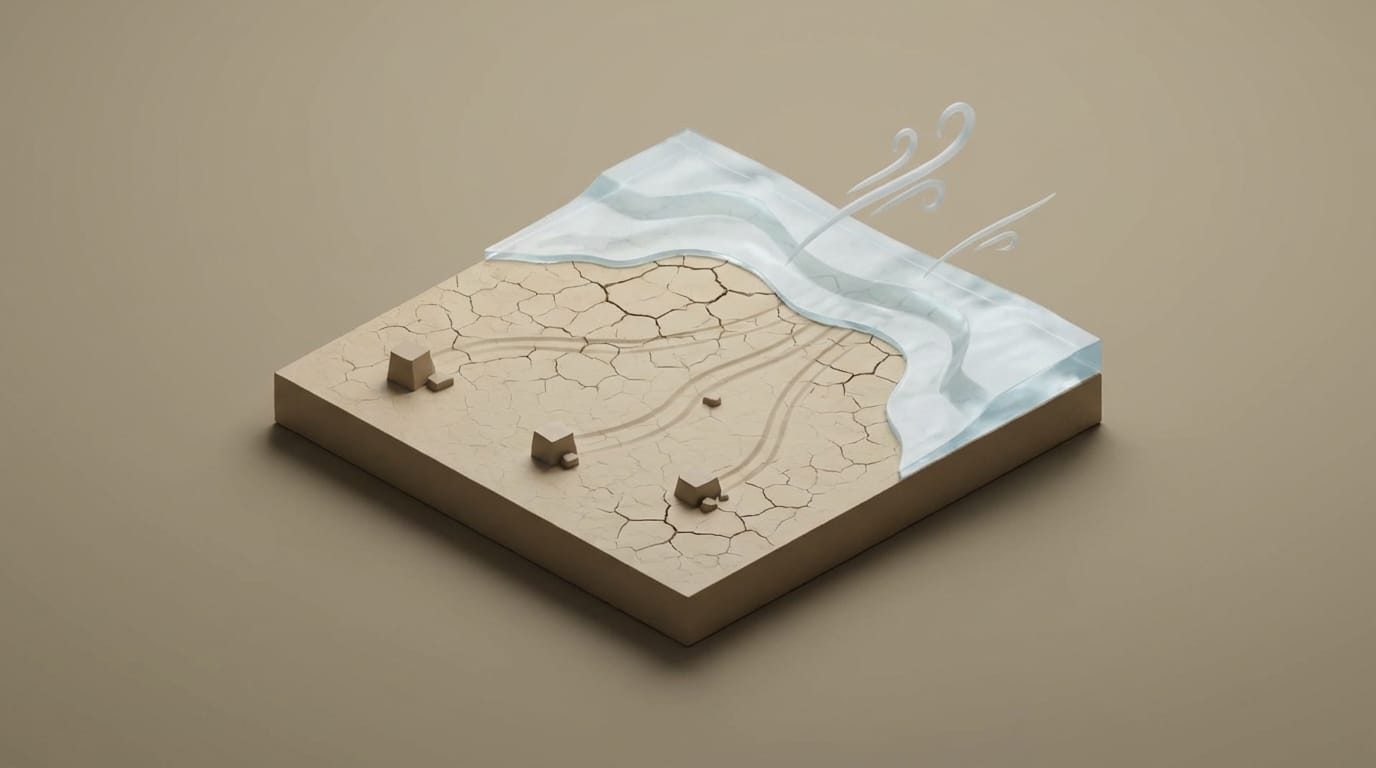
Racetrack Playa is a seasonally dry lake located in a remote canyon between the Cottonwood and Last Chance Ranges. Its surface is exceptionally flat and consists of fine-grained sediment that cracks into a mosaic of polygons when dry. The stones themselves are chunks of dolomite and shale that tumble from the surrounding cliffs. Once they land on the playa, they begin a journey that leaves unmistakable physical evidence of rock displacement in the form of shallow, grooved tracks.
The lack of eyewitnesses historically led to a vacuum of explanation. Because the playa is remote and the conditions required for movement are inhospitable, few people had ever seen a stone move until recently. This allowed fringe theories to grow. Some suggested that “dust devils” or hurricane-force winds moved the rocks, while others looked for magnetic fields in the valley’s crust. However, the tracks often ran parallel to one another before taking sharp, synchronized turns, suggesting a force that acted upon the entire field of stones at once rather than individual gusts of wind.
The scale of the displacement is significant. Some trails are straight, indicating a steady push, while others are zig-zagged or curved, suggesting a wandering path. Because the rocks are often found hundreds of feet from any hillside and the tracks they leave are deep enough to last for years, the energy required to move them is substantial. The mystery was not just if they moved, but how they did so without leaving behind any footprints or signs of human interference.
The Mechanical Symphony of the Sailing Stones Death Valley
The movement of the sailing stones death valley follows a process known as ice shove. This phenomenon requires a precise sequence of weather events to occur in order. First, the playa must receive enough winter rain to form a shallow pond. This water must be deep enough to allow for floating ice but shallow enough to keep the stones partially submerged. In the freezing temperatures of a winter night, this water forms windowpane ice, which consists of thin, translucent sheets that are strong enough to hold together but light enough to be moved by the wind.
As the morning sun begins to melt the ice, the large sheets break into floating panels. These panels can be hundreds of feet wide but only a few millimeters thick. When a steady, light wind of about 10 miles per hour begins to blow, it exerts a massive amount of cumulative force on the surface area of the ice. Because the ice panels are so large, they act like sails, capturing the wind’s energy and transferring it to any stone they encounter. This reduces the friction between the rock and the slick, muddy playa floor to almost zero.
The ice does not lift the rocks; it simply shoves them forward. A landmark study published in PLOS ONE found that these rocks move at a pace of about two to six meters per minute. This speed is almost imperceptible to the naked eye without a stationary reference point, which explains why the few people who might have been present during a move likely missed the transition. This rare alignment of water, ice, and wind shows how the earth’s systems produce complex outcomes, similar to how extreme weather patterns rely on specific atmospheric thresholds to trigger larger shifts.
The Rare Auditory Signal of Movement
One of the most profound aspects of the stone movement is its sound. When the ice sheets begin to fail under the pressure of the wind and sun, they do not slide silently. Instead, the playa fills with a crackling noise as the windowpane ice shatters against the stones and other ice panels. This auditory experience signals the start of a move, serving as a mechanical alarm for a terrain in transition.
Witnessing this is a full sensory experience. The air in the Racetrack is usually still and silent, making the sudden onset of crackling ice feel particularly eerie. This sound precedes the visual movement because the ice must first break into independent sails before it can begin the work of pushing the dolomite blocks. For the researchers who first captured this on camera, the sound was the first indication that the years of waiting were finally over.
The crackling represents the moment a physical threshold is crossed. It is the sound of friction being overcome and the rigid state of the frozen pond transitioning into a fluid, kinetic engine. In the vast openness of the desert, this noise creates an atmosphere that feels alive, reinforcing the idea that the movement is not a ghost story but a high-fidelity mechanical event. It simply operates on a frequency that humans rarely have the chance to hear.
The Statistical Improbability of Seeing a Stone Slide
To understand why the sailing stones death valley remained a mystery for so long, one must appreciate how rarely they move. Data suggests that the rocks are in motion for only a tiny fraction of their life. Physicist Ralph Lorenz estimated that the rocks move about one millionth of the time, according to researchers from the Scripps Institution of Oceanography. For decades, a stone may sit in the exact same spot, its trail slowly eroding under the desert sun, waiting for the one winter in ten that provides the necessary moisture.
The window for movement is narrow because it requires several factors to align perfectly. The desert must receive enough rainfall to saturate the clay and create a shallow pool, followed by nighttime temperatures that drop below freezing to create ice. A sunny morning must then break that ice into large, floating panels while a steady wind persists. If the wind is too strong, it shatters the ice too quickly; if the sun is too hot, it melts the sails before they can push the rocks.
This fragility makes the stones an indicator of local climate stability. As regional patterns shift, the frequency of these events may decline. This is a common theme in environmental systems, where even slight changes in temperature or moisture can disrupt long-standing patterns. We see similar patterns in how climate changes impact global systems by altering the predictable cycles of growth and transit we rely upon.
Debunking Previous Scientific Hypotheses
Before GPS studies provided a clear answer, several competing hypotheses attempted to explain the phenomenon. One popular theory suggested that the rocks were pushed by hurricane-force winds across a thin layer of slippery algae. While algae can make the playa surface slick, wind tunnel tests showed that it would take wind speeds exceeding 150 miles per hour to move the larger stones. Such speeds are almost never recorded on the floor of the Racetrack.
Modern studies using time-lapse photography and GPS sensors embedded in stones finally provided the data that proved the ice shove theory. Researchers were able to see dozens of rocks moving in perfect synchronicity. Because they were all being pushed by the same large sheet of ice, their tracks were identical in shape, explaining the parallel turns that had baffled previous generations of geologists. This evidence effectively closed the door on paranormal myths and confirmed that the movement is a byproduct of thin-film physics.
The rocks are not magical; they are simply the only visible markers of a much larger, invisible force. This is a recurring theme in geology, where spectacular results often come from mundane forces, provided they have enough surface area and the right conditions. Just as understanding the physics of light scattering explains the blue of the sky without needing a mystical cause, the ice-shove theory provides a mechanical backbone to a desert legend.
The sailing stones death valley represent a rare moment where the slow, incremental systems of geology become briefly kinetic. They remind us that our perception of the world as static is often just a matter of timing. To an observer with a thousand-year lifespan, the stones would appear to be constantly dancing across the playa. Understanding the mechanics of the Racetrack Playa does not diminish its beauty; it invites us to appreciate the sheer complexity required to move a single rock an inch across the sand.
By demystifying the movement of these stones, we gain a better appreciation for the fragile balance of desert environments. Does knowing the answer make the sight of a 500-pound rock with a 300-foot trail any less remarkable? It shifts our wonder from the magic of the rock to the staggering precision of the natural world. These boulders are a lesson in patience, showing that even the heaviest objects can move when the right forces align at the right time.