
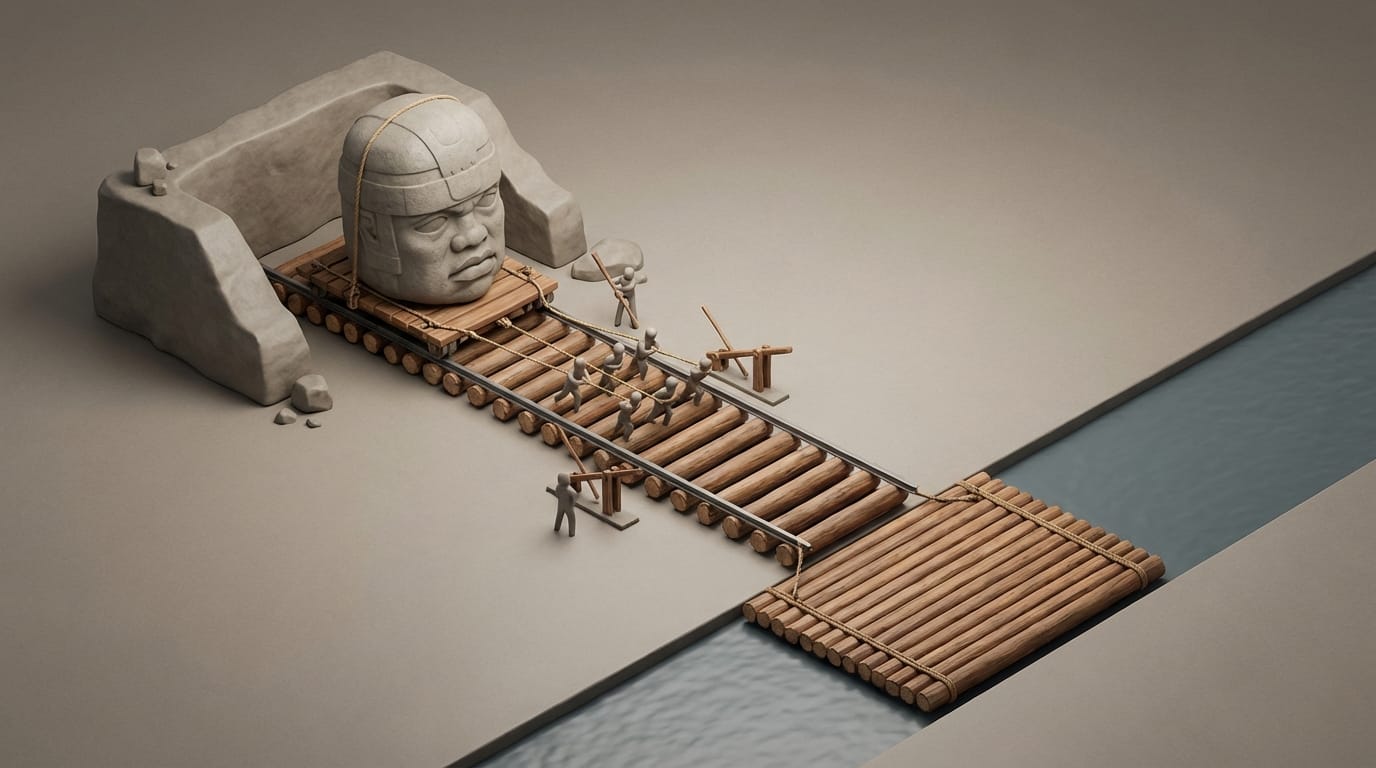
The Scale of Olmec Engineering Challenges
Moving a forty-ton basalt boulder through a dense tropical swamp requires more than force; it requires a deep understanding of geology and fluid mechanics. The logistical chain required for olmec colossal heads transport from mountains to river centers represents one of the most complex engineering feats of the ancient world. When we look at this system, we see a masterclass in risk management and local problem-solving. By studying how these stones moved across 100 kilometers of jungle, we see a culture that worked with its environment rather than fighting it.
The sheer mass of an Olmec head is hard to imagine until you consider the weight of the stone. Workers carved these monuments from single blocks of basalt; examples found at San Lorenzo weigh between 6 and 25 tons, while some unfinished stones reach 50 tons. Moving these objects was not a rare event but a constant requirement of Olmec rule for centuries.
Weight and Dimensions of the Colossal Heads
Each of the seventeen confirmed colossal heads has its own dimensions, but they generally stand between 1.5 and 3.4 meters tall. The largest head at San Lorenzo, known as Monument 53, weighs about 18 tons, while sculptures at other sites pushed the limits of human power even further. Because basalt is so dense, a small volume of stone carries immense weight, which caused the blocks to sink easily into the soft, silty soils of the Gulf Coast.
Distance from Quarry to Capital
The Olmecs sourced their basalt from the Sierra de los Tuxtlas, specifically the area around Cerro Cintepec. For the residents of San Lorenzo, this meant moving stones roughly 60 to 100 kilometers across a terrain filled with rivers, swamps, and dense trees. This distance was not a straight line; it was a path through changing elevations and floodplains that required the Olmecs to build specific paths just to move the weight.
Sourcing Basalt through Natural Geological Formations
While many think of ancient people cutting stone from solid rock walls, the Olmecs acted more like harvesters of geology. Evidence suggests they did not always cut fresh stone from a cliffside; instead, they used the results of ancient volcanic activity to simplify their work.
The Role of Volcanic Mudslides in Selecting Stone
Geological studies show that many of the boulders used for the heads were originally moved to the southern slopes of the Tuxtlas by lahars, which are massive volcanic mudslides. These slides acted as a natural sorting system by carrying large, high-quality basalt blocks down the mountain and leaving them in easy spots. By picking stones already free from the bedrock, the Olmecs skipped the most difficult stage of quarrying.
How Lahar Deposits Reduced Initial Carving Labor
The primary engineering win here was the selection process. Boulders moved by mudslides often wear down as they tumble, resulting in round or oval shapes. The Olmecs chose stones that already looked like the general shape of a human head or a rectangular throne. This reduced the weight they had to move, as they did not have to haul away the extra stone that they would have removed during the first phase of carving.
Mechanics of Land Transport Across Jungle Terrain
Once they identified a stone and roughly shaped it at the source, the olmec colossal heads transport entered its hardest phase. Without oxen or horses, and without the wheel, the Olmecs relied on a deep understanding of friction and physics.
Sledges and Rollers in Soft Soil Environments
The most likely method for moving stones over land involved heavy wooden sledges placed on top of log rollers. This system spread the weight of a 20-ton stone across a wide area, which kept it from digging into the mud. To make the work easier, workers likely greased the tracks with water or mud to create a sliding surface. This allowed a coordinated team of 300 to 500 people to pull the load together. Research on ancient stone movements suggests that a team of 325 men could pull a nine-ton monument about one kilometer per day.
Path Clearing and Causeways
Moving a stone of this size required more than just a trail; it required a prepared road. The Olmecs were skilled builders of earthen mounds and causeways, and they likely built stable paths made of packed soil and sand. These causeways were vital for crossing hilly areas and the swampy edges of the San Lorenzo plateau, ensuring the stone stayed level and the rollers did not sink into the mud.
Navigating the Waterways of the Gulf Coast
Water transport was the main road of the Olmec world. Whenever possible, they moved their megaliths toward major river systems, such as the Coatzacoalcos, to let buoyancy do the heavy lifting.
Rafting Heavy Loads on Seasonal Rivers
To keep a 20-ton basalt block afloat, the Olmecs used massive rafts made of balsa or cedar logs. According to the World History Encyclopedia, these rafts were the most likely solution for long distances. Calculations show that a raft 10 meters long and 6 meters wide could support the weight of a medium-sized head while staying high enough in the water to steer through river currents.
The Logistics of Balsa and Cedar Watercraft
Timing was the most important factor. The Olmecs had to plan their transport around seasonal floods. During the rainy season, the rivers rose and made shallow swamps easy to cross, allowing rafts to get closer to the city. This required a perfect knowledge of the local water cycle, as moving a stone during a dry spell would be impossible, while doing so during a peak flood might result in losing the monument to a fast current.
Social and Political Drivers of Mass Logistics
The technical side of the olmec colossal heads transport is only half the story; the other half is the social system that made it work. A project of this size is a show of absolute power.
Commanding Large Labor Forces
Bringing together hundreds of people for weeks at a time requires a strong support system. These workers needed food, housing, and management. This suggests that Olmec rulers had the power to move large parts of the population away from farming and toward state projects. This shift from simple survival to collective work is a sign of a complex civilization.
The Religious Significance of the Journey
The act of moving the stone was likely as important as the final carving. The journey served as a ritual to show the ruler’s power over the physical world. Some sculptures show human figures riding on top of bound stone blocks, which experts believe shows rulers leading the transport process. By moving a mountain stone through the jungle and river, the ruler proved they could command both nature and the people.
Legacy of Olmec Transport Techniques
The systems built by the Olmecs did not vanish; they became the base for all later Mesoamerican engineering. When we see the huge buildings of the Maya or the long roads of the Aztecs, we see the growth of the Olmec model.
Influence on Later Mesoamerican Civilizations
The use of rollers, sledges, and river transport became the standard for moving limestone for pyramids and obsidian for trade. The Olmecs fixed the problems of heavy transport in a world without wheels or large animals. This focus on human power and working with the environment defined the region for two thousand years.
The stone heads show what happens when a society matches its goals with its environment. By finding natural shapes in volcanic stone and using the rise and fall of rivers, the Olmecs turned an impossible task into a steady system. They remind us that engineering is not always about new tools; often, it is about seeing the potential in the terrain and organizing people to move it.
While we focus on how they moved these heads, the “why” is more interesting. In a world where power was measured by the ability to change the earth, the olmec colossal heads transport was the ultimate proof of a leader’s control. It was a message in stone that the ruler could bridge the gap between sacred mountains and the city center. If you want to see how other systems influence life today, you might explore the history of economic cycles or how the strategic invention of the weekend served as a response to industrial needs.